
9D Breathwork for Men - Why it works differently
Published by Kora Wellness | Port Kembla, NSW | Serving the Illawarra region including Wollongong, Shellharbour, Thirroul, and Warilla.
There's a reasonable chance someone else told you to look at this. A partner, a GP, a mate who'd already been. You typed it in, you found the page and you've given it roughly ninety seconds to make a case before you close the tab.
That's a fair amount of time. Here's what this post is for: explaining what 9D breathwork actually does in a body, why it works differently to the things most men have already tried or declined and what a session at Kora Wellness in Port Kembla looks like from the outside. Because the format matters and it matters more for men who'd rather not be looked at while they're working something out.
There is no forced sharing circle. There is no push to describe how you feel. There is an eye mask, a set of headphones, a mat and forty minutes where the audio does what talking has never quite managed to do - which is to get below the surface of the problem rather than circling it from above.
The physiology of why that works is worth understanding. It's also why some men leave a session feeling something they haven't felt in years and can't quite name it - and why that's not a problem, and not the point either.
If you're already at the point where you'd like to try rather than read further, our next sessions at Kora Wellness are listed here. The intro offer is $99 when you sign up for our first-time user discount and covers your first three sessions.
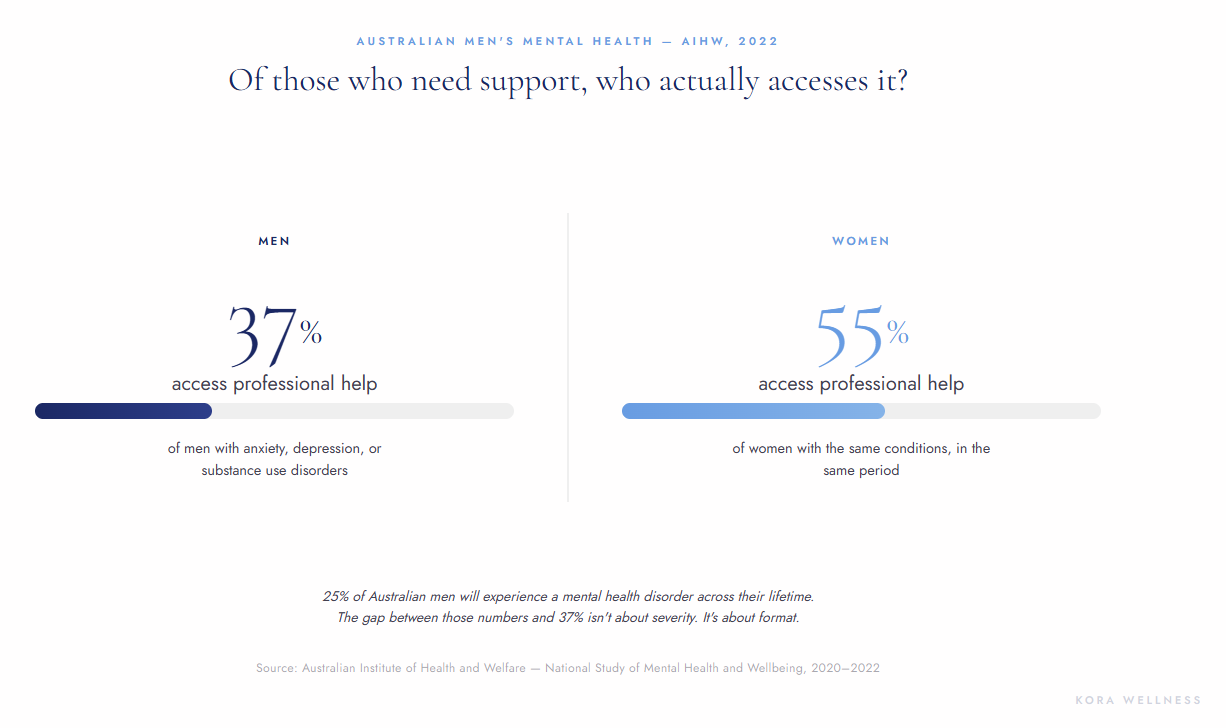
Most men who need support never access it - not because they don't feel anything, but because the available formats don't fit. That's a format problem and it has a physiological solution.
Most men in Australia never see a mental health professional and that isn't the same as being fine
The conventional explanation for this is that men don't seek help. That framing sits unexamined in most public health conversations.
The more accurate version, which is gaining traction among practitioners and researchers, is that men don't seek help in the formats currently on offer because those formats were largely designed around verbal emotional disclosure, which is a skill that isn’t evenly distributed and tends to come less naturally to men.
The Illawarra adds a specific layer to this.
The region carries an industrial and blue-collar working history - steelworks, construction, mining, port work - and the communities that grew up around that workforce have produced a particular relationship with stoicism and silence that isn't unique to this region but is pronounced here.
The Illawarra Shoalhaven Suicide Prevention Collaborative has documented a regional suicide rate above the NSW average, with men accounting for the large majority of those deaths. These are men who had something going on - who were, in the research language, dysregulated - but who did not convert that into a conversation with a professional.
The question worth asking isn't why they didn't seek help. It's what would have had to be different for a different outcome to have been available to them.
Breathwork is one answer to that question because it’s specific, physiologically-grounded and not the only one available in the Illawarra. This post names others. But understanding how breathwork actually works on the nervous system matters, because it explains why it suits men who've never responded to talking-based support.
The nervous system doesn't need you to have words for it
What Levant's research describes is a man who feels something but who cannot find words for it. When a therapist asks "how does that make you feel?", the honest answer is often "I don't know" and not as deflection, but as fact.
The gap between the sensation and the language is real and sitting in a room being asked to describe it can feel like being asked to solve a problem in a language you were never taught.
Stephen Porges' Polyvagal Theory provides the physiological frame for why breathwork bypasses this.
The theory identifies two distinct routes by which the nervous system can shift from sympathetic activation (threat response - high cortisol, elevated heart rate, shortened breath, muscle tension) to parasympathetic recovery.
The first route is from the top-down: cognitive, verbal, narrative - which is the basis of most talk-based therapies. The second route is from the bottom-up: sensory, somatic, breath-based - which is what breathwork works through.
Bottom-up regulation doesn't require the translation step where you describe what you’re experiencing. It doesn't ask the body to first produce language about its state before it's allowed to change its state.
It goes directly to the vagus nerve - the primary conductor of the parasympathetic nervous system - through breath pattern and rhythm, and it produces a measurable shift in autonomic state without the person needing to articulate anything at all.
For men who have found talk-based approaches insufficient, this is not a soft workaround. It is a different pathway for your body to the same outcome.
What breathwork actually does in a male body
Cortisol is the marker most men find worth understanding. It is the primary stress hormone, released by the adrenal glands in response to perceived threat. In short bursts, it's useful and it drives performance and focus.
In a man who has been running at sustained high output for months or years (a common profile in Illawarra trades workers, FIFO workers, fathers of young children, men in high-accountability roles) cortisol stays elevated well past the point where it's doing anything useful.
Chronically elevated cortisol degrades sleep quality, suppresses immune function and competes directly with testosterone production. The two hormones share a hormonal pathway and when cortisol remains high, testosterone tends to fall.
This matters because it reframes what many men experience as mood and energy problems - flatness, short fuse and a sense of running on empty - as endocrine consequences of a nervous system that hasn't had access to a genuine recovery state in a long time.
A 2023 study by Balban and colleagues, published in Cell Reports Medicine, tracked participants doing five minutes of structured breathwork daily for 28 days. Cortisol fell, mood improved and physiological arousal reduced - not only immediately after sessions but as a sustained baseline shift over the month.
Fincham and colleagues' 2023 meta-analysis in Scientific Reports, covering 12 randomised controlled trials, found breathwork produced a moderate reduction in anxiety (g≈-0.32) and depression (g≈-0.40) — effects comparable in scale to what medication and therapy produce, through a mechanism that requires nothing more than being present and breathing in a particular pattern.
Heart rate variability, which is the variation in timing between heartbeats, is the clearest indicator of vagal tone and parasympathetic capacity. High HRV indicates a nervous system with good recovery bandwidth; low HRV indicates one that's stuck in sympathetic dominance.
Breathwork at controlled rhythms reliably increases HRV, and a higher HRV baseline means sleep improves, stress lands differently and the gap between a difficult moment and recovery gets shorter. These are outcomes most men want. The pathway to them through breathwork doesn't require them to talk about why they need them.
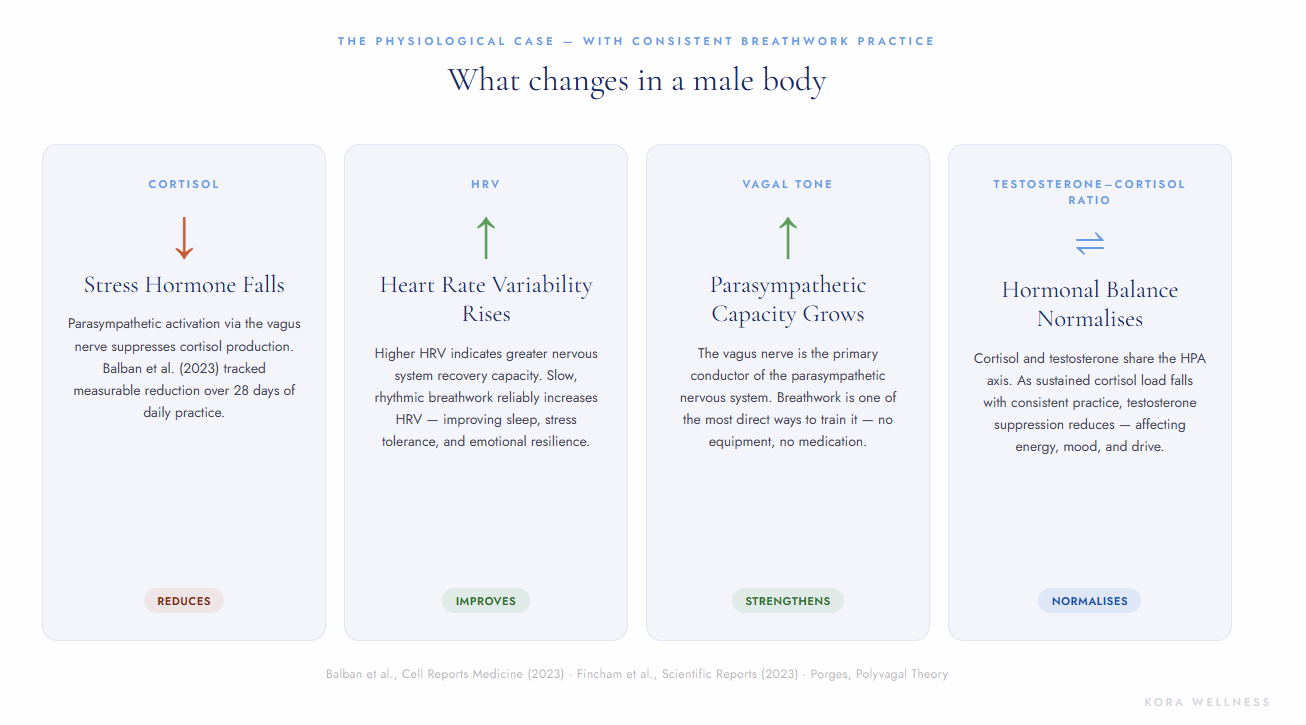
The case for breathwork doesn't rest on how it makes you feel in the room. It rests on what changes in the body over time and for men carrying a chronic stress load, those changes have measurable hormonal consequences
If the physiology is making sense and you're wondering what the actual session involves, that's the next section. If you're already across it, sessions at Kora Wellness in Port Kembla are available to book here — no prior experience needed, and the first session is the intro offer.
What a 9D session looks like for a man who has never done anything like this
The format is worth describing plainly because a significant number of men filter themselves out of breathwork before they understand what it actually involves.
The assumptions that it involves sitting cross-legged in a circle, sharing with strangers, being observed while you feel things are wrong in every particular.
A 9D session is a solo experience done in a group room. The eye mask means you are, for practical purposes, alone. What happens in your body happens without an audience.
There are two session types at Kora Wellness, and the difference between activating and downregulating sessions matters for men coming in with different nervous system states.
Activating sessions use continuous circular mouth breathing - a faster, more intense pattern that moves energy through the system and can produce strong physiological and emotional responses, sometimes including shaking, crying, or laughter. These sessions are not the right starting point for every man, particularly those who are already running hot.
Downregulating sessions use nasal breathing throughout and are designed to bring the nervous system toward recovery and is more appropriate for men who are exhausted, numbed out, or have been in a sustained high-cortisol state.
If you're not sure which applies, the answer for most men new to breathwork is to start with downregulating.
A nervous system that has been in sympathetic dominance for years needs to learn that the parasympathetic state is safe before it will let you move energy through it. Starting with activation on an unprepared system is the thing most likely to produce a session that feels like it "didn't work" or that is completely overwhelming for your mind and body.
On safety: the contraindications that apply to activating breathwork are specific and worth knowing. Cardiovascular disease, pregnancy, bipolar, detached retinas and epilepsy are flat contraindications - activating sessions are not appropriate regardless of clearance.
These restrictions apply to activating breathwork specifically; downregulating nasal breathing sessions have a substantially lower physiological load and a different risk profile.
The question men ask more often than the medical one is whether they will cry in front of people. The answer is that the eye mask is on for the whole session and the room dynamic is not a sharing environment during the session. The people around you are having their own experience and are not watching you.
Whether something moves in the session depends on where your nervous system is, not on you deciding to feel something.
Some men complete a first session and feel very little. Others feel more than they expected. Both are very real outcomes. The one that happens for you is not a measure of how the session went but simply an indication of what state your body is in.
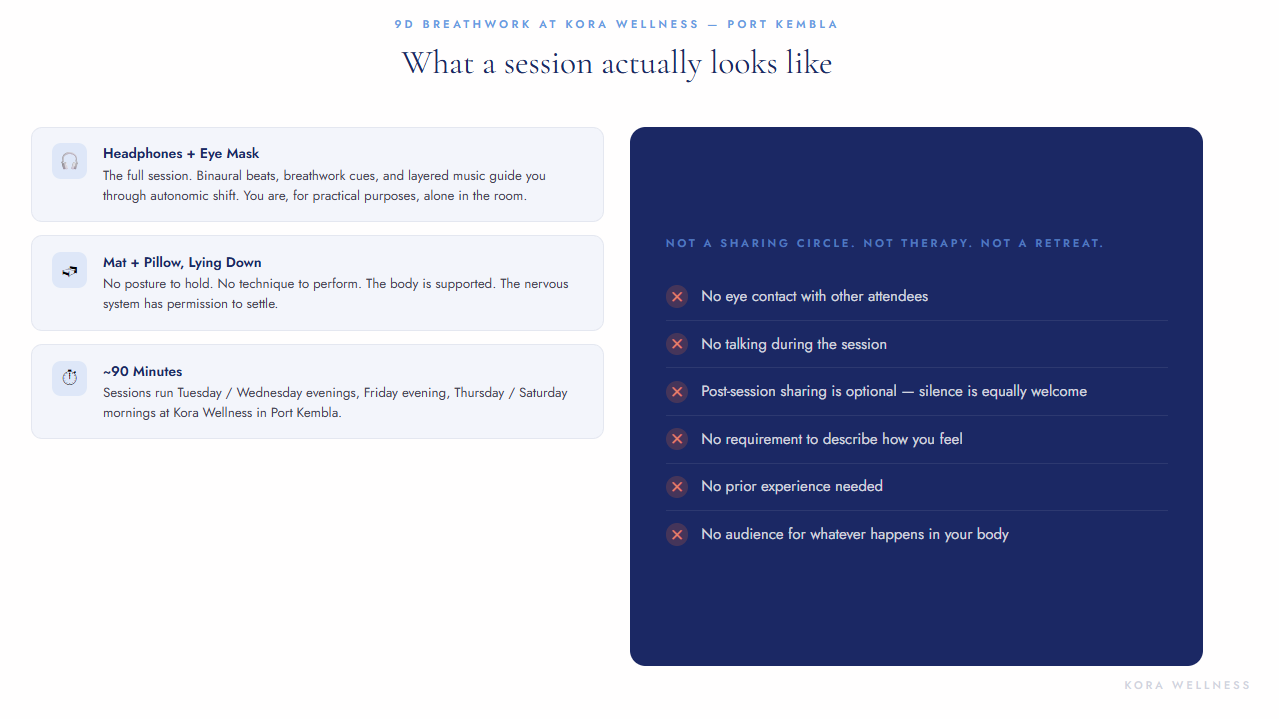
Headphones, eye mask, mat. No eye contact, no requirement to speak or share afterwards. The format is low-vulnerability by design, which is part of why it works for the men it reaches.
The men who are using breathwork in the Illawarra
There are men who come in because a partner booked them a session and they came out of obligation and kept coming back. There are men from the trades - construction, roads, the Port - who found the session post-shift did something that a beer didn't.
There are fathers who'd hit a point where they were present in the room but not quite in it, going through the motions of the week and who needed something that didn't require them to explain that to anyone. There are men who'd tried therapy, found something useful in it but felt there was still something physical they couldn't access through talking alone.
There are men whose GPs in Wollongong or Shellharbour had started recommending somatic work alongside medication and who landed here as a result. And there are men in the emergency services branches who experienced something in a group session that was so powerful, they just kept coming.
What they have in common is not that they had decided breathwork was right for them before they walked in. Most of them hadn't. What they have in common is that they were carrying something in the body. When the nervous system has been running hot for years, the weight of it is physical, not just an idea and the format of a 9D session was accessible to help them release it in a way that other options hadn't been able to.
Session frequency matters more than most men expect when they start. One session is not a treatment course. It is an introduction to what the nervous system is capable of in a regulated state.
The shift that one session produces lasts several days in most cases. A consistent practice of multiple sessions per week for men dealing with burnout or chronic dysregulation is what produces lasting baseline change.
That's worth knowing before the first session, so the measure of whether it worked isn't a single ninety minutes but whether you're willing to give it enough sessions to establish a pattern.
If you're not ready for a 9D session, here are other places Illawarra men are showing up
Not every man who reads this will be ready for a breathwork session and this post would be dishonest if it didn't say so. Entry points matter.
The right one depends on where you are, what you're carrying and what format your nervous system will actually accept right now. The Illawarra has more of these than most regions. Here are the ones worth knowing about:
Many men use more than one of these. A session at Kora Wellness and a Friday morning at City Beach are not competing options, they address different aspects of the same underlying problem. What matters is that there is an entry point available that fits and that you feel comfortable to use it.
Frequently asked questions
Is breathwork good for men?
Yes. Breathwork produces measurable changes in the body - reduced cortisol, increased heart rate variability, improved vagal tone - that are relevant to men regardless of whether they would describe themselves as having a mental health concern.
The 2023 Fincham meta-analysis in Scientific Reports found breathwork reduced anxiety and depressive symptoms across randomised controlled trials at effect sizes comparable to pharmaceutical and therapy-based interventions.
The format is also well-matched to men who find talking about their emotions difficult - breathwork operates through the body, not through language.
Can breathwork help men with anxiety?
Yes. What breathwork does to the physical symptoms of anxiety is well-documented: it activates the vagus nerve, reduces cortisol and increases parasympathetic activity which is the physiological opposite of the fight-or-flight response that drives anxiety symptoms.
For men who experience anxiety in their body (chest tightness, shallow breathing, jaw tension, difficulty sleeping) rather than primarily as a cognitive experience, breathwork's bottom-up approach tends to be particularly effective because it addresses the physical presentation directly.
Is 9D breathwork different for men than for women?
The physiological mechanism is the same - the vagus nerve, cortisol, HRV - but the starting conditions often differ. Men statistically carry higher rates of unaddressed nervous system load, more frequent help-avoidance and on average lower interoceptive awareness (the ability to read internal body states).
This means men may find their first sessions produce less obvious response than women who have done more prior somatic work, not because the process isn't working but because the nervous system has more baseline dysregulation to move through before it begins producing noticeable shifts. Frequency matters more as a result.
Does breathwork lower cortisol in men?
Yes. Structured breathwork, particularly slow, extended exhale patterns, activates the parasympathetic nervous system via the vagus nerve, which directly suppresses cortisol production.
Balban et al. (2023), published in Cell Reports Medicine, found measurable cortisol reduction in participants doing five minutes of structured breathwork daily over 28 days.
The effect compounds with consistent practice: a single session produces a cortisol drop that lasts several days; a regular practice shifts the resting baseline.
Does breathwork affect testosterone?
Indirectly, yes. Cortisol and testosterone share a hormonal pathway - the HPA axis - and chronically elevated cortisol suppresses testosterone production. Breathwork that consistently reduces cortisol over time can therefore support testosterone normalisation in men whose levels have been suppressed by sustained stress load.
The relationship is not direct enough to frame breathwork as a testosterone intervention, but for men who have experienced low energy, reduced libido, or mood changes associated with chronic stress, addressing the cortisol component is a meaningful part of the picture.
What does a 9D breathwork session feel like for men who've never done it?
Sessions run for approximately ninety minutes. You lie on a mat with a pillow, wearing an eye mask and headphones. The session is guided entirely by audio - no eye contact, no speaking, no sharing unless you decide you want to at the end of the session. The breathwork pattern is cued through the audio.
During the session, physical responses can include tingling in the hands or face, warmth in the chest, a heaviness in the limbs and sometimes strong emotional release including crying or laughter.
Some men feel very little in their first session, particularly if their nervous system has been in sustained sympathetic dominance for years. This is a physiologically normal response, not a sign the session didn't work.
If I don't feel anything in my first session, does that mean it didn't work?
No. A nervous system that has been running in high sympathetic activation for an extended period has, in effect, learned to treat its elevated state as normal. When it first encounters a genuine parasympathetic signal, the response is often subtle - a sense of heaviness, slight lightheadedness, or simply falling asleep. These are regulated responses.
The capacity to feel more develops with repeated sessions as the nervous system builds trust that the recovery state is safe. Men who describe their first session as "nothing happened" and continue to a second or third session frequently report a notable difference by session three or four.
Is breathwork safe for men with high blood pressure or heart conditions?
Downregulating sessions, which use nasal breathing throughout, have a substantially lower physiological load and are generally appropriate for men with managed high blood pressure - though medical advice specific to your situation applies.
Activating sessions, which use continuous circular mouth breathing, are contraindicated for cardiovascular disease and should not be undertaken without explicit medical clearance.
If you have any cardiac condition, discuss this with your GP before attending an activating session.
Is 9D breathwork too emotional for men who don't want to cry in a room?
The format makes this less of a concern than it sounds. You wear an eye mask for the full session, which means the room is not visible to you and you are not visible to others in any meaningful sense.
Whether or not something moves during a session depends on your nervous system's state and history - it's not something you decide to do.
Sessions where strong emotion arises are normal; so are sessions where nothing like that happens at all. Kora Wellness is not a space where emotional response is performed or celebrated by others, and there is no expectation for you to behave like there is.
How often should men do breathwork?
For men dealing with chronic stress, burnout, or sustained sympathetic activation, multiple sessions per week is the starting point for meaningful baseline change - not once a week, which produces relief but not structural shift.
A practical entry point is two to three downregulating sessions per week for the first four to six weeks, with activating sessions introduced as the nervous system develops capacity.
Once a week is a maintenance frequency, not a recovery frequency. Kora Wellness runs sessions Tuesday through Saturday in Port Kembla, which makes a multi-session-per-week practice logistically achievable for most Illawarra locations.
Where can men do 9D breathwork in Wollongong?
Kora Wellness is the Illawarra's original dedicated 9D breathwork studio, located at 43 Wentworth Street, Port Kembla NSW 2505 - approximately fifteen minutes from Wollongong CBD.
Sessions run Tuesday and Wednesday evenings, Friday evening, Thursday and Saturday mornings. Bookings are available here. The intro offer for first-time clients is $99 for 3 sessions when you sign up to our 10% discount on the website.
Where else can men get mental health support in the Illawarra?
The Illawarra has a range of men's wellbeing resources including Talk2MeBro (weekly 6am Friday catch-up at City Beach — ice bath, coffee, and conversation with no formal structure), MATES in Construction (24/7 helpline and peer support for trades workers), Men's Sheds across Port Kembla, Thirroul, Shellharbour, and Albion Park, The Man Walk (weekly walking groups), One Door Illawarra Clubhouse in Wollongong (34 Auburn Street), and Stride Wollongong Mental Health Hub (free walk-in support, no referral required). Contact details and links for all of these are in the body of this post.
If any of this has been useful, the next step is straightforward: Book a session. The intro offer is $99 for your first 3 sessions when you sign up for our 10% discount. There is no requirement to know exactly what you need before you arrive. Sessions run Tuesday and Wednesday evenings, Friday evening and Thursday and Saturday mornings.
About the Author
Kora Wellness is the Illawarra's dedicated 9D breathwork studio, founded by Hayley Simpson and located at 43 Wentworth Street, Port Kembla NSW. Hayley is a certified 9D Breathwork facilitator and Master NLP Practitioner with a trauma-informed approach. Kora Wellness offers weekly group sessions, private 1:1 journeys, and online breathwork for clients across Wollongong, Shellharbour, Thirroul, Warilla and the broader Illawarra.
