
9D Breathwork for Grief: What the body holds when the mind can't let go
Published by Kora Wellness | Port Kembla, NSW | Serving the Illawarra region including Wollongong, Shellharbour, Thirroul, and Warilla.
There's a moment most people who have grieved will recognise. You reach for your phone to tell someone something - something ordinary, something small - and you pause while the memory that they are no longer physically with you catches up to your thoughts. And in the pause that follows, something physical happens: your chest caves in, your breath stalls, and a weight you’d forgotten you were carrying settles back on before the mind has even finished catching up.
Grief changes how the body breathes. The nervous system, facing something it cannot fix or run from, moves into a protective state that has a measurable reaction in the body; shallow chest breathing, tight ribcage and disrupted sleep that doesn't restore no matter how exhausted you are. Most people carrying grief have noticed some version of this without having a word for it.
Most of what we understand about grief focuses on the mind: the feelings, the story, the meaning that needs to be made. But there is a layer underneath everything that words alone can't always reach. Its the part of your body that is still braced, still waiting, still holding the shape of something that is no longer there. 9D breathwork addresses that layer that sits underneath all the thoughts and unprocessed feelings.
If you're ready to experience this rather than read about it, you can see all our journeys on our bookings page.
Grief lives in the body, not just the mind
Grief is not only a draining emotional experience, it’s also a physical one. Bereavement activates the nervous system's stress pathways, altering breathing patterns, cortisol levels and vagal tone in ways that can continue long after the losing your loved one. The body holds grief as a physical state, not just an emotional one.
The physical experience of grief is easy to recognise once you're looking for it. The chest that feels heavier than usual. Breathing that sits high and shallow, rarely reaching the belly. The throat that closes when you try to speak about the person or the loved one that's gone. Sleep that stays broken even when exhaustion is total. The jaw that doesn't quite release. Shoulders that have been carried slightly higher for months. These are not the symptoms of weakness or of not coping, they are the body doing its job in the face of something it doesn't know how to put down.
Bessel van der Kolk's research into trauma and the body established that unresolved emotional experiences don't live only in memory. It is stored in your body - in muscle tension, breathing patterns and the ongoing state of the autonomic nervous system. Grief that has been compressed, suppressed, or never fully expressed operates in the same way. The body carries what it isn't able to move through.
This changes where you look for support.
If grief is only a story you're carrying, the work is finding peace with the story. But if grief is also a physical state the nervous system is holding, then the nervous system itself needs something, not just the mind that's trying to make meaning from the loss.
What's happening in your nervous system when you grieve
In grief, the nervous system moves between two protective states: hyperarousal, where the body floods with stress hormones and anxiety is high and sleep is broken; and hypoarousal, where the system shuts down into flatness, numbness, or disconnection. Most people who are grieving move between both, sometimes within the same day. This oscillation is not a disorder, it’s the body running a threat response to something that can't be resolved by fighting or running.
Hyperarousal in grief looks like lying awake at 3am with thoughts that won't settle. A hair-trigger stress response to ordinary frustrations and the sense of being wound tight without a clear reason. Hypoarousal looks like going through the motions of a day without quite landing in it. Essentially, functional numbness, the inability to feel the full weight of the loss even when you understand it intellectually, the flat quality that settles in when feeling becomes too costly to sustain.
Stephen Porges' Polyvagal Theory gives a useful framework for understanding why this happens. The nervous system has distinct states - social engagement, fight-or-flight and shutdown - and in the face of significant loss, it may cycle through all of them. The problem is not that the nervous system is responding this way. The problem is that without some way to physically express the emotional state, the cycle can persist long after the loss itself.
Downregulating 9D breathwork - slow, nasal breathing with an extended exhale - directly activates the parasympathetic branch of the nervous system, countering both hyperarousal and the conditions that happen before a shutdown. It doesn't eliminate your grief. It restores the nervous system's capacity to bear it without collapsing or bracing against it.
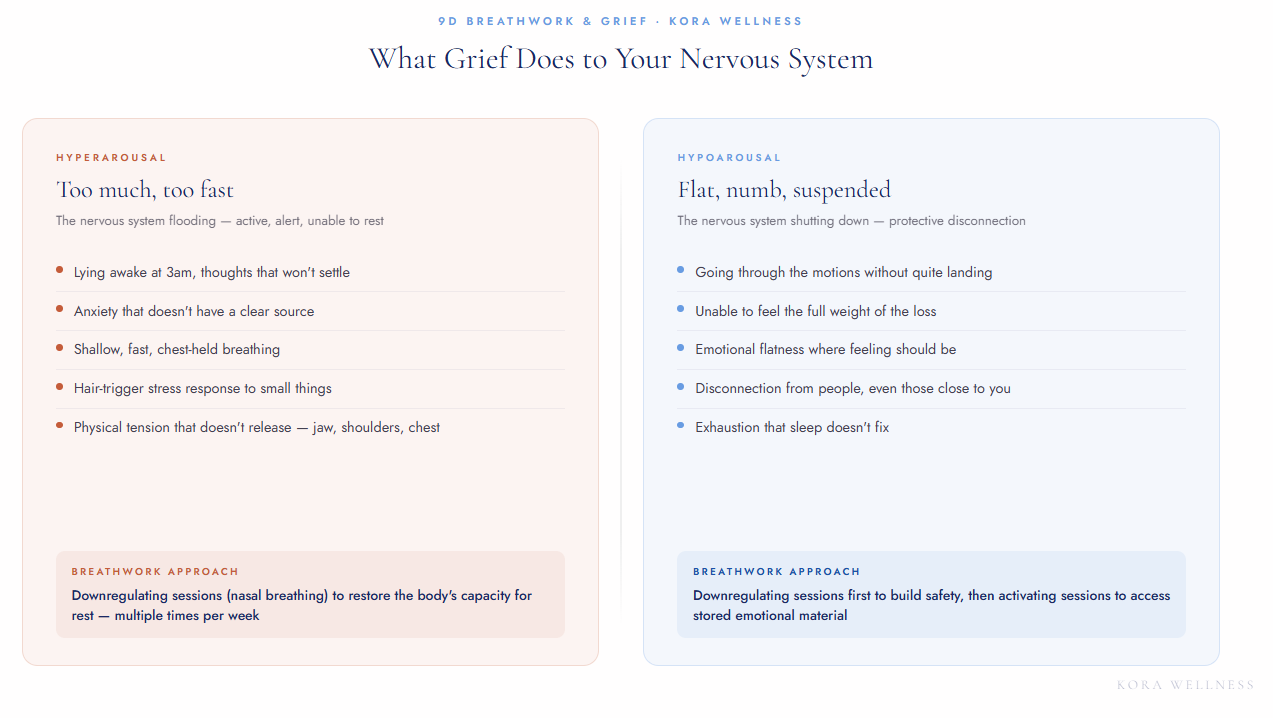
Most people in grief move between both states. Understanding which you're in changes which type of breathwork session to start with.
How 9D breathwork meets grief differently to grief therapy
9D breathwork works at the bodies layer of grief - the physical patterns held in the body and nervous system - rather than the heads layer that traditional therapy addresses. The two work on different aspects of the same experience and are not in competition. Many people find that breathwork reaches something that has stayed locked even after years of therapeutic work.
Traditional talking therapy is genuinely valuable and it would be a huge disservice to an entire industry to imply otherwise. The capacity to place language around a loss - to name what existed, to speak about what is now no longer with us - is part of how human beings integrate experience. Grief counsellors do real work.
But there is something that talking can't always reach. The session where you can explain everything clearly and still leave with the weight in your chest exactly where it was. The grief that you've processed intellectually and still feel at 4am. The tears that won't come regardless of how clearly you understand what you've lost. These are not signs that therapy hasn't worked. They are signs that the body is still holding what the mind has already, to some degree, made peace with.
9D breathwork uses circular nose breathing, immersive 9D audio and a contained group environment to shift the nervous system's state directly - bypassing the narrative mind and working with the body's own regulation pathways. For those who have felt emotionally numb, unable to access the full weight of a loss, the sessions can provide conditions for the body to gradually release what it's been holding. Nothing is forced. Hayley's trauma-informed approach means the sessions are paced carefully and participants set the threshold of what they're ready for.
This is why breathwork pairs well with, rather than replaces, existing therapeutic support. If you're already seeing a grief counsellor or psychologist, breathwork sits alongside that, working the layer underneath. To understand how breathwork works with stored emotional material, the post on trauma and breathwork covers the physiological mechanism in more depth.
Sessions at Kora Wellness in Port Kembla run throughout the week. If you're unsure which session type is right for where you are in grief, that's exactly the conversation we have before your first session. Find a time that works here.
Which type of breathwork is right for grief - and when
For grief, the appropriate breathwork approach depends on where you are in the process. In early stages of grief, downregulating sessions - using slow nasal breathing throughout - are the starting point, because they build nervous system capacity without generating additional stress on your nervous system. Activating sessions, which use continuous circular mouth breathing and produce a fuller physiological charge, are more appropriate once some regulation has been established.
The distinction matters here in a specific way and it's one that the differences between activating and downregulating sessions explains in full. In brief: downregulating breathwork signals safety to the nervous system. Breathing slowly through the nose, extending the exhale, fires the vagus nerve and begins to lower cortisol - the opposite of what the stress response is doing. For someone in early stages of grief, whose nervous system is already activated or switching between activation and shutdown, this is where to start. The goal is not to access more emotion. The goal is to build enough stability that daily life becomes more navigable with better sleep, concentration and the ability to be present with the people around you.
Activating breathwork has a different application in grief. Continuous circular mouth breathing produces more pronounced body sensations and a greater likelihood of an emotional response. This isn't the right starting point for someone whose nervous system is already destabilised. But for someone who is months or years out from a loss and still carrying something unexpressed - the grief that was compressed, the loss they had to keep functioning through, the things that were never fully felt - activating sessions can provide access to material that has been held a long time and is ready to be released.
A 2025 review published in Medical Sciences examining breathwork across techniques found that while most approaches share core neurophysiological mechanisms, technique selection matters when the nervous system is in an already-activated state. That finding is consistent with what Kora's approach has always been: read the nervous system first, then choose the session type accordingly.
If you're unsure which applies to you, the process is simple: if your grief still feels raw, recent, or destabilising (if sleep is broken and your anxiety is high) start with downregulating. If you feel more disconnected from your loss than overwhelmed by it, if you've never been able to cry about it or feel it fully, activating breathwork may be appropriate.
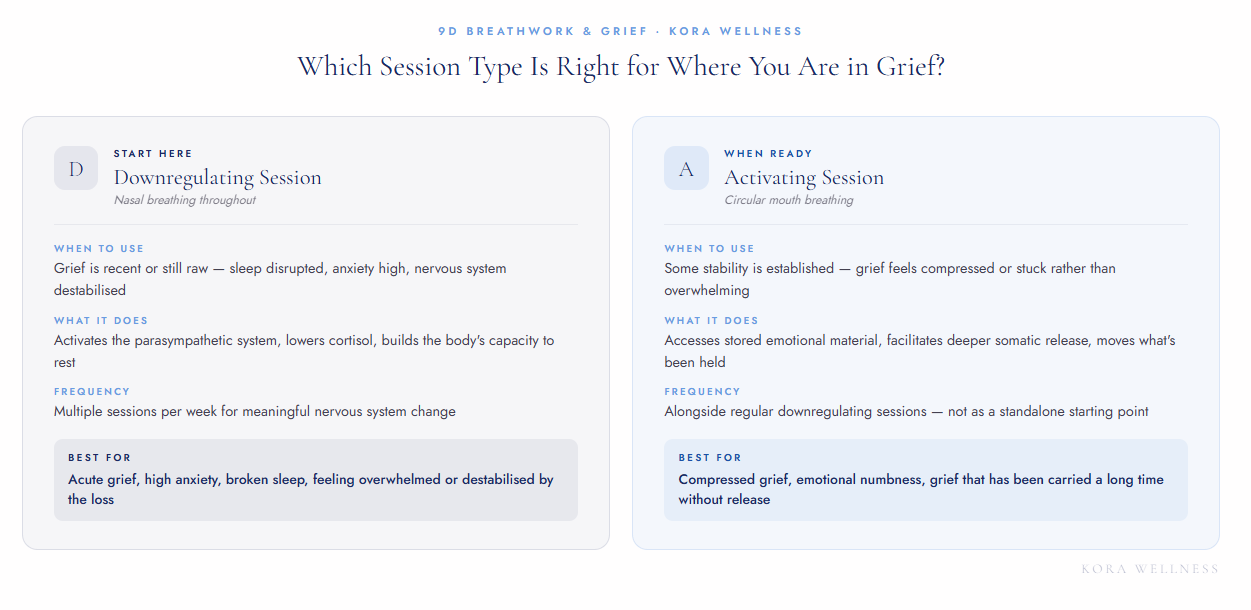
Downregulating sessions are always the starting point for grief. Activating sessions come later — once the nervous system has enough stability to bear a deeper release.
What to expect - and what release actually looks like
Physical and emotional release during an activating breathwork session is a natural nervous system response, not a sign that something has gone wrong. Common experiences include tears, sighing, tingling in the hands or face, tremoring, sweating or overheating, or a sensation of something shifting in the chest. Post-session integration which may include fatigue, emotional sensitivity, or more vivid dreams in the days following is part of how the nervous system consolidates what happened during the session.
Before coming to a session with grief in the background, it helps to know what release might look and feel like.
Tears are common. Not because the session forces emotion, but because the conditions - intentional breath, music held carefully, a contained space - can allow the body to stop holding what it has been refusing to let go. Most people don't make the connection between that held quality in the chest and what releases when the conditions are finally safe enough. Sighing and yawning are also a nervous system release; the body exhaling something it's been carrying. Tingling in the hands or around the mouth is a normal physiological response to altered breathing patterns. Some people sweat and others feel cold, or a physical lightening in the chest. Others feel a kind of heaviness, the soft exhaustion of something having moved.
None of this should be alarming. The session is facilitated by Hayley and held in a group in Port Kembla. The pace is set by the participant and nothing is pushed.
Some people leave feeling noticeably different; lighter, clearer, more present in their own body. Others notice the shift more in the hours and days following: sleep that comes more easily, a slightly wider emotional range, less compression. Some feel more emotionally close to the surface in the day or two after a session, which is the integration process continuing. Dreams may be more vivid. This is worth knowing in advance, because it can catch people off guard when they don't expect it. The work doesn't stop when the session ends, the nervous system keeps processing in the days that follow and aftercare is an essential part of this process. Looking after yourself is a crucial part of learning how to physically process what your body carries in a way that nurtures rather than supresses what our bodies need.
This is also true when grief and anxiety overlap as well. The post-session integration period can temporarily heighten emotional sensitivity before it settles. Knowing this in advance makes it easier to hold.
People come to Kora Wellness from across the Illawarra - from Wollongong and Shellharbour, from Thirroul and Warilla and the smaller suburbs in between. What they describe after their first grief-related session is often not "lighter" exactly, but something more like less compressed. The body has put something down (not all of it, and not permanently) but enough to breathe a little more freely for a while.
Frequently asked questions
Why is it so hard to breathe when I'm grieving?
Grief activates the body's stress response, shifting the nervous system into protective states that alter breathing patterns. In hyperarousal, breathing becomes shallow and rapid; in hypoarousal, the breath may feel constricted or held. Both are the body's response to a perceived threat - in this case, the threat of loss rather than physical danger. The restricted or heavy quality of breathing in grief is a physiological holding response, not a medical problem, though it can compound fatigue and sleep disruption if it continues.
Will I fall apart if I do breathwork while I'm grieving?
Sessions at Kora Wellness are facilitated with a trauma-informed approach, which means the pace and intensity are held carefully. Downregulating sessions - the appropriate starting point for early stages of grief - use slow nasal breathing that supports nervous system stability rather than flooding. The session is designed to provide enough containment that release, if it occurs, is the body letting something go rather than being overwhelmed. Participants are not pushed toward emotional territory they're not ready for and nothing is forced.
Is it normal to cry during breathwork?
Yes. Tears during breathwork are a common and healthy nervous system response of the body releasing activation it has been holding and not not able to express itself the way it needs to. The conditions of a session (intentional breath, immersive audio, a supported group space) can allow the body to stop bracing in a way that everyday life often doesn't allow for. Some participants cry during their first session; others don't cry until their third or fourth. Some don't cry at all and experience release differently - through sighing, tingling, or a physical sensation of something shifting in the chest. All of this is within the normal range.
I've been grieving for months and nothing helps - would breathwork do anything?
Extended grief often involves the nervous system becoming locked in a low-level pattern of suppression or activation that persists even when the acute phase has passed. Breathwork addresses this physiological dimension directly. A 2025 review in Medical Sciences found that breathwork produces measurable effects on stress pathways regardless of the specific technique. Many people who describe feeling stuck in grief (not progressing, not worsening, just suspended) find that somatic work reaches something that other approaches haven't.
I've never cried about my loss. Can breathwork help me feel it?
For some people, grief becomes compressed, particularly when there was no space to grieve at the time, or when life had to keep going through the loss. Activating 9D breathwork, which uses continuous circular mouth breathing, can give you access to emotional material that has been held for a long time. This is typically explored after downregulating sessions have established some nervous system stability. Beginning with activating breathwork is not recommended if the nervous system is already in a state of dysregulation or acute distress.
Is breathwork better than therapy for grief?
Breathwork and therapy address different layers of grief and are not in competition. Traditional therapy works primarily with the narrative of a loss - the meaning, the relationship, the story of what happened. Breathwork works with the somatic layer - the physical patterns the body and nervous system are holding. Most people find the two complement each other. Kora Wellness sessions are frequently attended alongside ongoing therapeutic support. Neither replaces the other; they work on different aspects of the same experience.
What actually happens in a 9D breathwork session if I'm grieving?
A standard session runs 90 minutes and combines a guided breathwork journey with immersive 9D audio; binaural beats, carefully selected music, and guided elements that support nervous system state change. You lie down, use either nasal or circular mouth breathing depending on the session type and follow the facilitated journey. Physical release - tears, sighing, tingling, a sense of something shifting - is common but not universal. Sessions are held in a group at Kora Wellness, 43 Wentworth Street, Port Kembla and are led by Hayley Simpson.
How many breathwork sessions does it take to process grief?
There is no set number and framing grief as something that can be "processed" in a fixed sequence of sessions can be misleading. Grief is not linear and breathwork doesn't shortcut it. What consistent breathwork provides is nervous system support that, over time, expands the body's ability to carry grief without being destabilised by it. Most people notice a shift in their physical state - sleep, tension, breathing quality - after two to four sessions. The deeper integration typically develops across several weeks or months of regular attendance.
What's the difference between activating and downregulating breathwork for grief?
Downregulating 9D breathwork uses slow nasal breathing throughout the session, activating the parasympathetic nervous system and building capacity for stability. This is the appropriate starting point for early stage grief, high stress or a dysregulated nervous system. Activating 9D breathwork uses continuous circular mouth breathing and produces more pronounced physiological activation and is more appropriate for those seeking to access compressed or long-held emotional material once some regulation is established. For grief specifically, downregulating sessions are always the recommended starting point.
Sessions at Kora Wellness run Tuesday, Wednesday and Friday evenings, and Thursday and Saturday mornings, at 43 Wentworth Street, Port Kembla. If grief has brought you here, you don't need to arrive with anything figured out. Book a session at Kora Wellness here.
About the Author
Kora Wellness is the Illawarra's dedicated 9D breathwork studio, founded by Hayley Simpson and located at 43 Wentworth Street, Port Kembla NSW. Hayley is a certified 9D Breathwork facilitator and Master NLP Practitioner with a trauma-informed approach. Kora Wellness offers weekly group sessions, private 1:1 journeys, and online breathwork for clients across Wollongong, Shellharbour, Thirroul, Warilla and the broader Illawarra.
Continue reading
You might also find helpful: If anxiety is part of what grief has brought - the racing thoughts, physical tension and sleep that won't settle - our post on 9D breathwork for anxiety explains what's happening in the body and how breathwork addresses it. And if you're new to 9D breathwork and want to understand the difference between session types before you come, this post on activating and downregulating breathwork covers everything you need to know.
