
How often should you do 9D Breathwork? (The answer depends on your Nervous System)
Published by Kora Wellness | Port Kembla, NSW | Serving the Illawarra region including Wollongong, Shellharbour, Thirroul, and Warilla.
Someone asked me this after her first session last month. She'd come in carrying the kind of tension that builds over years - the tight-chest, shallow-breath, perpetually-almost-fine kind. Ninety minutes later she stood in the doorway, jacket half-on, looking like someone who had put something down. She said, quietly: "How often should I do this?"
The honest answer isn't a number.
Most things you'll find online will tell you to start with once a week. That's not wrong but for a lot of people, it's also why breathwork feels like it's working in the session and then fading by Wednesday. The acute relief is real but the lasting shift takes more repetition than that.
The real question isn't how often, it's what is your nervous system is trying to do right now? Once you understand that, the frequency question largely answers itself and the answer is almost always more than once a week.
If you're ready to find out what your nervous system actually needs, our next sessions are listed on our bookings page and there’s no pressure to have it figured out before you arrive.
Why "once a week" is the floor, not the ceiling
Here's what I've noticed over hundreds of sessions. The women who come once a week feel better after each one. But the ones whose baseline actually shifts - whose sleep changes, whose shoulders stay down between sessions, who stop running on stress hormones as their operating mode - they almost always started coming more than once a week.
Single sessions create a moment of regulation. Repetition is what teaches the nervous system that regulation is its new normal.
A 2023 randomised trial by Dr. Melis Yilmaz Balban and colleagues at Stanford University, published in Cell Reports Medicine, followed 108 adults practising five minutes of structured breathwork daily for 28 days. The benefits didn't plateau after week one or two, they kept accumulating. The longer people practised, the more their mood improved - a compounding effect that doesn't show up at once-a-week frequency.
Stephen Porges's Polyvagal Theory describes the nervous system as constantly reading its environment for cues of safety. Consistent breathwork is one of the most direct inputs you can give that ongoing process. One session says: this is possible. Twelve sessions says: this is who I am now.
The nervous system learns through repetition, the same way any system does.
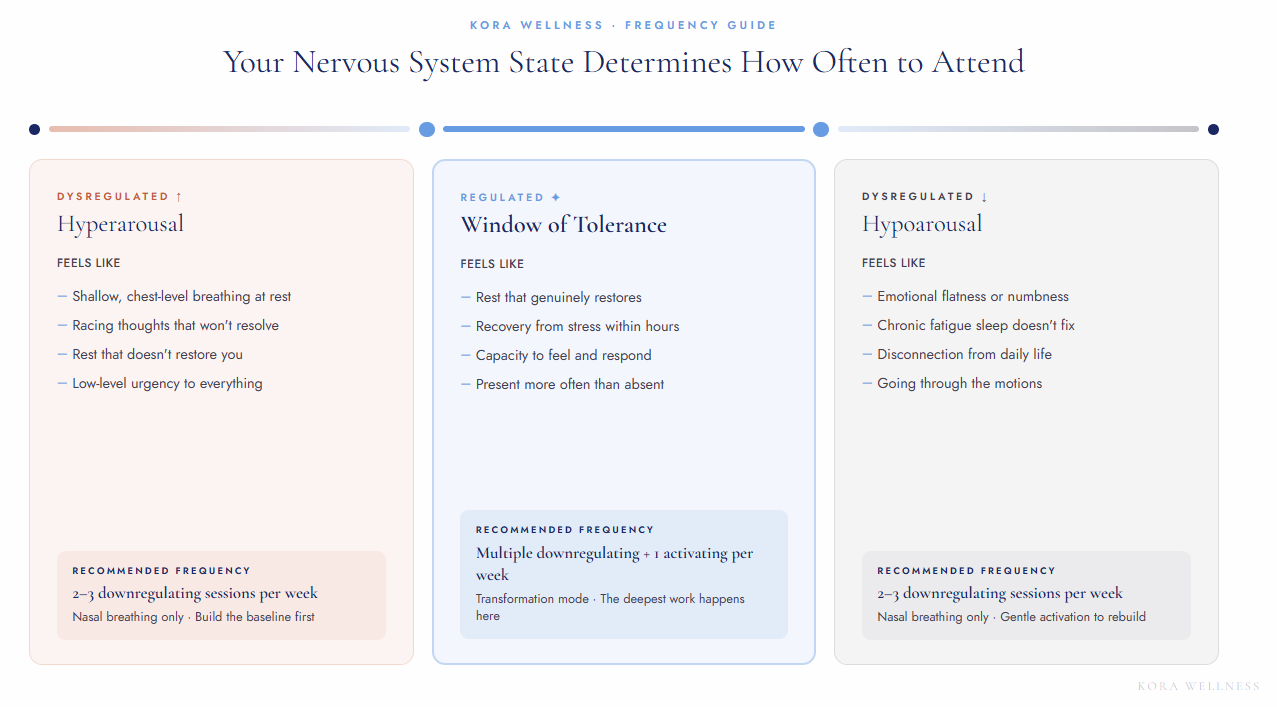
Your nervous system's current state — not your schedule — determines how often you should attend. This is the spectrum Kora Wellness works with.
How often you do breathwork is different for activating and downregulating sessions
The type of session changes the frequency rules entirely. Activating sessions use continuous circular mouth breathing to stimulate the sympathetic nervous system - they're energising, emotionally cathartic, physiologically demanding. Downregulating sessions use nasal breathing throughout to engage the parasympathetic system - restorative, gentler and much easier to sustain doing more sessions.
This is where most generic advice misses. "Start with once a week" doesn't account for which kind of session you're doing or where your nervous system is starting from.
If you're already stretched - burned out, anxious, running on empty - loading more activating sessions onto a depleted system won't accelerate anything. It tends to do the opposite. The route through a dysregulated state is downregulating first: nasal-breathing sessions, parasympathetic activation, enough repetition for the body to actually hold regulation between visits. You need to build the floor before you raise the ceiling.
Once that floor is there, activating work lands completely differently. The same intensity that felt overwhelming before becomes workable and then genuinely cathartic.
For someone whose nervous system is depleted - and when burnout has depleted your nervous system, this distinction matters more than almost anything - two to three downregulating sessions a week is where to begin.
For a regulated nervous system doing active transformation work: multiple downregulating sessions through the week, one activating. This is the rhythm that produces lasting change rather than session-by-session relief.
Maintaining a healthy baseline? Come at least weekly and know that more is always available when you want it.
Not sure where your nervous system is sitting right now? We talk through this before every session at Kora Wellness. See our weekly timetable here.
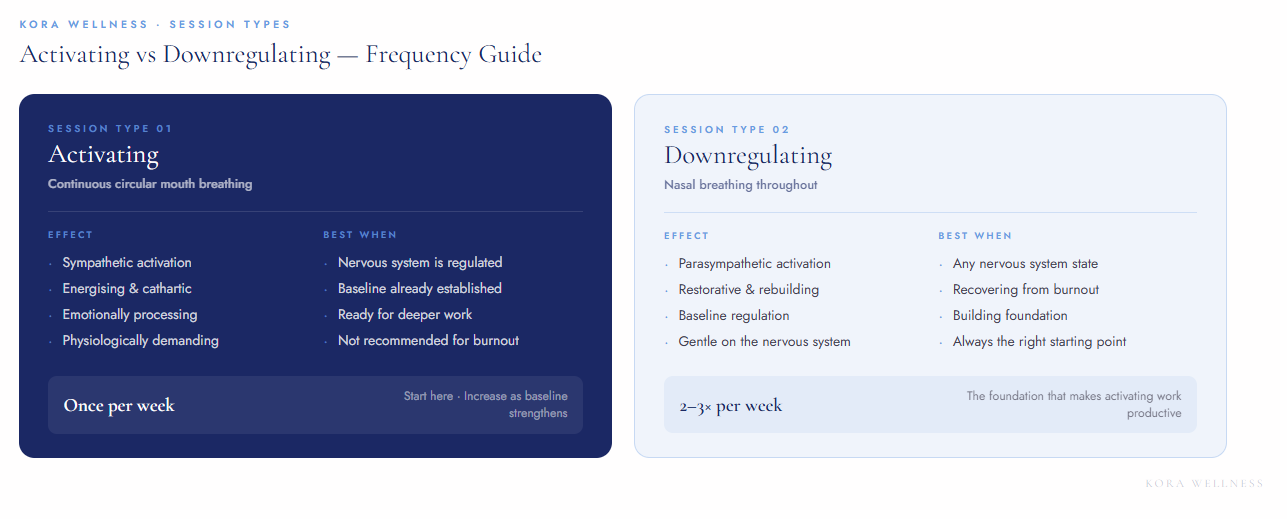
Both session types are therapeutic. The frequency that's right for you depends on which direction your nervous system needs to move first.
How to read what your nervous system actually needs
Dan Siegel's Window of Tolerance describes the zone in which your nervous system can process experience without shutting down or flooding. Inside it, you can feel things, think clearly, respond rather than react. Above it (hyperarousal) there's a low hum of urgency to everything, rest that doesn't restore, an inability to settle even when nothing is actually wrong. Below it (hypoarousal) you're flat, far away from yourself, doing life from behind glass.
Most people who come through the studio for the first time are in one of those two states. Hyperarousal looks like shallow breathing, tight chest, racing thoughts that circle without resolving. Hypoarousal is quieter, a low-grade absence, a tiredness that sleep stopped fixing some time ago.
Both tell you the same thing about frequency: more than once a week.
A 2023 meta-analysis by Fincham and colleagues at the University of Sussex, published in Scientific Reports, reviewed 12 randomised controlled trials across 785 adults and found significant reductions in anxiety (effect size g≈−0.32) and depression (g≈−0.40) in people practising breathwork versus control conditions. The mechanism is straightforward: more repetitions of parasympathetic activation gives the nervous system more opportunities to practise returning to baseline. That practice is what changes the baseline itself.
When you're genuinely regulated - when rest restores you and you recover from stress in hours rather than days - the question shifts from repair to growth. Both session types are fully available to you and the number of sessions you do becomes about what you want to build rather than what needs fixing. The clients across Wollongong and the Illawarra who describe the biggest shifts are almost always working from a regulated baseline with multiple sessions a week. Not because they're more committed. Because they gave their nervous system enough repetition to actually learn something new.
How to know which state you're in? How anxiety affects your nervous system's readiness for breathwork goes into this in more detail - it's worth reading alongside this one if anxiety is part of the picture.
What changes at each stage of consistent practice
The first session produces real physiological change - cortisol falling, vagal tone activating, the body receiving a cue it may not have had access to in a long time. That's a meaningful starting point but it isn't yet a pattern.
Four weeks of consistent attendance, two or three sessions a week and the changes go deeper. Your heart rate variability begins to improve with HRV being one of the clearest markers of how well the autonomic nervous system handles incoming stress. Slow nasal breathing consistently produces measurable gains with regular practice, and those gains begin to hold between sessions rather than dissipating before the next one.
By eight weeks, something structurally different is happening. Consistent nervous system input doesn't just change how a session feels, it begins to change how the brain processes the next stressor before it even arrives. The Balban study found benefits continuing to compound across the full 28-day protocol with no sign of plateau, which is what distinguishes a practice from an intervention.
What the women I work with describe after months of consistent attendance is a change in the texture of daily life rather than a single turning point: sleep that doesn't break as easily, a shorter gap between a stressor landing and the body settling, a sense that what used to knock them off for three days now resolves by evening. The window of tolerance has widened and that's what coming regularly to breathwork sessions builds and it doesn't happen at once a week.
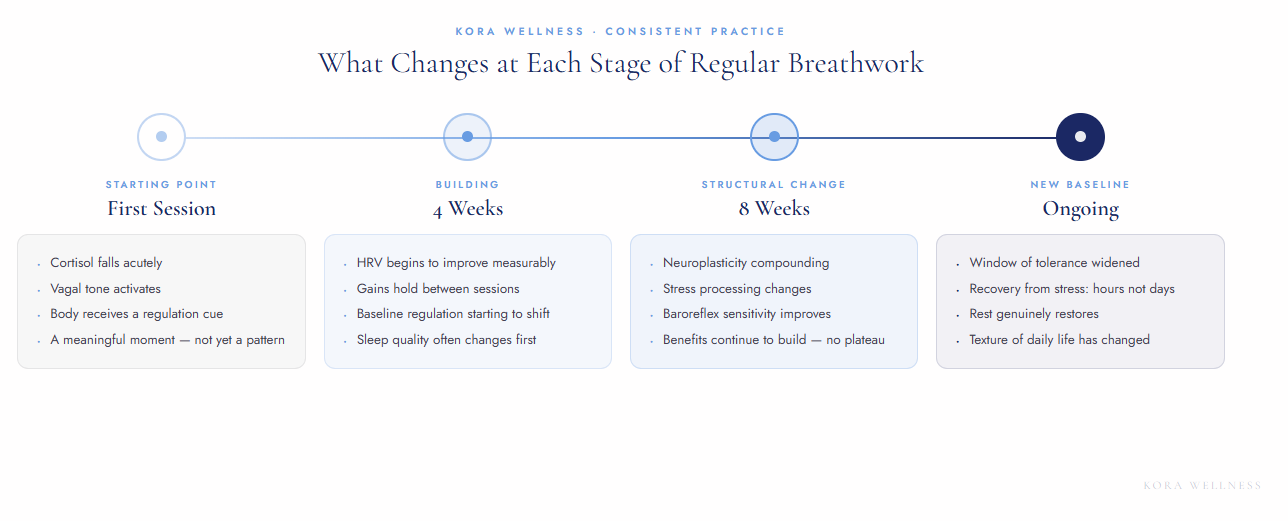
Change doesn't happen in a single session. Here's what shifts at each stage — and why frequency is what drives the timeline.
How to build a breathwork schedule that creates real change
Kora Wellness runs sessions five days a week - Tuesday, Wednesday and Friday evenings at 6:30pm, Thursday and Saturday mornings at 10am.
If you're recovering from burnout, chronic stress, or persistent anxiety: two to three sessions a week, prioritising downregulating work. One full day between sessions is worth protecting - that's your integration time, when your nervous system consolidates what was released. Don't try to rush the timeline by stacking sessions, your body needs the time acclimate and rushing it will either stall you, or set you back.
If you're attending for ongoing wellbeing: one to two sessions a week are what we’d recommend as a minimum. Weekly attendance produces benefit, twice-weekly attendance produces a different nervous system - usually within four weeks, sometimes faster.
For active transformation work: multiple downregulating sessions through the week, one activating. This is the schedule that produces the deeper, more durable shift. Not a single session breakthrough, but a quieter change in how everyday life feels from the inside. Clients in Shellharbour, Thirroul and across the broader Illawarra who describe the biggest shifts are almost always in this rhythm. They didn't commit harder. They just came more often.
A single session is enough to know that something is available here. How often you join a session is what makes it stay.
Group 9D breathwork sessions run five days a week at Kora Wellness, 43 Wentworth Street, Port Kembla. If you're ready to move beyond once a week, book your next session here.
Frequently asked questions: How often should you do 9D breathwork?
How often should you do breathwork?
The optimal frequency for breathwork depends on your current nervous system state and the type of session. For general wellbeing, one to two sessions per week is a reasonable starting point. For people managing burnout, chronic stress, or anxiety, two to three downregulating sessions per week produces faster and more lasting change. Once-a-week attendance provides benefit, but research consistently shows better results with coming more often - the nervous system learns through repetition, not single exposures.
Can you do 9D breathwork every day?
For downregulating 9D breathwork sessions - which use nasal breathing to stimulate the parasympathetic nervous system - daily practice is generally well-tolerated. Activating 9D breathwork, which uses continuous circular mouth breathing and places more physiological demand on the body, is typically better suited to two to three times per week with rest days between. The type of session determines how frequently it can be safely repeated. To understand what type of session you need, see our activating vs downregulating article.
How many breathwork sessions per week for anxiety?
For anxiety, two to three downregulating breathwork sessions per week - using nasal breathing to engage the parasympathetic nervous system - produces measurable improvement in symptoms faster than once-weekly attendance. Fincham and colleagues' 2023 meta-analysis in Scientific Reports found significant reductions in self-reported anxiety (effect size g≈−0.32) across breathwork interventions. The mechanism is repeated vagal activation, which trains the nervous system to return to baseline more efficiently after a stress response.
Is it safe to do breathwork multiple times a week?
For downregulating breathwork using nasal breathing, attending multiple times per week is safe for most people. For activating breathwork using continuous circular mouth breathing, certain medical conditions - including cardiovascular disease, epilepsy, and bipolar disorder without psychiatrist clearance - mean contraindications must be assessed before beginning. Kora Wellness uses a health intake process before all sessions. When in doubt, begin with downregulating sessions and discuss your health history with your facilitator.
How long before breathwork starts working?
Most people notice an acute shift (reduced physical tension, a sense of settling, sometimes emotional release) in their first session. Measurable changes to nervous system baselines, including improvements in heart rate variability and reductions in resting respiratory rate, typically emerge within four to eight weeks of consistent practice. Balban and colleagues' 2023 study in Cell Reports Medicine found that benefits from daily structured breathwork continued to build across 28 days rather than levelling off. The first session gives you something real but what happens over weeks and months goes deeper.
What happens if you do breathwork too often?
The most common experience from very frequent practice is fatigue or emotional overwhelm, particularly when activating sessions are repeated multiple times a week without adequate integration time. This is not a sign that breathwork is harmful; it signals that the nervous system needs more recovery between sessions. If you feel unusually flat, tired, or like more material is surfacing than you can process, reduce frequency temporarily and prioritise integration. Downregulating sessions are gentler and generally sustain higher frequency better than activating ones.
How often should I do breathwork for burnout recovery?
For burnout, where the nervous system is typically depleted and sitting in a state of hypoarousal, downregulating breathwork sessions two to three times per week is the recommended starting point. Activating sessions should be introduced gradually, and only once a more regulated baseline has been re-established. The priority in burnout recovery is rebuilding baseline regulation, not pushing the system harder. Consistent downregulating practice at higher frequency than once a week is what creates the foundation for genuine recovery rather than temporary relief.
Should I do activating or downregulating breathwork more often?
For most people building a consistent practice, downregulating sessions (nasal breathing, parasympathetic activation) should form the majority of weekly attendance. These sessions are gentler, more sustainable at higher frequency and build the baseline regulation that makes activating sessions more effective. Activating sessions, using continuous circular mouth breathing, are typically recommended once or twice per week rather than as the primary mode. As the nervous system becomes more regulated, the balance between session types can be adjusted with guidance from a facilitator.
How do I know when my nervous system is ready for more breathwork?
Signs that your nervous system is ready to increase session frequency include: improved sleep quality, faster recovery from stressful events (hours rather than days), a sense that rest is actually restorative and a lighter baseline between sessions. If you are still feeling emotionally raw, activated, or depleted two days after a session, that integration time should be respected before adding more. There is no fixed timeline. The nervous system moves at its own pace and learning to read that pace is itself part of what consistent practice teaches.
About the Author
Kora Wellness is the Illawarra's dedicated 9D breathwork studio, founded by Hayley Simpson and located at 43 Wentworth Street, Port Kembla NSW. Hayley is a certified 9D Breathwork facilitator and Master NLP Practitioner with a trauma-informed approach. Kora Wellness offers weekly group sessions, private 1:1 journeys, and online breathwork for clients across Wollongong, Shellharbour, Thirroul, Warilla and the broader Illawarra.
