Is 9D Breathwork safe? The honest, trauma-informed Guide
Published by Kora Wellness | Port Kembla, NSW | Serving the Illawarra region including Wollongong, Shellharbour, Thirroul, and Warilla.
You've heard about it, or maybe a friend described it, or you stumbled across it online and something pulled at you. And now you're here, reading this, because somewhere between curiosity and the booking page there's a question you need answered first.
Is it safe for me?
It's the right question to ask. And it deserves a more honest answer than a generic list of conditions followed by "consult your doctor."
So here it is: yes, 9D breathwork is safe for most people. For many men and women across the Illawarra, it's one of the most carefully held, deeply supportive experiences they've encountered and many of them had the same question you do before they arrived.
But safe is more nuanced than a yes or a no. Because the most important safety question isn't just is breathwork safe - it's is this session type right for where my nervous system is right now? That distinction is something most breathwork content never addresses. And it's what this post is actually about.
If you're already curious and want to have a conversation before you book, reach out to us directly, that's always an option.
If you're already confident it's right for you, our sessions are here.
Is 9D breathwork safe? For most people, yes - and here's why
9D breathwork is a facilitated, immersive practice held in a studio environment with a trained facilitator present from the moment you arrive. You lie down, you put on headphones and for 50–90 minutes, nine layers of audio (breath cues, binaural beats, music, guided narration) do the work of guiding your nervous system into a state it's been waiting to reach. You can slow down at any point, you can stop, nothing is forced. For most people, it's one of the most supported experiences they've ever had.
What that feels like in practice is something we describe in detail in our post on what actually happens in a 9D session, but the short version is: you are held. By the sound, by the space and by a facilitator who is watching the room the entire time. That combination (the structure, the guidance, the human presence) is exactly what makes facilitated breathwork different from trying a breathing exercise alone AND it's what the research reflects too.
Dr. James Eyerman followed over 11,000 people through holotropic breathwork across 12 years - the same category of somatic breathwork that 9D activating sessions draw from. Zero serious adverse events and in fact, the overwhelming majority left with meaningful benefit. A 2023 review by Fincham et al. in Neuroscience and Biobehavioral Reviews confirmed it: when contraindications are screened and sessions are properly facilitated, this category of breathwork is safe and therapeutically effective. The science says what the experience already suggests; when you're properly held, this work is safe.
For most women coming to Kora Wellness - carrying stress, anxiety, disrupted sleep, or weight they haven't been able to shift through other means - 9D breathwork is not only safe. It's exactly what their body has been asking for.
The sensations that feel alarming but aren't
These sensations come up specifically in activating sessions - where you breathe in and out through the mouth in a continuous circular pattern, with no pause between the inhale and exhale.
If you've heard someone describe a breathwork experience that sounded intense or unfamiliar, this is likely what they were talking about. Most people who hesitate about breathwork do so because they've heard about these sensations second-hand and aren't sure what to make of them. Here's what they actually are.
Tingling or buzzing in the hands, arms and face. This is the most commonly reported sensation in activating breathwork and it's completely harmless. When you breathe in a connected pattern for a sustained period, the CO2 balance in your blood shifts temporarily and your body interprets this through a gentle buzzing or fizzing sensation at the extremities. It resolves within minutes of returning to normal breath. It is not a sign that something is going wrong. It's a sign your breath is doing something.
Hands or fingers stiffening or cramping (called tetany). This happens for the same reason - the temporary shift in your blood chemistry causes muscles to contract involuntarily. It can feel alarming if you haven't been told to expect it. It's harmless, it releases naturally as the breath settles and it's a sign your body is actively responding to the session. This is why we explain tetany during the group introduction at the start of every session, it should never be a surprise.
Waves of emotion - crying, shaking, laughing, grief. Activating breathwork creates the conditions for stored emotional tension to move through the body in ways it hasn't been able to in ordinary life. This is what release looks like. It doesn't mean something has gone wrong, it means your nervous system felt safe enough to let go of something it's been holding.
Feeling raw or tender for 24–48 hours after a session. Some people, particularly after their first activating session, notice heightened sensitivity the day or two following. This is an integration response; your system has moved something significant and is processing it. It will settle.
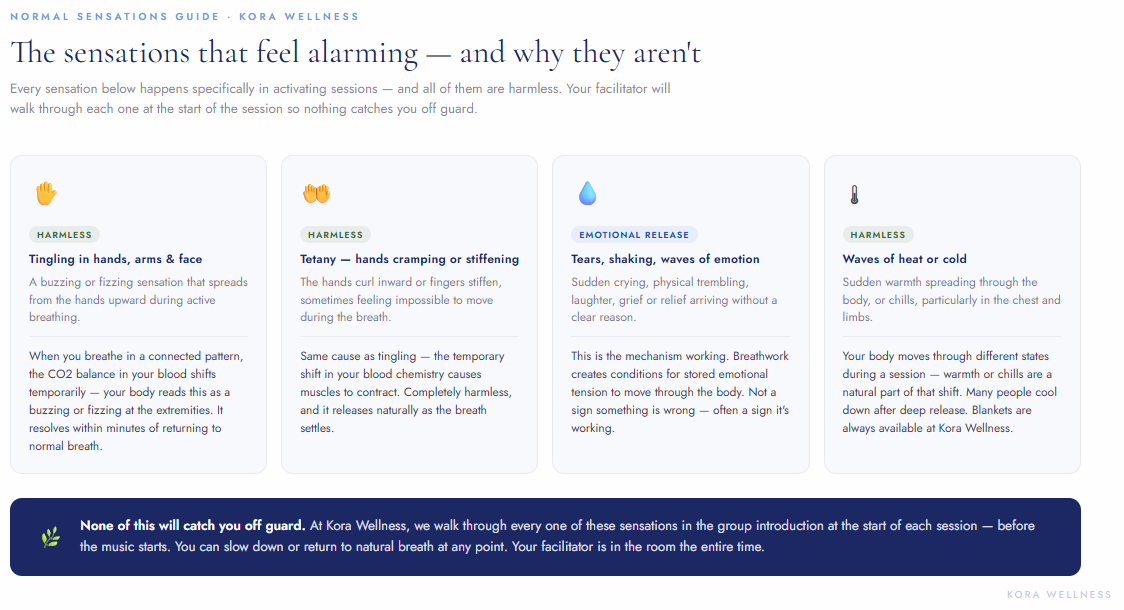
The sensations that feel alarming are almost always signs your nervous system is doing exactly what it came to do.
Who activating breathwork isn't right for and what we recommend instead
Activating breathwork contraindications are the conditions where the breathing pattern itself creates direct clinical risk. In activating sessions, you breathe in and out through the mouth in a continuous circular pattern - no pause between inhale and exhale. This is what drives the CO2 shift, the cardiovascular response and the altered states the session produces. It is also why the physiological profile of activating sessions is meaningfully different from downregulating sessions, where breathing is nasal throughout.
We share this information as part of our duty of care. Everyone who comes to Kora Wellness deserves to arrive in a session that's right for where their body actually is. The list below is how we make sure that happens.
Everything here applies specifically to activating breathwork. Downregulating breathwork has a much gentler physiological profile and remains open to significantly more people - if you're in either list below, that may well be the right starting point and we'd love to talk through what that could look like for you.
The list is split into two. The first covers conditions where activating sessions aren't appropriate regardless of how you're feeling right now - the risk is in the breathing pattern itself, not your current state. The second is a please-reach-out-before-you-book list - conditions where we want to know you're coming so we can hold you well and point you toward the right session type.
We ask that you don't book activating sessions if any of these apply to you:
Heart conditions - including high or low blood pressure, arrhythmia, angina, or history of heart attack or stroke. The breathing pattern in activating sessions raises heart rate and alters blood chemistry in ways that a compromised cardiovascular system cannot safely manage.
Epilepsy or seizure history. The connected breathing pattern is actually used clinically to induce seizures for diagnostic testing, which tells you everything you need to know about the risk.
Pregnancy. Activating breathwork lowers maternal CO2 and can reduce oxygen transfer to your baby through the placenta. Deeply immersive sessions may trigger premature contractions.
Active psychosis or schizophrenia. The altered states that activating breathwork produces can trigger or worsen psychotic episodes.
Personal history of aneurysm, or close family history of aneurysm. The blood pressure shifts during activating breathwork pose a direct risk of rupture.
Bipolar disorder. Activating breathwork carries a genuine clinical risk of triggering a manic episode regardless of your current mood phase, because the high-ventilation breathing pattern itself is the variable that creates risk.
Recent surgery or significant injury. The raised heart rate, muscular tension and physical intensity of activating breathwork can strain healing tissue.
Glaucoma or retinal detachment. Breath holds in activating sessions temporarily increase pressure in the eye, which can worsen these conditions and risk permanent damage.
You're in active crisis right now. Breathwork is a healing tool - it works best when you have enough ground beneath you to use it. If you're in crisis, please reach out to Lifeline on 13 11 14 or your mental health team first. We'll be here when you're ready.
And we'd love to hear from you before you book if any of these are part of your picture:
Anxiety disorders. This one deserves its own section - see below.
Panic disorder. The connected breathing in activating sessions can temporarily mimic the physical sensation of a panic response - elevated heart rate, altered breath rhythm, lightheadedness. Reach out before you book your first session and we'll work out the right starting point with you.
BPD (Borderline Personality Disorder). Activating sessions before sufficient nervous system capacity has been built can feel destabilising rather than releasing. Reach out before you book so we can support you well from the start.
Dissociative disorders or history of significant dissociation. The altered states that activating breathwork can produce need careful facilitation for someone with a dissociation history. Let us know before your first session.
Very recent trauma (last few weeks). A nervous system in the immediate aftermath of trauma may not yet have the capacity to process what activating breathwork brings up. Reach out before you book and we'll talk through what's right for where you are.
Asthma or managed respiratory conditions. Many people with well-controlled asthma participate safely. Let us know when you book so your facilitator is aware from the start.
Trauma or PTSD history. Pacing and session sequencing matter significantly for anyone carrying significant trauma. Reach out before your first session - Hayley's trauma-informed approach means this is held with real care. Our post on whether breathwork can release trauma goes deeper if you want to understand what that process looks like.
Osteoporosis or significant bone density concerns. During activating sessions some people experience strong physical responses (muscle tension, arching, trembling) that carry a small risk for fragile bone structure. Let us know before your first session so your facilitator can support you appropriately.
Hyperthyroidism or Graves disease. An overactive thyroid increases the body's sensitivity to the stress response that activating breathwork produces. Let us know before you book.
Medications affecting blood pressure, heart rate, or mental health - including blood thinners and anticoagulants, beta blockers, antidepressants, anxiolytics, and antipsychotics. Some medications interact with the physiological shifts activating breathwork produces and blood thinners in particular are listed as a specific contraindication in clinical breathwork screening. Let us know before you book and speak with your prescribing doctor beforehand.
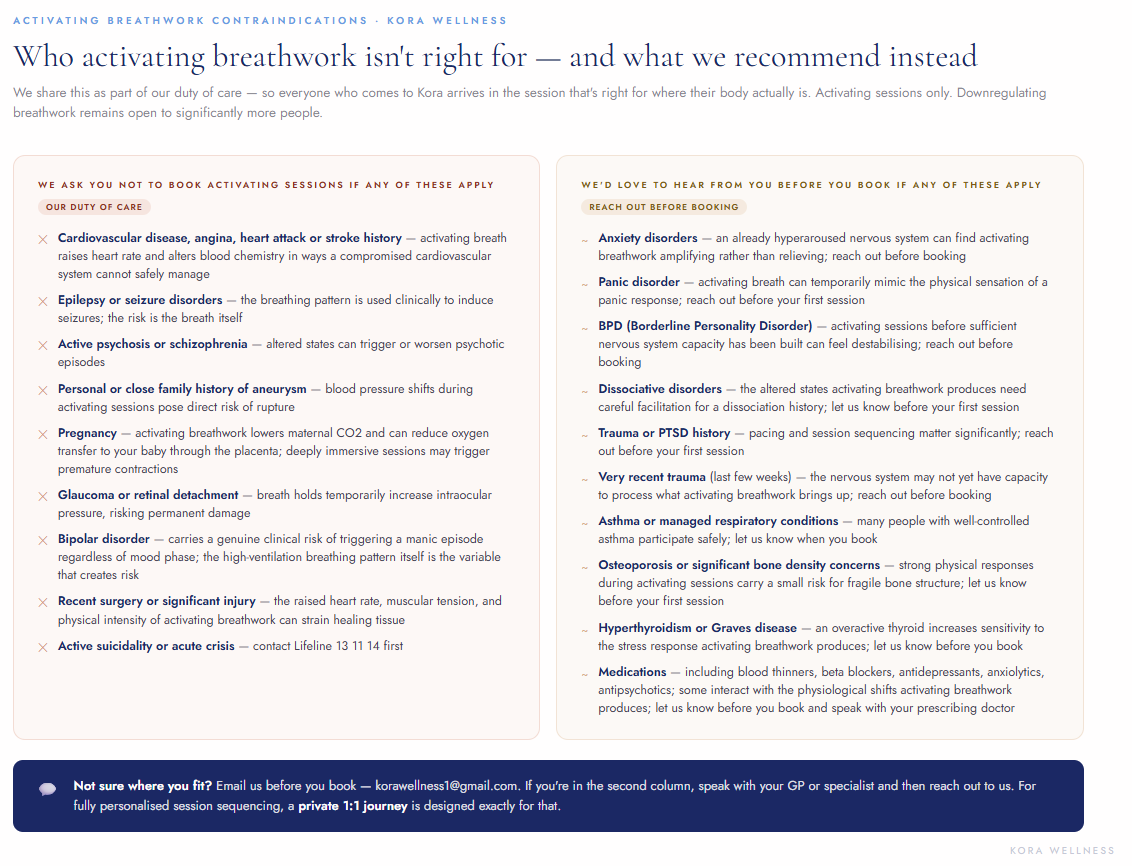
We share this because we care what happens to you. The first column is a no for activating sessions - our duty of care means we can't offer these in good conscience. The second is an invitation to reach out so we can work out the right starting point together.
If you have anxiety, breathwork can still be for you - here's why
This is perhaps the most important safety nuance that most breathwork content gets wrong.
Anxiety is one of the most common reasons women come to Kora Wellness. And yet anxiety also appears on contraindications lists - specifically panic disorder - which causes understandable confusion.
Here's the distinction that matters: activating breathwork, when applied to a nervous system already in a state of chronic hyperarousal, can temporarily amplify that state. This is not a failure of the method, it's a sequencing issue.
The solution is not to avoid breathwork. It's to start with downregulating sessions.
Downregulating 9D breathwork (slower breath, extended exhales, audio tuned to delta and theta frequencies) works in the opposite direction. It brings an overactivated nervous system down. It builds a felt sense of safety in the body. It teaches your system what genuine rest feels like. And once that baseline has been established, activating sessions can be introduced in a way the nervous system can actually absorb and integrate.
At Kora Wellness, you can see which session type is running each week on our social media and bookings page before you book. For most people presenting with anxiety, we recommend choosing downregulating sessions as your starting point; and, once you've built that baseline, introducing activating sessions. If you're unsure which type is right for you right now, a private 1:1 is where we tailor the session specifically to where you are.
If anxiety is part of your picture, our post on 9D breathwork for anxiety explains the full mechanism; including why the guided structure of 9D specifically addresses the thing that makes solo breathwork difficult for an anxious nervous system.
Ready to check which session type is running this week? View the current schedule and book here.
Your medical history is only half the picture
The most important safety consideration in 9D breathwork is not just what medical conditions you have - it's whether the session type matches where your nervous system is right now. An activating session on an already dysregulated nervous system can amplify distress rather than resolve it. A downregulating session, by contrast, is appropriate for a much wider range of people and states. This distinction is what most breathwork safety content never addresses.
Most safety conversations stop at the question of what's in your medical history. That matters, but it's only half the picture.
The other half is this: where is your nervous system right now? And does the session type match that? If you haven't already read our guide to activating vs downregulating 9D breathwork, that post explains the difference in depth. But the short version is that activating sessions build energy and move emotion, while downregulating sessions restore and repair. Both are healing, they just work in different directions.
Here's why the direction matters for safety. If your nervous system has been running on stress, broken sleep and accumulated weight for months - it's already running hot. Arriving into an activating session in that state can push an already overloaded system a little further, rather than giving it relief. It's not dangerous. But it might not feel like what you were hoping for and that experience can put someone off a practice that would genuinely change their life.
Think of it like this: if your legs are cramping and exhausted, the most helpful thing isn't a sprint. it's a stretch. Your nervous system works the same way. And the good news is, downregulating sessions exist exactly for this - to restore your baseline first, so activating sessions can do their deeper work from a place of genuine resource.
Stephen Porges' Polyvagal Theory describes this beautifully: the nervous system needs to feel safe before it can open to release. Downregulating sessions create that safety. Research published in Scientific Reports backs this up - facilitated breathwork with appropriate screening consistently produces wellbeing improvements with minimal adverse effects.
At Kora Wellness, the session schedule is posted on social media each month so you can see what type of session is running before you book. Choosing the right session type for your nervous system state is what determines whether your experience is genuinely therapeutic; it's worth a moment to check what's on. For truly personalised sequencing, a private 1:1 is designed exactly for that.
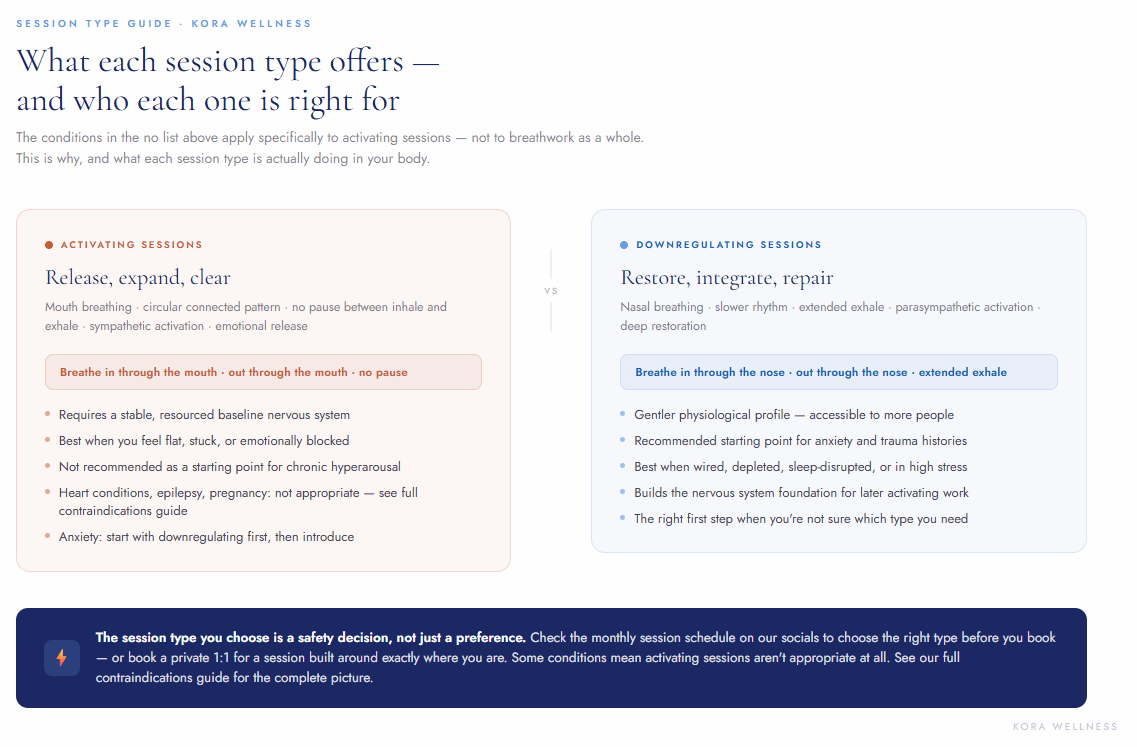
The most important safety question about 9D breathwork isn't what's in your medical history — it's which session type matches where your nervous system is right now.
Why the facilitator in the room changes everything
If you've ever tried a breathing exercise at home and found yourself wondering whether you were doing it right, or whether it was actually working, or whether you should stop - that experience captures exactly what makes facilitated 9D different.
A trained facilitator is present throughout. Hayley and Jade are both certified breathwork facilitators with trauma-informed training. They are watching the room during every session, noticing when someone needs grounding support, when a session needs to be paced differently, when someone might benefit from a different approach. That presence is not incidental. It's what creates safety.
Health screening happens at your first session. Every new client completes a health intake before their first session so that contraindications are known and the facilitator can provide appropriate support during the session. For those wanting a session type tailored specifically to where they are, private 1:1 journeys are available for exactly that purpose. This level of care is not something most online or app-based breathwork includes.
The environment is designed for nervous system safety. The studio at 43 Wentworth Street, Port Kembla is intentionally designed; soft lighting, warm mats, blankets, grounding colours. The body reads environmental safety before the session even begins. This is not an aesthetic choice. It's a physiological one.
Touch consent is explicit. Before every session, clients are asked whether they would like light grounding touch during the journey. If you'd prefer not to be touched, that is equally respected. You stay in full agency throughout.
You can slow down or stop at any time. The breath pattern in 9D sessions can always be adjusted. If the intensity of an activating session feels like too much, you can slow to a natural breath rhythm. The audio continues to support you, the facilitator is aware and you are never locked into an experience you're not ready for.
“Walking into Kora Wellness Centre, you immediately feel the intention behind the space — calm, grounded, and deeply supportive. But it’s Hayley who truly defines the experience. As a trauma‑informed practitioner and founder of Kora Wellness, she brings a rare blend of professional expertise and genuine human warmth to every session”
“I’ve had several breathwork sessions with Kora Wellness and every time I leave lighter and with clarity. Feeling sad? Breathwork. Angry? Breathwork. Relationship troubles? Breathwork. Trauma? Breathwork. I could go on. So many incredible benefits.”
A note on 9D breathwork and mental health
Breathwork can be a powerful complement to therapy, medication, and other mental health support. It is not a replacement for any of these and we never position it as one.
If you are currently working with a psychologist, psychiatrist, or GP on a mental health condition, it's worth mentioning that you're interested in breathwork. In most cases, your treating professional will have no objection and may actually welcome it as a somatic complement to the cognitive and verbal work you're doing together.
If you are in active crisis, please reach out to a mental health professional or contact Lifeline on 13 11 14 before booking a breathwork session. Breathwork is a tool for healing and regulation, not emergency support.
Frequently Asked Questions
Is 9D breathwork safe for people with anxiety? Yes, for most people with anxiety, 9D breathwork is not only safe but specifically effective. The key is session sequencing. For anxious nervous systems, downregulating sessions - breathing through the nose, extended exhales, audio tuned for parasympathetic activation - are the recommended starting point before any activating work is introduced. This builds a felt sense of safety in the body first, which makes subsequent sessions more effective and better tolerated. At Kora Wellness, the monthly schedule is posted so you can choose a downregulating session as your starting point and private 1:1 journeys are available for fully personalised sequencing.
What are the contraindications for 9D breathwork? Contraindications for 9D breathwork apply specifically to activating sessions, where you breathe in and out through the mouth in a continuous circular pattern. This is the breathing pattern that creates the cardiovascular and physiological changes that make certain conditions incompatible. Activating sessions are not appropriate for people with cardiovascular disease, history of heart attack or stroke, epilepsy, active psychosis, bipolar disorder, personal or close family history of aneurysm, pregnancy, recent surgery, or glaucoma or retinal detachment. Conditions where we ask you to reach out before booking include: panic disorder, BPD, dissociative disorders, PTSD, recent trauma, asthma, osteoporosis, hyperthyroidism, and relevant medications. Downregulating sessions - nose breathing throughout - have a much gentler physiological profile and are appropriate for significantly more people.
Can breathwork make anxiety worse? Yes, activating breathwork applied to an already hyperaroused nervous system can temporarily amplify anxiety. This is a sequencing issue, not a failure of the method. The solution is to begin with downregulating sessions, which bring the nervous system down rather than up. At Kora Wellness, the session schedule is posted monthly so you can choose the session type that matches where you are. For fully personalised session selection, private 1:1 journeys are tailored specifically to your nervous system state.
Is 9D breathwork safe during pregnancy? Activating 9D breathwork is not recommended during pregnancy. The continuous circular mouth breathing pattern lowers maternal CO2 and can reduce oxygen transfer to your baby through the placenta and deeply immersive sessions may trigger premature contractions.
What does tingling during breathwork mean? Is it dangerous? Tingling in the hands, arms and face is harmless and extremely common in activating breathwork. It's caused by a temporary shift in blood CO2 levels that occurs when breathing in and out through the mouth in a continuous circular pattern - the breath mechanic used in activating sessions. This CO2 shift changes how the nervous system registers sensation at the extremities. It resolves within minutes of returning to normal breathing and is not a sign that anything is wrong. All common sensations are explained during the group introduction at the start of every session.
What is tetany in breathwork and is it safe? Tetany is a temporary stiffening or cramping of the hands and fingers that occurs in activating breathwork. It is caused by the same CO2 shift that produces tingling - a result of the continuous circular mouth breathing pattern used in activating sessions. It is completely harmless and resolves as the breath settles. It can feel alarming if you haven't been told to expect it, which is why it's covered during the group introduction at the start of every session at Kora Wellness.
Is 9D breathwork safe for people with trauma? 9D breathwork can be profoundly healing for people with a history of trauma but the pacing, session type and facilitator approach matter significantly. At Kora Wellness, Hayley holds a trauma-informed approach and always discusses your history before any private 1:1 session. For group sessions, downregulating work is often the recommended starting point for those with significant trauma histories, as it builds a felt sense of safety before any activating or releasing work begins. The goal is always to work within your window of tolerance, not to push through it.
Is 9D breathwork safe for people with bipolar disorder or BPD? For bipolar disorder, activating breathwork - which uses continuous circular mouth breathing - carries a genuine clinical risk of triggering a manic episode regardless of current mood phase. For BPD, activating sessions before sufficient nervous system capacity has been built can feel destabilising rather than releasing. For either condition, reach out to Kora Wellness before booking.
How is facilitated 9D breathwork different from doing breathwork at home? Facilitated 9D breathwork differs from home practice in several important ways: a trained facilitator is present and monitoring throughout the session; new clients complete a health intake before their first session; the environment is designed to signal nervous system safety; and the audio technology is calibrated for therapeutic outcomes. For fully personalised session selection and sequencing, private 1:1 journeys are tailored to each individual. These elements collectively produce a safety profile and therapeutic depth that self-directed home practice cannot replicate.
You don't have to have it all figured out before you arrive
One of the most common things we hear at Kora Wellness is: I wasn't sure if it was right for me, so I waited.
If you've been waiting because you weren't sure it was safe, we hope this post has answered that question honestly. For most people, it is safe. For those with specific conditions, the conversation is worth having - not to be talked out of coming, but to make sure you choose the right session type and know what to expect. Our monthly schedule is posted on social media and if you want a session built around exactly where you are right now, a private 1:1 is what that looks like.
One more thing worth knowing before you book: the shift people describe (feeling genuinely different between sessions, not just during them) happens with frequency, not from a single visit. For a depleted or dysregulated nervous system, multiple downregulating sessions per week is where real change begins. One session can shift something. Consistent sessions change the baseline.
Our sessions are at Kora Wellness, 43 Wentworth Street, Port Kembla NSW, serving the Wollongong, Shellharbour, Thirroul, Warilla and broader Illawarra community. View our session types here or book directly here.
If you'd prefer a conversation first, email us directly, no pressure, no obligation, just an honest answer to whatever's still on your mind.
About the Author
Kora Wellness is the Illawarra's dedicated 9D breathwork studio, founded by Hayley Simpson and located at 43 Wentworth Street, Port Kembla NSW. Hayley is a certified 9D Breathwork facilitator and Master NLP Practitioner with a trauma-informed approach. Kora Wellness offers weekly group sessions, private 1:1 journeys, and online breathwork for clients across Wollongong, Shellharbour, Thirroul, Warilla and the broader Illawarra.
