9D Breathwork for Anxiety: What actually happens in your body
Published by Kora Wellness | Port Kembla, NSW | Serving Wollongong, Shellharbour, Thirroul, Warilla and the Illawarra
Most people with anxiety have already tried breathing.
They've done the 4-7-8 before bed. They've opened a calm app in a work bathroom. They've been told by a therapist, a friend, a well-meaning article that if they just focused on their breath, it would help.
And sometimes it does. A little. Momentarily. Until the thought comes back: am I doing this right? Is this working? Why isn't this working?
This is the thing nobody talks about when it comes to breathwork and anxiety: an anxious nervous system can make solo breathing techniques harder to do, not easier. The very mechanism that makes anxiety debilitating - a brain that won't stop monitoring, assessing and second-guessing - is the same mechanism that quietly undermines DIY breathwork from the inside.
9D breathwork works differently and not because it's more intense, more disciplined or requires more from you. It works differently because of what it removes and what the audio architecture puts in its place.
This post explains exactly what happens in your body during a 9D breathwork session when anxiety is present, why the guided structure matters neurologically and what the research actually says about breathwork as a tool for lasting anxiety relief, not just temporary calm.
Why Anxiety makes solo Breathwork harder than it should be
Here is something that rarely gets said directly: when you try to guide yourself through a relaxation technique, part of your brain stays switched on. It's monitoring, judging, tracking whether you're doing it right and measuring whether it's working yet.
That part of the brain - the evaluative, narrative, self-monitoring cortex - is precisely the part that's already overactive in anxiety. So when you try to calm your anxious system using a technique that requires that same system to stay alert and guide the process, you're asking the problem to solve itself.
Researchers studying breathwork effectiveness have identified this as a real barrier to self-guided practice. A systematic review of 58 clinical breathwork studies found that the most consistently effective interventions shared a key feature: human-guided training with multiple sessions. Solo, app-based practice was significantly less effective, particularly for people with high anxiety.
This isn't a failure of willpower or technique, it's neurological. And it's exactly why facilitated breathwork (and 9D specifically) produces different results.
What the Amygdala has to do with it
Your amygdala is a small, almond-shaped structure deep in your brain. It's the body's threat-detection system - the part that decides, before your conscious mind has time to weigh in, whether something in your environment is dangerous. In people with anxiety, the amygdala is chronically over-sensitised. It fires more readily, recovers more slowly and keeps the rest of the nervous system in a low-level state of readiness waiting for the next threat.
This is why anxiety often doesn't feel like fear about something specific. It feels like a background hum of not-quite-safe, even when nothing is wrong. The amygdala doesn't distinguish between real and perceived threat, it just fires.
Breathwork addresses this directly - not by talking the amygdala down, but by changing the physiological signals it receives. When you breathe slowly, with an extended exhale, your heart rate variability (HRV) increases. This sends a direct signal up the vagus nerve to the brain stem and limbic system: the body is safe. Stand down.
Research has gone further than this. Studies on mindful breathing practices have found that sustained breathwork can actually reduce the size and reactivity of the amygdala over time. Not just calm it temporarily, but change its baseline sensitivity. This is not symptom management. This is structural change in the fear-processing architecture of the brain.
“The distinction worth holding: Anxiety medication and most coping strategies work on the output of the amygdala - they reduce the experience of anxiety symptoms after the alarm has fired. Breathwork, practiced consistently, works on the input, changing how readily the alarm fires in the first place.”
What 9D Breathwork does that other Breathwork doesn't
To understand why 9D is particularly well-suited to anxiety, it helps to understand what the nine layers of audio are actually doing because this is where the fundamental difference from solo practice lives.
In a standard breathwork session, you bring your awareness to your breath and try to follow a pattern. Your nervous system does its best to cooperate. But the brain is still running its normal background chatter. It's still tracking time, assessing progress, managing distractions.
In a 9D session, the audio architecture essentially takes over that function.
The binaural beats (different frequencies played in each ear) guide your brain toward specific brainwave states. For anxiety, downregulating 9D sessions use frequencies tuned toward delta and theta waves: the states associated with deep rest, safety and reduced cortisol. Your brain doesn't decide to move toward those states. It's gently entrained there by the sound itself, the same way a tuning fork causes a nearby string to vibrate at the same frequency.
At the same time, the guided narration removes the need for self-direction. You don't need to monitor whether you're breathing correctly. You don't need to assess whether it's working. The track handles the guidance. Your only job is to follow the breath and let the sound do its work.
This is the structural answer to the problem of meta-anxiety - the anxiety about doing anxiety relief correctly. It's removed from the equation entirely.
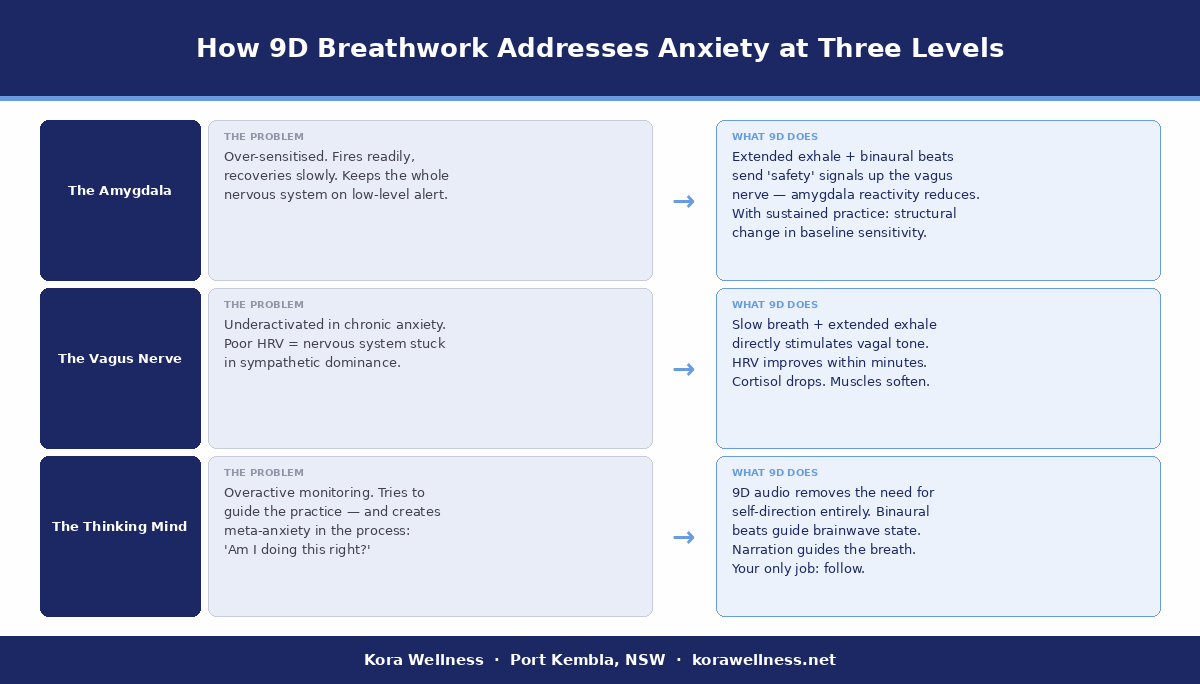
The three places anxiety lives in your body — and what 9D addresses at each one.
What actually happens in your body during a session
For someone carrying anxiety, here is the physiological sequence of a downregulating 9D breathwork session:
In the first few minutes: The guided breath pattern slows your respiratory rate. As your exhales lengthen, your vagus nerve - the main highway of the parasympathetic nervous system - begins to activate. Heart rate variability increases. Cortisol production starts to reduce. Your muscles, which have been holding chronic low-level tension, begin to receive the signal that it is safe to soften.
Around the 15-20 minute mark: The binaural beats have begun to shift your brainwave state. The default mode network - the brain's narrative, ruminating system - quietens. This is the neurological equivalent of the mental chatter turning down. Not because you've forced it, but because the brain has moved into a state where that network is naturally less dominant.
In the middle of the session: For many people with anxiety, this is where something unexpected happens. In the absence of the mental chatter, and in the presence of physiological safety, emotions that have been held just below the surface begin to move. Not always dramatically. Sometimes it's a quiet release of breath, a softening of the chest, a few unexpected tears. Sometimes it's simply a quality of stillness that feels unfamiliar because it is: genuine nervous system rest, not just distraction from anxiety.
After the session: Cortisol levels remain reduced for several hours. HRV stays elevated. The amygdala, having received extended signals of safety, settles back to a lower baseline. Most people describe feeling quieter than usual, not sedated, but genuinely less reactive. Like the volume on everything has been turned down a few notches.
“I have been doing breathwork at Kora now for six months, three times a week. I can honestly say it has changed my life and I couldn’t be without it. For me it’s like exercising the mind and soul, practicing regularly to manage my depression and anxiety.”
The research behind it
The evidence for breathwork and anxiety has grown substantially in recent years.
A 2024 randomised controlled trial published in the Journal of Chiropractic Medicine examined the effects of conscious connected breathwork - the same category of breath technique used in activating 9D sessions - on anxiety symptoms. The intervention group showed a statistically significant reduction in anxiety scores with a Cohen's d of 1.44 - one of the largest effect sizes recorded in this research area, larger than most pharmacological interventions in equivalent studies.
A 2025 systematic review published in MDPI examined 15 clinical studies and found that breathwork consistently produced statistically significant reductions in anxiety symptoms across all eight studies that specifically examined anxiety as an outcome.
A separate meta-analysis of randomised controlled trials published in Scientific Reports found that breathwork was associated with significant reductions in anxiety (g = -0.32, p < 0.0001) across 20 trials. The researchers noted that breathwork represents a "bottom-up" approach to anxiety regulation (working through the body and autonomic nervous system rather than through cognitive reappraisal) which may explain why it reaches people for whom top-down approaches like talking therapy have felt insufficient.
Neuroscientist Andrew Huberman's research at Stanford identified the "physiological sigh" - a double inhale followed by a long exhale - as the single most effective real-time intervention for reducing acute stress, outperforming mindfulness meditation in head-to-head comparison. The extended exhale that characterises downregulating 9D breathwork follows the same neurological principle, applied across a full session.
None of these studies examined 9D breathwork specifically, the research on this modality is still emerging. But the physiological mechanisms they document are exactly the ones a well-designed 9D session activates: vagal tone, HRV, brainwave entrainment, cortisol reduction and amygdala regulation. The science of how breathwork affects anxiety is well established. 9D's contribution is the structure that makes those mechanisms accessible to people whose anxiety has previously made breathwork difficult.
Can Breathwork make anxiety worse?
This is one of the most important questions we get asked and it deserves an honest answer: yes, breathwork can make anxiety worse in specific circumstances.
Activating breathwork techniques - faster, more connected breathing - deliberately increases arousal. For someone already in a state of hyperarousal (anxiety, panic, a highly activated nervous system), beginning with an activating session can amplify that state rather than resolve it. This is not a failure of breathwork. It's a misalignment of session type with nervous system state and understanding the difference between activating and downregulating sessions is what makes all the difference.
This is why we always assess where you are before a session at Kora Wellness. For most people presenting with anxiety, we begin with downregulating sessions; the slower, more restorative work that builds a felt sense of safety in the body first. Once that baseline is established, activating sessions can be introduced and they become part of how the nervous system genuinely expands its capacity to process and release.
There is also a phenomenon worth naming: some people experience a temporary increase in anxiety in the 24-48 hours after a breathwork session, particularly after their first few. This is not a sign that breathwork isn't working. It's often a sign that the session began to move something - emotions or stored tension that the nervous system is now processing and integrating. It settles. And the baseline, consistently, comes down.
“A note on trauma and anxiety: If your anxiety is rooted in trauma - particularly complex or developmental trauma - the relationship between breathwork and your nervous system needs care and attention. We work with a trauma-informed approach at Kora Wellness and always discuss your history before any private 1:1 sessions. Breathwork can be profoundly healing for trauma-based anxiety, but the pacing and sequencing matter.”
Our post on whether breathwork can release trauma explores what that release process actually looks like.
Why consistent practice matters more than a single session
A single 9D breathwork session can provide significant, immediate relief from anxiety. Many people walk out of their first session describing it as the most genuinely calm they've felt in years.
But a single session is not a nervous system reset. The amygdala doesn't permanently recalibrate from one encounter with safety. Anxiety patterns that have been reinforced over years through chronic stress, early experiences and accumulated trauma have a structural hold in the nervous system. Shifting that hold requires repeated, consistent experiences of genuine safety which is exactly what a regular 9D practice at Kora provides. Research supports this: longitudinal breathwork studies have shown sustained improvements in resting HRV, parasympathetic dominance and reduced anxiety scores over time; effects that compound rather than plateau with consistent practice.
The members at Kora Wellness who report the most significant changes in their anxiety - the ones who describe genuinely feeling different, not just managing better - are consistently the ones who have committed to 8-12 weeks of regular sessions. Not because they've worked harder or suffered through more sessions. Because they've given their nervous systems enough repeated experiences of safety for that to become the new baseline. Anxiety and disrupted sleep almost always go hand in hand. If sleep is also a factor for you, read our guide to 9D Breathwork for Sleep.
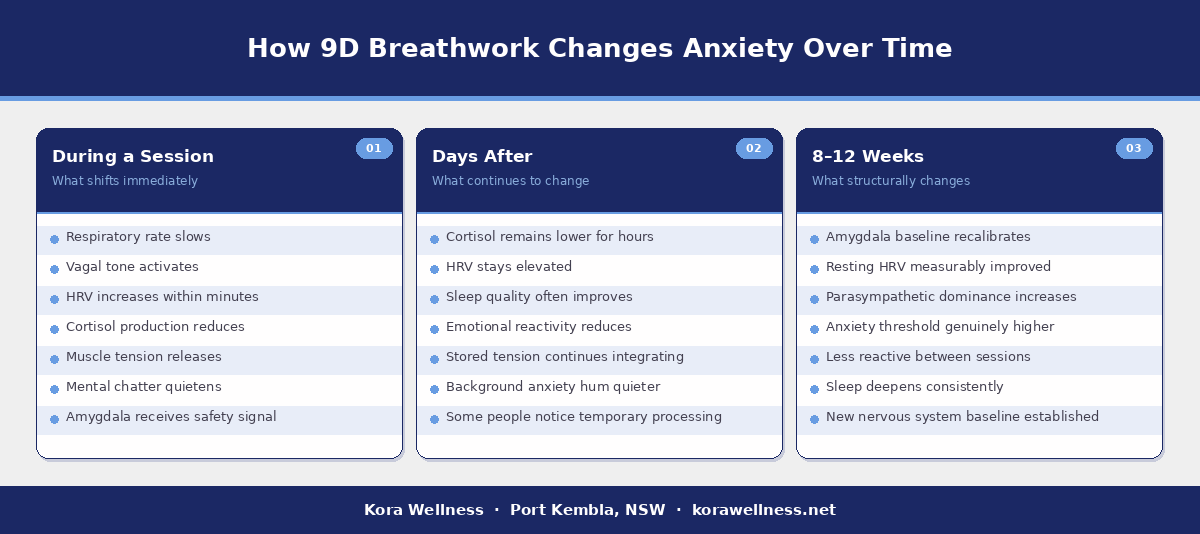
Change doesn't happen in a single session. Here's what shifts at each stage of a consistent practice.
What a first session looks like for someone with anxiety
If you're considering your first session and anxiety is part of why you're here, here is what the experience typically looks like:
When you book, you'll complete a health disclaimer and contraindications checklist - this is how we make sure breathwork is safe and appropriate for you before you arrive. For activating sessions, there's also a brief health check questionnaire on arrival, along with a quick mental health check-in on the day. This allows your facilitator to adjust the breathing speed or pattern for individuals within the group if needed. Downregulating sessions don't require the same on-arrival process, the nature of the work is restorative and the threshold for adjustment is much lower.
Each scheduled journey has a pre-set session type, so when you book you'll already know whether it's an activating or downregulating session. You can find the schedule on our Facebook page. This makes it straightforward to choose based on where you are right now.
When you arrive at Kora Wellness in Port Kembla, the space is intentionally designed to settle a nervous system rather than stimulate it. Soft lighting, warm temperature, your own mat, eye pillow or mask and blanket.
Once the session begins, your only job is to follow the breath pattern and let the audio do its work. There's nothing to monitor, nothing to assess, nothing to get right. If your mind wanders - which it will - that's not a problem. The audio will bring you back. If emotions come up, that's part of the process. You won't be alone in the room and you're always in control of your own breath.
After the session, we give you time to integrate before you re-enter the world. Most people sit quietly for 10-15 minutes. Some people want to talk about what came up. Some don't. Both are fine. Your nervous system has just done significant work and it deserves a gentle landing.
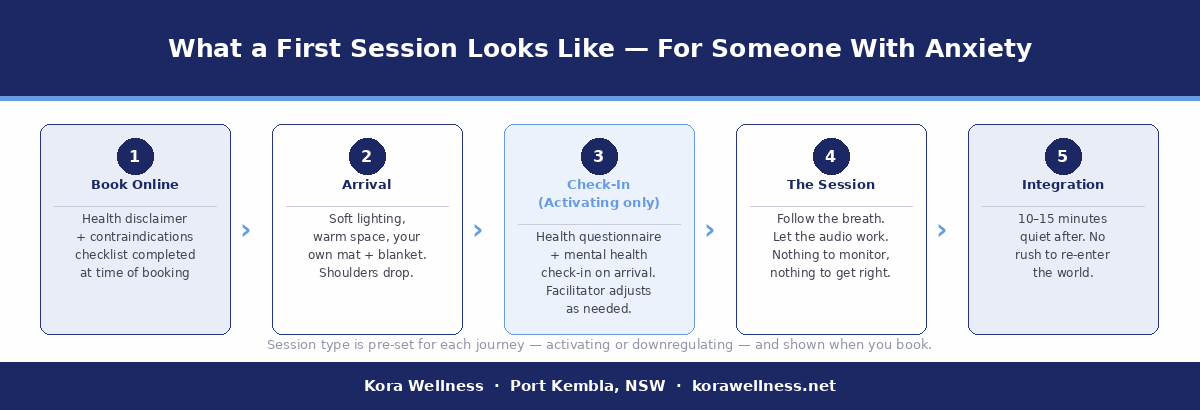
From booking to integration - what your first session looks like when anxiety is part of why you're here.
Frequently Asked Questions
Can 9D breathwork help with anxiety? Yes, and the evidence is substantial. Multiple randomised controlled trials and systematic reviews have found that breathwork produces significant reductions in anxiety symptoms, with some studies showing effect sizes larger than equivalent pharmacological interventions. 9D breathwork applies these same physiological mechanisms - vagal nerve stimulation, cortisol reduction, HRV improvement and brainwave regulation - within a guided, trauma-informed structure that makes them accessible to people whose anxiety has previously made solo breathing techniques difficult.
Can breathwork make anxiety worse? It can, in specific circumstances. Activating breathwork techniques - faster, more connected breathing - are not appropriate as a starting point for highly activated or anxious nervous systems. At Kora Wellness, we always assess where you are before a session and typically recommend beginning with downregulating sessions for clients presenting with anxiety. Some people also notice a temporary increase in anxiety in the 24-48 hours after their first few sessions, as the nervous system begins to process and integrate stored tension - this is normal and settles.
How many sessions does it take to see results for anxiety? Many people notice a significant shift after a single session. Lasting change in anxiety patterns typically develops over 8-12 weeks of consistent practice, as the nervous system accumulates repeated experiences of genuine safety and begins to recalibrate its baseline. Research on breathwork and anxiety shows that effects compound over time and sustained practice produces greater and more durable reductions in anxiety than single or infrequent sessions.
Is 9D breathwork safe for people with anxiety disorders? For most people with anxiety disorders, yes - 9D breathwork is safe and can be profoundly beneficial. There are some contraindications (including certain cardiac and respiratory conditions, pregnancy and some medications) that are screened via the health disclaimer and contraindications checklist completed at the time of booking. For activating sessions, there's an additional health check questionnaire and mental health check-in on arrival. If you have a diagnosed anxiety disorder and are working with a mental health professional, 9D breathwork can complement that work well, many of our clients engage in both.
What does 9D breathwork feel like when you have anxiety? Most people with anxiety describe the experience of a downregulating 9D session as initially unfamiliar; a quality of stillness that their nervous system hasn't often encountered. Some people notice they're waiting for the anxiety to come back. Some cry without quite knowing why. Some feel their chest soften in a way that surprises them. After the session, most describe feeling genuinely quieter, not sedated, but less reactive. Like the background hum has reduced.
Why is 9D breathwork better for anxiety than DIY breathing techniques? The key difference is structural. Solo breathing techniques require the same self-monitoring, evaluative part of the brain to stay active and guide the process, which is precisely the part that's overactive in anxiety, creating what researchers call meta-anxiety (the anxiety about whether you're doing the anxiety relief correctly). 9D's guided audio structure removes that requirement entirely. The binaural beats guide your brainwave state. The narration guides your breath. Your only task is to follow. This is why clinical research consistently finds that human-guided, multi-session breathwork is significantly more effective than self-guided practice - particularly for people with high anxiety.
Where can I do 9D breathwork for anxiety near Wollongong? Kora Wellness is the Illawarra's only dedicated 9D breathwork studio, located at 43 Wentworth Street, Port Kembla NSW — a short drive from Wollongong, Shellharbour, Thirroul, Warilla and across the wider Illawarra region. We offer weekly group sessions and private 1:1 journeys and both session types are available depending on what your nervous system needs.
About the Author
Kora Wellness is the Illawarra's dedicated 9D breathwork studio, founded by Hayley Simpson and located at 43 Wentworth Street, Port Kembla NSW. Hayley is a certified 9D Breathwork facilitator and Master NLP Practitioner with a trauma-informed approach. Kora Wellness offers weekly group sessions, private 1:1 journeys, and online breathwork for clients across Wollongong, Shellharbour, Thirroul, Warilla and the broader Illawarra.
Ready to experience this for yourself? Our sessions at Kora Wellness, Port Kembla are designed with anxious nervous systems in mind and your facilitator will always match the session type to where you are that day.
Book your first session here or if you'd like to talk through whether 9D is right for you before booking, reach out here.
