
9D Breathwork for sleep: Why one session can change how you sleep for days.
Published by Kora Wellness | Port Kembla, NSW | Serving Wollongong, Shellharbour, Thirroul, Warilla and the Illawarra
Most sleep advice treats the symptom.
An early night, a dark room and no screens after 8pm…maybe magnesium. Or, maybe a sleep meditation you've tried seventeen times and you're still lying there at midnight with your brain rehearsing tomorrow's to-do list.
All of it is good advice but none of it reaches the actual problem.
For a lot of women, particularly those carrying chronic stress, unresolved emotional weight, or a nervous system that's been in overdrive for months, the issue isn't the bedroom environment or the pre-sleep routine. The issue is cortisol. And cortisol doesn't respond to good intentions.
This post is about why 9D breathwork addresses sleep at the level most interventions can't reach and why the effects of a single downregulating session can carry through your sleep quality for several days afterward.
If you'd rather experience it than read about it, our next sessions are here.
Why you can't think your way to sleep
Your body has a sleep switch and it isn't in your willpower. It's in your autonomic nervous system - specifically, in the balance between your sympathetic (fight-or-flight) and parasympathetic (rest-and-digest) branches.
When you're lying awake at 1am, it's not because you forgot to relax. It's because your nervous system is reading the signals around it and concluding: not safe yet. Cortisol (which is your primary stress hormone) stays elevated, your heart rate doesn't settle and your mind keeps scanning. Even when you're exhausted, the system stays on if it does not feel safe.
The thing is, this isn't a mindset problem you can think your way out of. It's a physiology problem. Studies on people with chronic insomnia consistently show that their cortisol is highest in the evening and the first half of the night - exactly the window when deep sleep should be building. The body simply won't slide into rest while it believes there's still a threat to manage.
This is the loop that most sleep advice doesn't break. It addresses your habits but it doesn't address your nervous system's baseline state. For many women, the sleep problem is actually an anxiety problem in disguise. If that resonates, our guide to 9D Breathwork for Anxiety is worth reading alongside this one.
What cortisol is actually doing to your sleep
The part most people don't realise is that poor sleep and high cortisol aren't just correlated, they actively make each other worse.
The deepest, most restorative stage of sleep (called slow-wave or N3 sleep) is when your brain produces delta waves. This is where your body repairs tissue, consolidates memory, releases growth hormone and resets your immune system. It's the sleep that actually makes you feel rested.
Cortisol suppresses delta wave production so the higher your cortisol when you go to bed, the less time your brain spends in that deep, restorative stage. And here's where it spirals: research by sleep scientist Dr. Eve Van Cauter at the University of Chicago showed that even a partial night of poor sleep raises your cortisol the following evening by up to 37–45% making the next night harder. Bad sleep raises cortisol. High cortisol wrecks sleep. Repeat.
This is the cycle that most sleep-troubled women are caught in and it’s not because of bad habits. It’s because of a nervous system that's never fully landing and given a chance to reset and repair.
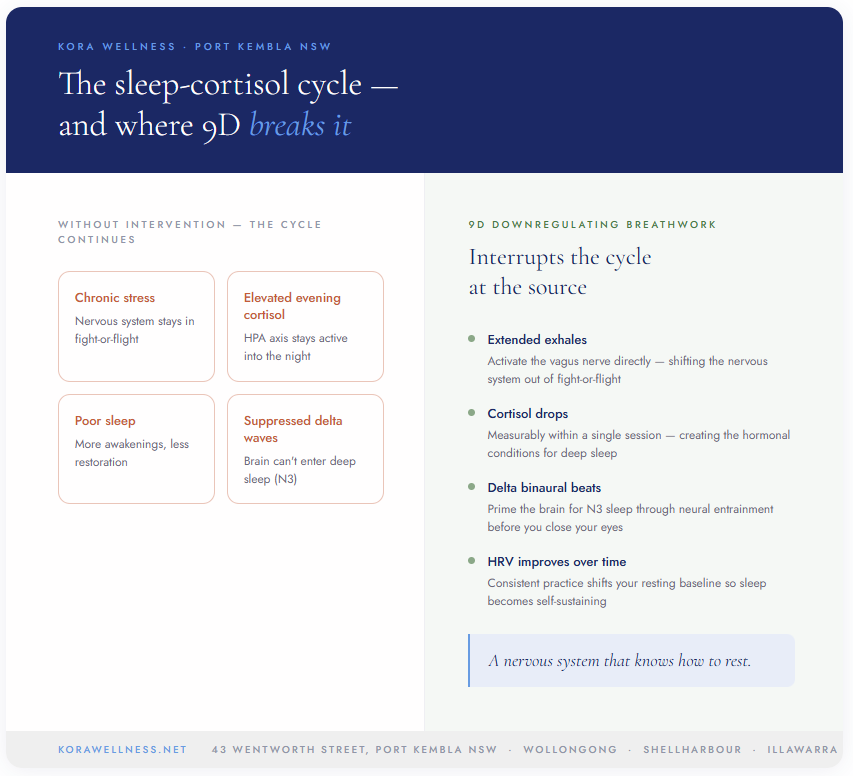
The sleep-cortisol cycle most interventions don't reach. Here's where 9D works.
What downregulating 9D Breathwork does differently
Downregulating 9D breathwork is a guided, immersive breathwork practice that uses extended exhales, slowed breath rate and multi-layered audio to deliberately activate the parasympathetic nervous system - shifting your body out of fight-or-flight and into genuine rest. Unlike activating breathwork, which builds energy and emotional release, downregulating sessions are designed to bring everything down. To understand exactly how downregulating sessions work and how they differ from activating breathwork, read our full guide to activating vs downregulating 9D breathwork.
The science behind why it works is actually straightforward. When you slow your breath and extend your exhales, you directly activate the vagus nerve which is the main highway of your parasympathetic nervous system. Your heart rate drops and your cortisol begins to fall. Your body gets the signal it's been waiting for: I am safe now. Twenty years of research consistently shows that slow, diaphragmatic breathing lowers cortisol, improves heart rate variability and shifts the nervous system toward rest - AND that this happens even after a single session.
When you do this in the hours before bed, you're not just feeling calmer. You're changing the hormonal conditions that determine whether your body can access deep sleep that night.
At Kora Wellness, downregulating sessions run 50-60 minutes long which is enough to create a real, sustained shift, not just a momentary exhale. Wondering which session type is right for you? Our session overview walks you through it.
The Delta Wave layer: What 9D does that other breathwork doesn't
Here's the piece that most sleep content misses entirely and the reason 9D breathwork produces results that regular breathwork often doesn't.
The "9D" refers to nine dimensions of sound layered into the audio experience you hear through the headphones. One of those layers is binaural beats which are two slightly different tones played in each ear simultaneously. Your brain perceives the difference between them as a third frequency and over time, starts to sync its own electrical activity toward that frequency. It's called neural entrainment and it's been studied for decades.
For sleep, the relevant frequency is delta — 1 to 4 Hz, the same range your brain produces during deep, slow-wave sleep. Research has found that listening to binaural beats in the delta range can actually increase the brain's own delta wave production, helping people reach deep sleep faster and stay in it longer. A separate pilot study found that one week of delta binaural beat exposure improved sleep quality, reduced night wakings and left people in a better mood the following morning. More recently, a 2024 study in Scientific Reports found that even very slow binaural beats shortened the time it took people to enter slow-wave sleep.
In plain terms: the audio in a 9D downregulating session isn't just relaxing music. It's actively coaching your brain toward the frequency it needs for deep sleep before you even close your eyes that night.
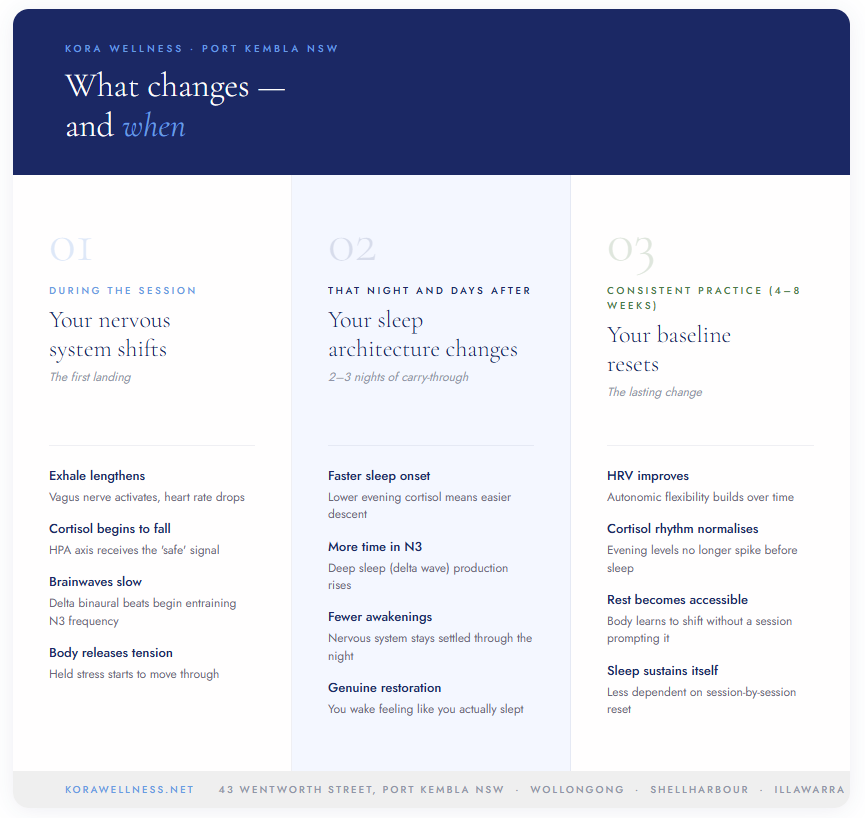
Sleep doesn't improve in a single session — but the process starts in one.
Why the effects last several days
This is the part that surprises most people and it's worth understanding, because it explains why regular practice matters so much more than a single session.
When you do breathwork consistently, something shifts beyond just feeling calmer afterward. Your heart rate variability (a measure of how well your nervous system can flex between activation and rest) begins to improve. Research tracking people over weeks of regular slow breathing shows sustained improvements in HRV, parasympathetic function and sleep quality. In other words, your nervous system's resting baseline starts to change.
What that means practically:
your cortisol stops spiking as high in the evenings
your body finds it easier to shift into rest at bedtime
you spend more time in deep sleep
you wake up fewer times because your nervous system learned a new default.
Studies on consistent breathwork practice have found that people practising regularly see significantly greater sleep improvements than those who do it occasionally - which is why at Kora Wellness we talk about membership rather than single sessions. One session often produces a noticeably different night. But the lasting shift, from a nervous system that fights rest to one that welcomes it, happens with frequency. For most people working on sleep, that means multiple downregulating sessions a week, not one. If your nervous system is genuinely depleted, that's especially true - more regular sessions is how it learns the new default, not a occasional reminder.
What a sleep-focused session at Kora looks like
When not being able to sleep is the reason you're coming in, a downregulating session is what you'll want. These sessions are specifically designed to bring your nervous system down - slower breath pacing, longer exhales, audio layered for parasympathetic activation and delta wave entrainment.
Booking: Sessions are listed on our bookings page and social media pages with the session type clearly described. A health disclaimer and contraindications checklist are completed at booking BUT if you're unsure which type is right for you, our session overview explains the difference.
Arriving: You don't need to prepare anything. The session is completely guided from start to finish. You'll lie down, put on the noise-cancelling headphones and the soundscape takes over.
During: The extended exhales and slower breath cadence activate your vagus nerve and shift your autonomic state throughout the session. Most people describe a sense of profound heaviness and calm - not quite sleep, but the closest most of them have come to it in a long time.
Afterward: Most people notice the sleep effect most strongly that night and the following two to three nights.
Can 9D Breathwork replace sleep medication?
This deserves an honest answer rather than an enthusiastic yes.
For many people - particularly those whose poor sleep is driven by chronic stress, anxiety, or a nervous system that's been in overdrive - consistent breathwork practice can produce real, lasting improvement without medication. It works on the underlying cause rather than the symptom.
That said, if you have a diagnosed sleep disorder, sleep apnea, or are currently taking sleep medication, speak with your GP before making changes. Breathwork can be an excellent complement to existing care but that conversation belongs with your healthcare provider, not a blog post. For nights when you need something gentle and immediate, our breathing techniques guide walks through box breathing and 4-7-8 as effective pre-sleep tools.
If you're unsure whether it's right for your situation, you're welcome to reach out to us directly before booking.
The difference between a good night and a regulated nervous system
The clients who come in specifically for better sleep aren't just looking for a better night. They're exhausted by years of fighting their own body at 11pm. They've tried everything that's supposed to work. What they actually need isn't another technique to add to the routine, it's a nervous system that stops treating bedtime like a threat.
That's what consistent downregulating practice builds.
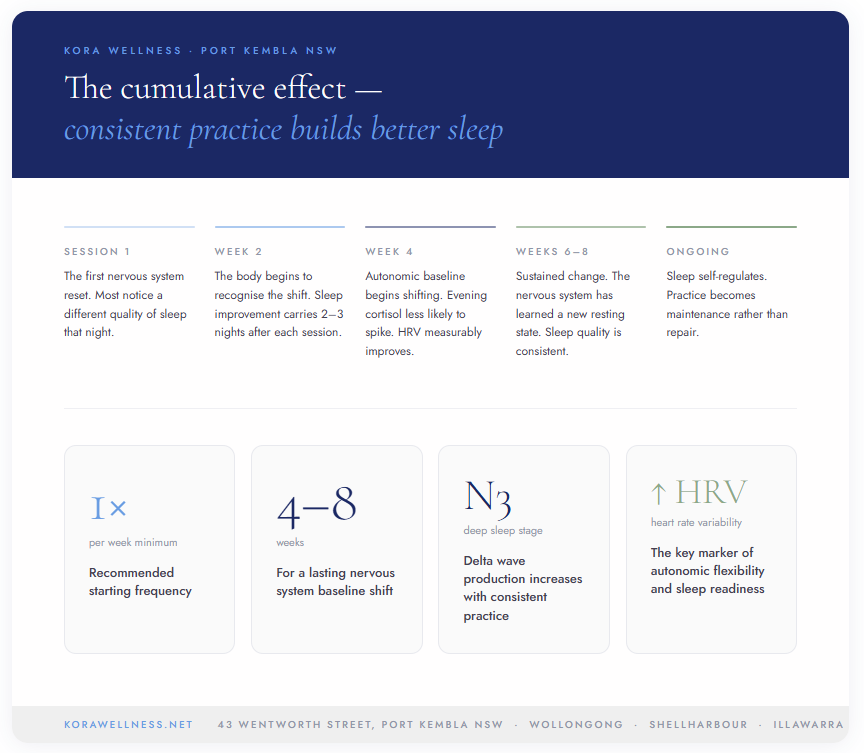
The session is the starting point. The change builds from there
Frequently Asked Questions
What is downregulating 9D breathwork for sleep? Downregulating 9D breathwork for sleep is a guided, immersive breathing practice that uses extended exhales, slowed breath pacing, and multi-layered audio (including delta-range binaural beats) to activate the parasympathetic nervous system, reduce cortisol and prime the brain for deep, restorative sleep. Unlike techniques you practise alone, the fully guided structure means your nervous system can surrender into the process rather than monitoring itself.
How does 9D breathwork improve sleep quality? 9D breathwork improves sleep through two primary mechanisms. First, the extended exhale breathing pattern activates the vagus nerve and shifts the autonomic nervous system toward parasympathetic dominance - lowering cortisol and heart rate to create the hormonal conditions your body needs for deep sleep. Second, the delta-frequency binaural beats in the audio layer use neural entrainment to encourage your brain to produce delta wave activity, the brainwave state associated with slow-wave (deep) sleep.
How long does the sleep benefit last after a session? Most people notice improved sleep quality most strongly on the night of the session and the two to three nights that follow. With regular practice - ideally multiple sessions a week for those with disrupted sleep - the nervous system baseline shifts and the improvements become more consistent and self-sustaining rather than session-dependent.
What's the difference between a downregulating and activating 9D session for sleep? For sleep, a downregulating session is the right choice. Activating sessions are designed to build energy, access deeper emotional layers and create a sympathetic response - useful for emotional release and clearing, but not ideal if rest is your primary goal. If you're unsure which you need, our session guide walks through the difference in detail.
Can 9D breathwork help with insomnia? 9D breathwork addresses many of the underlying nervous system and hormonal factors that contribute to insomnia - particularly chronic stress-driven insomnia where cortisol remains elevated in the evening. Research on structured breathwork practices has shown improvements in sleep onset latency, slow-wave sleep duration and overall sleep quality. It is not a medical treatment for insomnia disorders and if you have a diagnosed condition we recommend speaking with your GP about incorporating breathwork alongside your existing care.
How often should I do 9D breathwork for sleep? Once a week will produce results, but it's the floor not the goal. The research on breathwork and sleep consistently shows that frequency drives outcomes. For people whose sleep is genuinely disrupted, multiple downregulating sessions a week is where the real shift happens. If you're also working on deeper change or transformation alongside sleep, a rhythm of several downregulating sessions plus an activating journey each week is what we'd typically work toward. Our membership options are built around that kind of consistent practice.
Is 9D breathwork for sleep available in Wollongong? Yes. Kora Wellness is located at 43 Wentworth Street, Port Kembla NSW - a dedicated 9D breathwork studio serving Wollongong, Shellharbour, Thirroul, Warilla and the broader Illawarra region. Group sessions run Monday, Wednesday and Friday evenings and Saturday mornings. Online sessions are also available every Tuesday and Thursday morning.
About the Author
Kora Wellness is the Illawarra's dedicated 9D breathwork studio, founded by Hayley Simpson and located at 43 Wentworth Street, Port Kembla NSW. Hayley is a certified 9D Breathwork facilitator and Master NLP Practitioner with a trauma-informed approach. Kora Wellness offers weekly group sessions, private 1:1 journeys, and online breathwork for clients across Wollongong, Shellharbour, Thirroul, Warilla and the broader Illawarra.
