
Activating vs Downregulating 9D Breathwork: Why your Nervous System needs both.
Published by Kora Wellness | Port Kembla, NSW | Serving Wollongong, Shellharbour, Thirroul, Warilla and the Illawarra
There's a question we get asked regularly at Kora Wellness - usually from someone who's been coming for a few weeks and feels like something has shifted, but can't quite name what or why.
"Should I always do the same type of session? Or does it matter which one I choose?"
It matters more than most people realise. And understanding the difference - not just intellectually, but in your body - is what transforms 9D breathwork from a single powerful experience into a genuine nervous system healing practice.
This post is the deep explanation we give our clients before their third or fourth session. By the end, you'll understand what each session type actually does physiologically, what the Window of Tolerance has to do with all of it and why the alternating rhythm between activating and downregulating sessions is the thing that produces lasting change - not just temporary relief.
First: What makes 9D Breathwork different from other Breathwork?
Before we get into the two session types, it's worth briefly explaining what makes 9D different - because the session type distinction means something specific here that it doesn't in other modalities.
In traditional breathwork, you typically choose a technique (box breathing, 4-7-8, holotropic, Wim Hof) and apply it yourself. The technique determines the outcome. In 9D breathwork, the audio track itself is doing much of the physiological work - nine layered elements including binaural beats, solfeggio frequencies, hypnotic guidance, NLP and somatic breathwork cues are all timed and sequenced to produce a specific nervous system response.
This matters because it means the session type in 9D is already engineered for a specific outcome. An activating track is built to activate. A downregulating track is built to restore. Your job is to breathe and trust the process and the tracks handle the rest.
“The distinction that matters: In 9D breathwork, choosing a session type isn’t just choosing an intensity. It’s choosing a direction: toward release and expansion, or toward restoration and integration. Both are healing. They just work on different parts of the nervous system and they work better together than either does alone.”
Activating 9D Breathwork: Opening, releasing, moving
An activating session is the one most people picture when they think about breathwork. It's the session where things happen - where emotion surfaces, where the body starts to tingle and shake, where something you've been carrying finally has room to move.
Physiologically, activating breathwork uses a faster, more connected breath pattern - often circular breathing without a pause between inhale and exhale. This temporarily shifts your blood chemistry: CO2 levels drop, oxygen delivery changes and your system enters a heightened state. Used in a controlled, guided environment, this is exactly what creates the physiological conditions for deep emotional release and energetic clearing.
The audio layering in an activating 9D session amplifies this. Binaural beats are tuned to guide your brain toward theta waves - the same state present in REM sleep, deep meditation and hypnagogic states - which is precisely when the subconscious becomes accessible. This is the window where old patterns, stored emotions and limiting beliefs can be genuinely updated, not just observed.
What an activating session is designed to do:
Faster, connected conscious breathing:
Binaural beats tuned for theta/alpha states (subconscious access)
Emotional release and catharsis
Energy clearing and subconscious reprogramming
Stored trauma and grief begins to move
Often more intense, more cathartic
Expands upper edge of Window of Tolerance.
After an activating session, people often describe feeling a weight lifted - lighter in the chest, clearer in the mind, sometimes tearful in a way that feels like relief rather than sadness. Physically, the shoulders have dropped. The jaw has unclenched. There's a quality of space that wasn't there before.
Some people feel a little raw for a day or two after a deeply activating session. This is normal and part of the process, your system has moved something significant and needs time to integrate it.
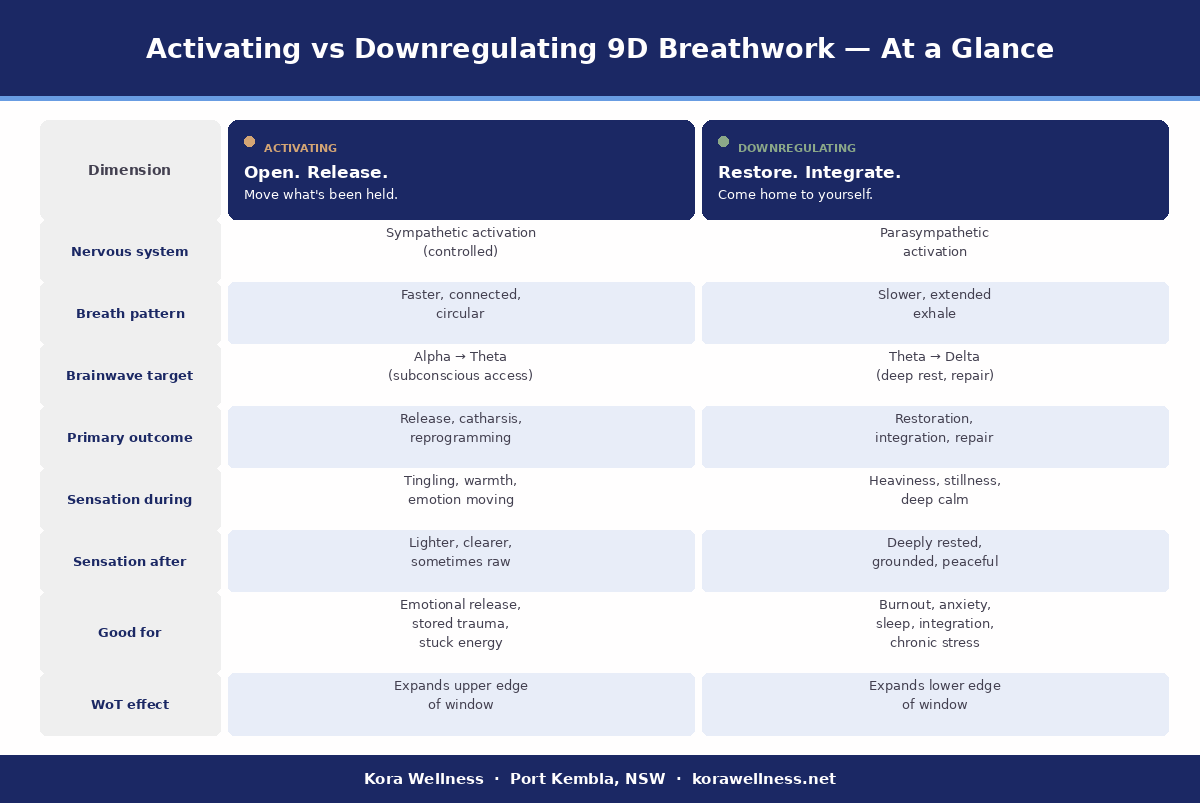
Side-by-side cards comparing what activating and downregulating 9D breathwork sessions do - including breath pattern, brainwave target, primary outcome and Window of Tolerance effect at Kora Wellness in Port Kembla.
Downregulating 9D Breathwork: Restoring, integrating, repairing
A downregulating session is quieter, slower and (for a lot of people) harder to choose. We live in a culture that equates progress with intensity, so a session that asks you to simply rest and receive can feel less "productive." This couldn't be further from the truth.
Downregulating breathwork works by deliberately shifting your nervous system into parasympathetic dominance - what the body calls "rest and digest," as opposed to "fight or flight." Slower breath rates with extended exhales, directly stimulate the vagus nerve. Your heart rate slows, cortisol drops and muscles soften in a way they often can't during ordinary rest, because ordinary rest still happens in a stressed nervous system.
The 9D audio in a downregulating session is tuned to delta waves; the frequencies present in the deepest stages of sleep. This creates conditions where your body can do the repair work it rarely has permission to do: reducing inflammation, consolidating emotional memory, rewiring neural pathways laid down during stress.
“What our clients say: “It was the kind of rest I hadn’t felt in years. Not sleep exactly, something deeper. I cried for a few minutes somewhere in the middle and then felt completely still. I drove home and just sat in the car for a bit before going inside.””
Why downregulating sessions are often undervalued
There's a bias in wellness culture toward intensity, toward the session that "worked" because you cried or felt something big happen. But healing is not only release. Healing is also what happens in the restoration that follows release. Without integration, emotional release is just re-traumatisation. Without restoration, the nervous system stays in a state of heightened alert - slightly more open perhaps, but still fundamentally exhausted.
This is the piece that most breathwork content misses. And it's exactly why the rhythm between session types matters more than choosing the "right" one.
The Window of Tolerance: The framework that explains everything
If you've worked with a trauma therapist, somatic practitioner or psychologist, you may have heard the term "Window of Tolerance." It was coined by neuropsychiatrist Dan Siegel to describe the optimal zone of nervous system arousal in which we can function effectively - processing emotions, learning, forming connections, feeling present.
Inside the window: you feel okay. Regulated. Able to think clearly, feel without being overwhelmed, respond rather than react.
Outside the window: either above it (hyperarousal: anxiety, panic, dissociation, rage) or below it (hypoarousal: numbness, shutdown, collapse, depression) - your system can't fully process or integrate experience. This is where survival responses live.
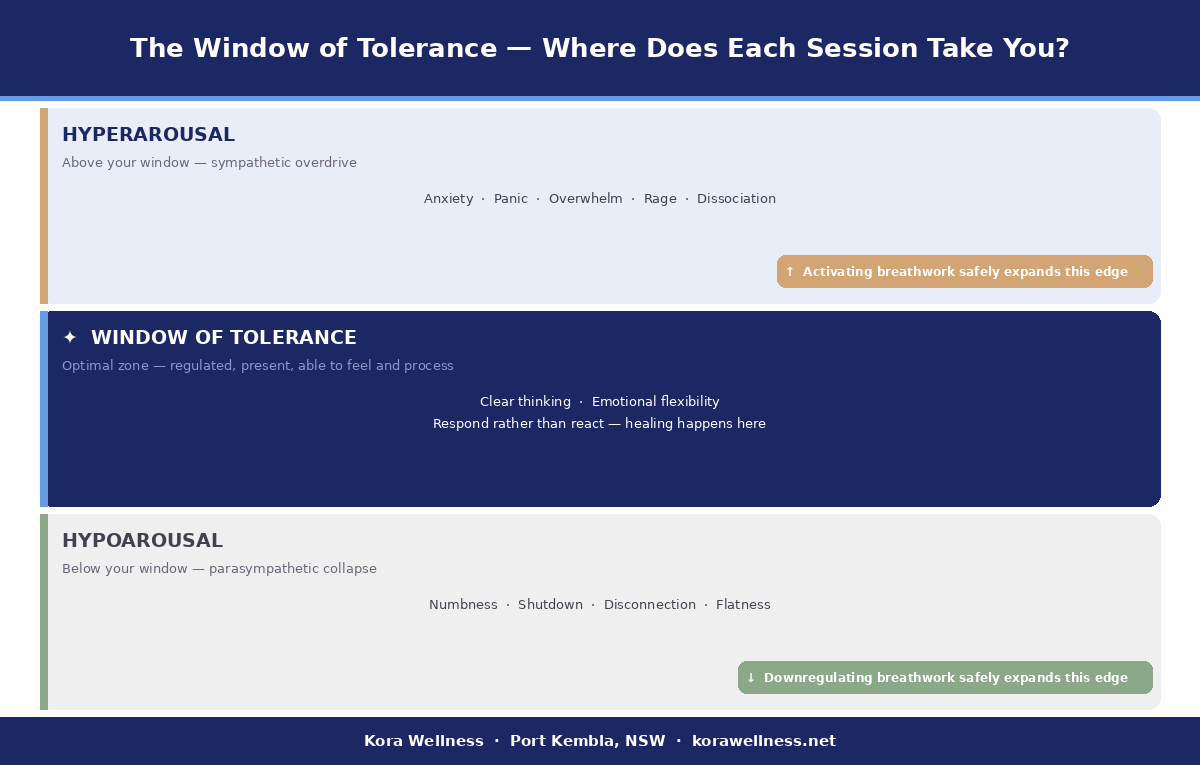
Window of Tolerance diagram showing hyperarousal at the top, the regulated zone in the middle and hypoarousal at the bottom — with notes showing activating breathwork expands the upper edge and downregulating breathwork expands the lower edge.
Here is why this framework matters for 9D breathwork:
Activating sessions work at the upper edge of your window. By deliberately and safely entering a heightened state - with full guidance and support - you learn that you can go there and come back. Stored emotions that have been locked at the boundary of your window get enough space to move. Each time, your window expands slightly upward. You become capable of feeling more without being overwhelmed.
Downregulating sessions work at the lower edge of your window. By deliberately entering deep rest with full body safety, you begin to recognise stillness as safe and not as shutdown. For many people with anxiety or chronic stress, stillness has been equated with danger. Downregulating breathwork teaches your nervous system that deep quiet is different from dissociation. Each time, your window expands slightly downward. You become capable of resting more deeply without disconnecting.
Over time with consistent, alternating practice your Window of Tolerance genuinely widens. This is the neurological mechanism behind what people describe as "feeling different" after a few months of regular breathwork. They're not imagining it. Their nervous system has genuinely changed its baseline.
If stored trauma or emotional dysregulation is part of the picture, our post on whether breathwork can release trauma goes deeper into what that process looks like.
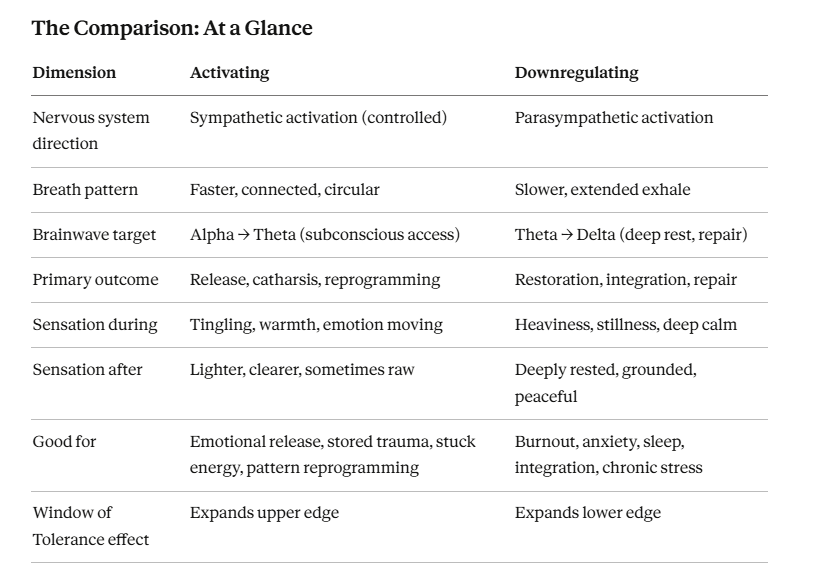
Both session types are therapeutic. The difference is the direction — and why your nervous system needs both.
Why the rhythm between them is the real practice
This is the thing that gets missed in almost all the content written about breathwork modalities. The question isn't activating or downregulating? It's how do I build a practice that uses both in a way my nervous system can actually absorb?
Here's an analogy that might help.
Think of strength training. You go to the gym (stimulus). Your muscles are broken down. Then you rest (recovery). The muscle builds during the rest, not during the workout. If you only went to the gym and never rested, you would not get stronger. You would get injured. If you only rested and never went to the gym, you would not get stronger either. The growth happens in the dialogue between the two.
The same is true of nervous system healing. Activating breathwork provides the stimulus; the safe emotional activation that signals to your system - we can go here and come back. Downregulating breathwork provides the recovery; the deep rest in which your system actually integrates what moved, restores its baselin, and consolidates the new neural pathway.
One without the other produces partial results. Both together, in a thoughtful rhythm, produce genuine change.
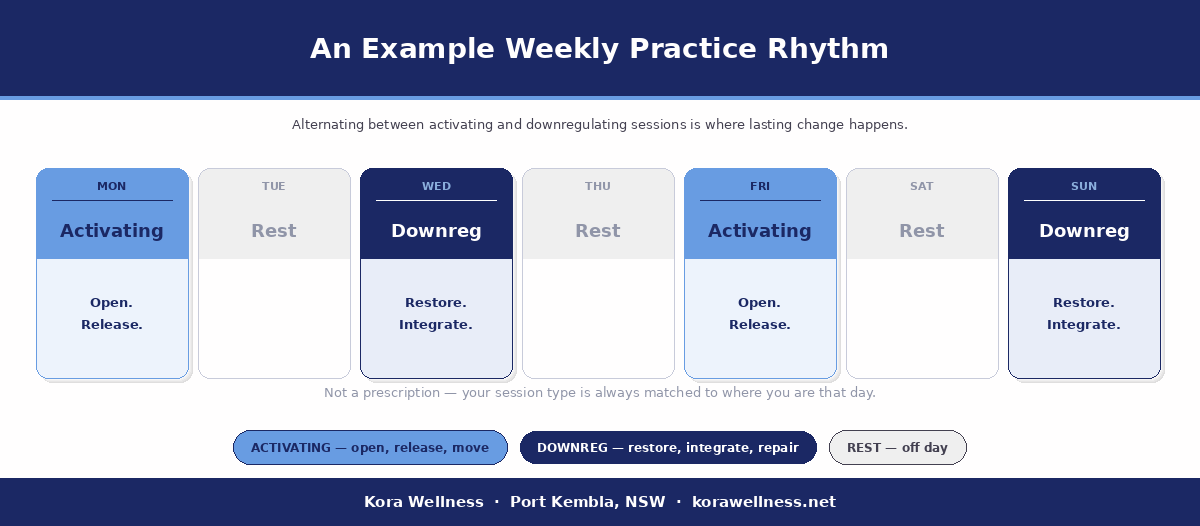
This is one example rhythm, not a prescription. Some weeks call for more restoration. Some call for deeper release. Your body knows.
How to know which session you need right now
We always check in with clients before every session at Kora Wellness, not as a formality but because the right session type genuinely depends on where you are that day. Here's a rough guide:
You might need an activating session if:
You've been feeling flat, disconnected or numb.
You have a sense of things being "stuck" emotionally, energetically or creatively.
You've been functioning but not feeling.
There's anger, grief or old emotion you can sense beneath the surface but haven't been able to access.
You feel the need to move something.
You might need a downregulating session if:
You've been running on adrenaline.
Sleep has been disrupted.
You're in a period of high external stress - work, relationships, transitions.
You've recently had an emotionally significant experience (including a previous activating session) and need time to integrate.
Your body feels tight, wired or depleted.
You need to be reminded what genuine rest feels like.
For those coming to breathwork specifically for anxiety, we've written a detailed guide on how 9D breathwork supports an anxious nervous system. Downregulating sessions are also one of the most effective tools for sleep - read more in our guide to 9D Breathwork for Sleep.
When you're not sure:
When in doubt, downregulating is almost always the right starting point - particularly for first-timers or those with a history of anxiety or trauma. You can always activate from a place of restored baseline. It's much harder to integrate release from a place of depletion.
“A note on trauma-sensitive practice:
If you carry significant trauma history - particularly if you experience frequent hyperarousal, dissociation or freeze responses - we recommend starting with exclusively downregulating sessions until your nervous system has a felt sense of safety within the practice. Activating breathwork can be profoundly healing for trauma but only when the body already trusts that it can return to regulation.”
What this means for a regular 9D Breathwork practice
The reason Kora's membership structure includes access to both session types across the week isn't accidental, it's the whole point. A single activating session can shift something. A single downregulating session can provide relief. But the consistent, alternating practice is what actually rewires your nervous system over time.
Most of our members who stay for 6–12 weeks notice the same shift: they don't just feel better after sessions. They feel different between them. The window has widened. Situations that used to trigger overwhelm don't reach the same pitch. The quiet between thoughts is longer. Sleep is deeper. There's more capacity for whatever life brings and not because circumstances have changed, but because the nervous system is genuinely more resilient.
That's not a marketing claim. That's the physiology of what happens when a nervous system has consistent, safe experiences of both activation and restoration and gradually learns that it can go to those edges and return, every time.
Frequently Asked Questions
What is the difference between activating and downregulating 9D breathwork? Activating 9D breathwork uses conscious connected breathing to build energy, release stored emotion and stimulate the sympathetic nervous system. It’s designed for emotional catharsis, energy clearing and subconscious reprogramming. Downregulating 9D breathwork uses slower, gentler breath patterns to activate the parasympathetic nervous system and it’s designed for deep rest, nervous system restoration, stress reduction and sleep support. Both are therapeutic and both are needed for lasting nervous system healing.
Which type of 9D breathwork should I do first? For most beginners, a downregulating session is a gentle and grounding introduction is best - especially if you carry anxiety, trauma history or a highly activated nervous system. Once your system feels more regulated, alternating between activating and downregulating sessions creates the rhythm that produces lasting change.
Can I do both activating and downregulating breathwork in the same week? Yes, and for many people this alternating rhythm is exactly what produces the deepest results. Activating sessions open and release. Downregulating sessions integrate and restore. Doing both within the same week gives your nervous system the full cycle it needs to process, heal and build resilience. Kora Wellness members have access to both session types as part of their regular practice.
Is activating breathwork safe if I have anxiety or trauma? Activating breathwork can be safe and deeply beneficial for people with anxiety or trauma history, but it's important to start with a facilitator who is trauma-informed and can read your nervous system's cues. At Kora Wellness, if you have significant trauma history, we often recommend starting with downregulating sessions to build a felt sense of safety first before moving into more activating work. We always discuss your history and needs before any private session.
What does the Window of Tolerance have to do with 9D breathwork? The Window of Tolerance, a concept from trauma therapy developed by Dan Siegel, describes the optimal zone of nervous system arousal in which we can process emotions, learn and heal. Activating breathwork temporarily expands the upper edge of your window helping you safely access and release stored stress and emotion. Downregulating breathwork restores your baseline and expands the lower edge. Over time, alternating between the two genuinely widens your window, meaning you can handle more without being overwhelmed.
How many 9D breathwork sessions do I need to see results? Many people notice significant shifts after a single session. However, lasting nervous system change happens through consistent practice, particularly through alternating activating and downregulating sessions over weeks and months. At Kora Wellness, our 12-week membership is designed around this rhythm, giving your nervous system time to genuinely rewire rather than just providing temporary relief.
Where can I do 9D breathwork near Wollongong? Kora Wellness is the Illawarra's only dedicated 9D breathwork studio, located at 43 Wentworth Street, Port Kembla NSW. We offer weekly group sessions and private 1:1 journeys, including both activating and downregulating session types. We serve clients from across the Illawarra region including Wollongong, Shellharbour, Thirroul and Warilla.
About the Author
Kora Wellness is the Illawarra's dedicated 9D breathwork studio, founded by Hayley Simpson and located at 43 Wentworth Street, Port Kembla NSW. Hayley is a certified 9D Breathwork facilitator and Master NLP Practitioner with a trauma-informed approach. Kora Wellness offers weekly group sessions, private 1:1 journeys, and online breathwork for clients across Wollongong, Shellharbour, Thirroul, Warilla and the broader Illawarra.
Ready to experience both for yourself?
Our sessions at Kora Wellness, Port Kembla are designed around exactly this rhythm and your facilitator will always match the session type to where you are that day for any private sessions.
Or explore our 3-Week Intro Offer — the perfect way to experience both session types.
