What happens in a 9D Breathwork session? A complete walkthrough
Published by Kora Wellness | Port Kembla, NSW | Serving Wollongong, Shellharbour, Thirroul, Warilla and the Illawarra
Here's what happens in a 9D Breathwork session: you lie down, you put on a pair of noise-cancelling headphones, and for the next 60 to 90 minutes, your breath and a multi-layered soundscape guide you through one of the most surprisingly moving experiences most people have ever had. Some people cry. Some shake. Some feel waves of tingling moving from their hands to their chest. Some feel nothing at all on the first session, just a deep, unfamiliar quiet. All of it is valid. All of it is the process working.
If you're curious about trying 9D Breathwork but not quite sure what you're walking into, this is the honest, step-by-step walkthrough you're looking for.
First - What is 9D Breathwork, exactly?
Before walking through the session itself, it helps to understand what you're actually doing when you breathe this way.
9D Breathwork is a guided breathwork method created by Brian Kelly, who developed it after his own profound experience with somatic breathwork following burnout and nervous system overload. The "9D" refers to nine layers of audio and therapeutic technology woven into every session:
Multidimensional soundscapes
Binaural brain entrainment (different tones in each ear that guide brainwave states)
Solfeggio healing frequencies
Isochronic brainwave tones
Bioacoustic sound effects
Somatic conscious connected breathing
Subliminal hypnotic messaging
Guided vocal coaching
Low-frequency audio stimulus
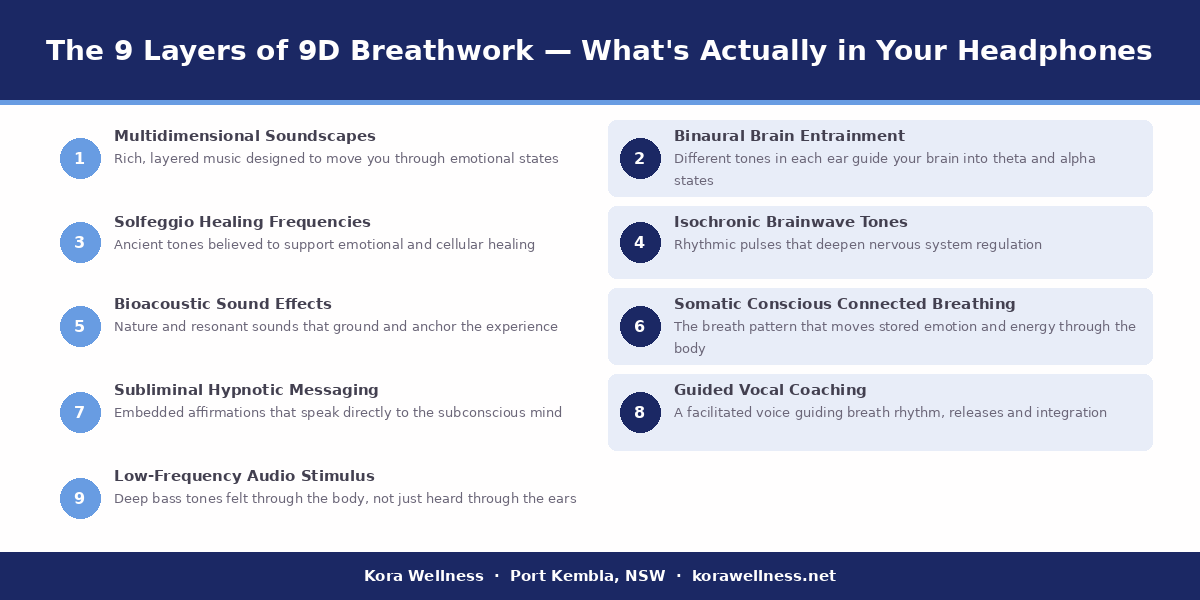
Nine elements working simultaneously - so your only job is to breathe.
What makes this different from regular breathwork or meditation is the way these layers work together. The breath does the somatic work; moving energy, releasing stored tension, and activating the nervous system. The sound does the subconscious work; shifting brainwave states, embedding affirmations and guiding emotional release - all without you needing to think about any of it. You just breathe.
If you want to go deeper into the method itself, our What is 9D Breathwork page covers the science and structure in detail.
What to expect: The full session walkthrough
Arriving at the Studio
When you arrive at Kora Wellness at 43 Wentworth Street, Port Kembla, the first thing you'll notice is that it doesn't feel clinical. The room is intentionally soft; warm lighting, cosy mats, blankets. The kind of space where your shoulders drop the moment you walk in, because your nervous system reads "safe" before your brain has time to catch up.
If it's your first session, you'll fill in a short intake form. We'll check in about how you're feeling, answer any questions you have and make sure you know where everything is before you settle in. You choose your own spot - your mat, your cocoon for the journey - and you're free to lie down and start arriving in your body from the moment you're ready.
If you're trying to decide between session types before you arrive, our guide to activating vs downregulating 9D breathwork will help you understand which one your nervous system needs right now.
The group check-in and intention setting
Once everyone has settled, we gather briefly as a group. Hayley — a Master NLP Practitioner and certified 9D Breathwork Facilitator — or Jade — an Energy Worker, Psychic Medium and Certified Breathwork Facilitator — will introduce the session, share the theme of the night and walk you through what this particular journey is designed to do.
Each 9D session has a different intention. Some are deeply activating, designed for emotional release, energy clearing and subconscious reprogramming. Others are downregulating, designed to restore the nervous system, promote deep calm and support sleep and integration. You'll know which type of session you're in before the music starts.
This is also a quiet moment to set your own intention. You don't have to share it. Something as simple as "I'm open" is enough.
Wondering how this applies to your specific situation? We've written in depth about the three most common reasons people come to Kora: 9D Breathwork for Anxiety · 9D Breathwork for Sleep · Can Breathwork Release Trauma?
Learning the breath pattern
Before anyone puts on headphones, we walk you through the exact breathing technique you'll be using in that night's journey. You'll learn:
The breathing rhythm (usually a conscious connected breath; a full inhale followed immediately by a relaxed exhale, no pause, in a continuous loop)
How your body might respond as the session builds
How to adjust your intensity if something feels too strong
Where breath holds or sound releases appear in the journey, if that session includes them
How to signal to us if you need support
Then we do a short practice round together - maybe two to three minutes - so you can feel the pattern in your body before the immersive audio begins. This matters. It's the difference between being surprised and being prepared.
Getting comfortable
You settle back into your mat. You're offered:
Noise-cancelling headphones with individually adjustable volume
An eye mask if you want it (highly recommended, removing visual input helps the sound work more deeply)
A blanket for warmth, many people cool down during the journey as their body shifts states.
Before we begin, we clarify touch consent. If you'd like light, grounding touch during the session, a hand on the shoulder, gentle pressure on the feet, you can indicate that. If you'd rather not be touched, that's equally respected. You stay in full agency throughout.
Once the music starts — what actually happens
This is the part people most want to know, and it varies depending on the type of session. Here's how a typical activating journey unfolds:
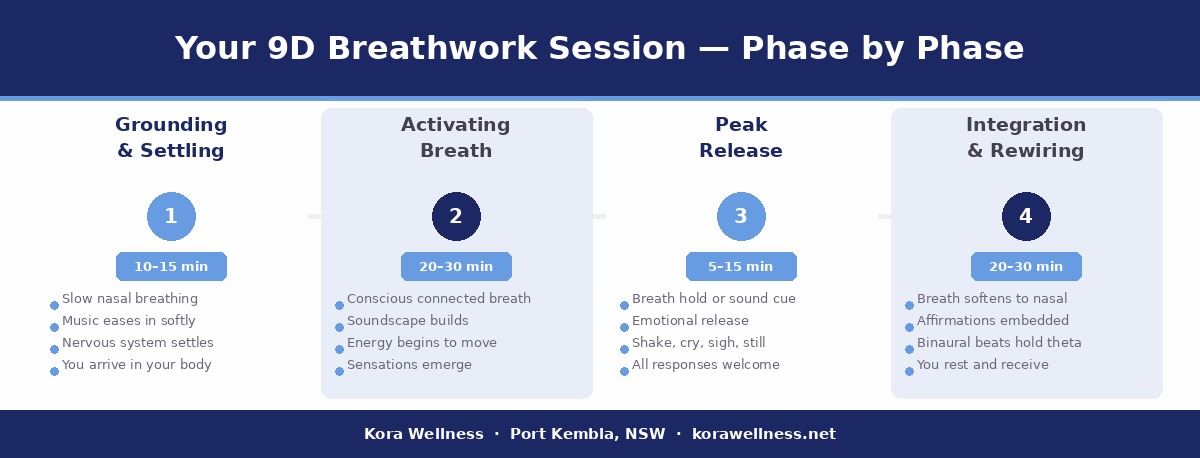
From the first breath to the last note — here's what's happening at each stage of your journey.
Phase 1: Grounding and settling (10–15 minutes)
The journey opens softly. You begin with slow nasal breathing, guided by the audio. The music is gentle at this stage, designed to settle your nervous system and help you feel present and safe before anything builds. Some people feel themselves soften almost immediately. Others spend this phase with a busy mind. Both are completely normal. You don't need to force anything. The process will come to you.
Phase 2: The Activating breath (20–30 minutes)
Once you're grounded, the audio guides you into the conscious connected breath pattern you practised. The music layers build - frequencies shifting, the soundscape expanding through the headphones - and your breath starts doing what it came to do.
This is where the body begins to speak. The conscious connected breath pattern increases oxygen flow and activates the sympathetic nervous system deliberately and safely, creating the physiological conditions for stored emotion and tension to surface and move. You might feel:
Tingling or warmth spreading from your hands up your arms and across your face
A tightening or buzzing in the chest that softens as you breathe through it
Waves of emotion - grief, relief, love, anger - that feel like they're coming from somewhere beneath thought
Physical sensations like trembling, yawning, temperature shifts, or the urge to move
None of this is dangerous. These are signs your nervous system is doing exactly what it came to do. Hayley or Jade are in the room the entire time, watching your body, available to support you.
Phase 3: Peak release (5–15 minutes)
Somewhere near the middle or end of the activating phase, the journey reaches its peak. Depending on the session, this may include:
A breath hold - a pause at the top of the inhale, often accompanied by a surge of energy or emotion
An invitation to release sound - a sigh, a cry, a yell, a vocal release. This isn't theatre, it's physiology. Sound releases trapped energy from the body in a way that silence can't always reach.
A moment of profound stillness or clarity that arrives unexpectedly.
You choose how much you engage. Silence is always welcome. There is no performance here, only your own process.
Phase 4: Integration and subconscious rewiring (20–30 minutes)
After the peak, the journey softens. The activating breath gives way to slow nasal breathing. The music shifts; slower, deeper, more spacious. This is where the real magic of 9D happens.
While your nervous system settles into its parasympathetic state (rest-and-digest, repair, restore), the audio delivers:
Guided meditation
Embedded affirmations and subconscious belief work
Binaural beats holding your brain in theta and alpha states - the same brainwave states associated with deep sleep, hypnotherapy, and receptive learning
Solfeggio frequencies tuned to support emotional healing and cellular regulation.
You don't need to engage with any of this consciously. Your job at this stage is simply to rest and receive. The subconscious is most receptive when the analytical mind is quiet and by this point in the journey, it usually is.
Coming back
The music fades slowly. The breath returns to natural rhythm. You land gently.
We always take our time here. Nobody is rushed back to the room. You stay on your mat as long as you need. Some people lie still for ten minutes, eyes closed, processing. Some open their eyes and smile. Some cry quietly. All of it is right.
After the session: grounding, tea, and integration
When the group is ready, we come back together. Warm herbal tea is offered, something to ground you back in your body. There's space to share your experience if you'd like, or to simply sit in companionable quiet.
Sharing is always optional. Some of the most profound sessions are the ones people can't yet put into words.
Before you leave, we offer simple aftercare guidance for the next 24–48 hours:
Drink plenty of water - breathwork is mildly dehydrating
Eat something grounding within 30 minutes (fruit, oats, a light meal)
Keep your evening gentle - low screens, early rest if your body asks for it
Notice what surfaces over the next few days - insights, dreams, emotional shifts - these are often part of the integration process
Reach out if you need support. We're always available.
What does 9D Breathwork feel like? (The honest answer)
Everyone's experience is different and the same person can have completely different sessions across different journeys. That said, here are some of the most common experiences people describe:
During the session: tingling (especially hands, lips, face), waves of emotion, warmth or cold, heaviness or floating, chest pressure that opens and releases, visual imagery with eyes closed, a feeling of leaving the thinking mind behind.
Immediately after: lightness, rawness, spaciousness, tearfulness, joy, deep calm, the sensation of having put something down that you'd been carrying for a long time.
In the days following: better sleep, emotional clarity, reduced anxiety, a quieter inner critic, unexpected insights about relationships or patterns, more capacity to feel both difficult and joyful emotions.
Not every session produces dramatic release. Some sessions feel subtle in the room but ripple outward over days. Your nervous system processes at its own pace, and that pace is always right.
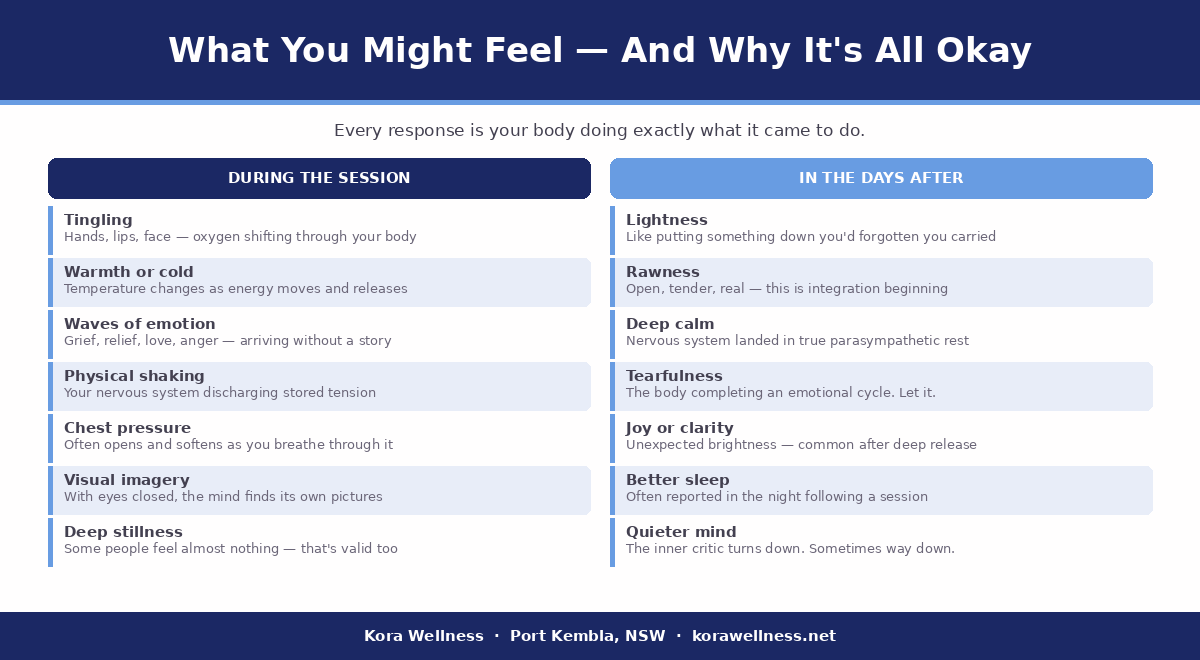
Everything your body might offer — during the session and in the quiet days that follow. All of it is information. All of it is the process.
9D Breathwork vs Regular Breathwork vs Meditation: What's different?
This is one of the most common questions people bring. Here's the honest comparison:
Regular breathwork (pranayama, box breathing, diaphragmatic breathing) uses a single technique to regulate the nervous system. It's valuable and accessible, but works primarily on the conscious, voluntary nervous system. It's great maintenance. It rarely reaches the stored, somatic layers.
Meditation works with awareness and observation. It builds a different capacity - the ability to witness thoughts and emotions without being swept away. Transformative in its own right, but it doesn't move stored energy from the body in the same way. You can meditate for years and still have the same grief sitting in your chest.
9D Breathwork bypasses the analytical mind through the combination of breath, frequency and sound. It works directly with the autonomic nervous system and the somatic body - the parts that store trauma, pattern and emotional memory below the level of thought. That's why people often shift things in a single session that years of talking about it couldn't touch.
They're not in competition. Many people find that 9D breathwork opens them up in ways that make meditation easier and that regular breathing techniques help them maintain between sessions. We offer guidance on building a daily practice as part of your integration support.
Is 9D Breathwork safe?
For most people, yes - 9D Breathwork is a safe and well-supported practice when held by a trained facilitator. The sensations that arise (tingling, emotional waves, physical releases) are normal physiological responses to conscious connected breathing, not signs that something is wrong.
That said, there are some situations where we'd encourage caution or a modified approach:
Pregnancy - activating breathwork is not recommended
Cardiovascular conditions - please consult your doctor first
Epilepsy or history of seizures - check with your healthcare provider
Severe mental health conditions or recent trauma with active destabilisation - speak to us first and we can discuss whether a downregulating session would be more appropriate as a starting point
Recent surgery - wait until you're medically cleared
Chronic respiratory conditions like asthma - inform your facilitator; adjustments can be made
If you're uncertain, reach out before booking. We'd rather have an honest conversation upfront than have you arrive unsure. Our contact page is always open.
Who holds the space at Kora Wellness?
Hayley is a Master NLP Practitioner and certified 9D Breathwork Facilitator with deep training in nervous system regulation and trauma-informed practice. Jade brings her own grounded, warm presence to every session along with her energy healing work and psychic mediumship. Together they create a container that is both professionally held and genuinely human - the kind of space where you can go somewhere real.
Sessions are kept intentionally small. You will be seen. You will not feel like a number.
Frequently Asked Questions
How long is a 9D Breathwork session? A full guided session at Kora Wellness runs 60 to 120 minutes, including the introduction, the breath journey itself and integration time at the end. We don't rush the landing.
What should I wear to a 9D Breathwork session? Comfortable, loose clothing - whatever you'd wear to lie down and rest in for an hour. Layers are helpful as body temperature can shift during the journey.
What should I eat before a breathwork session? Eat lightly in the 2–3 hours before your session. A full stomach can make deep breathing uncomfortable. Stay hydrated, but avoid large amounts of liquid right before.
Can I do 9D Breathwork if I've never done breathwork before? Absolutely. Most people who come to Kora Wellness are beginners. Every session includes a full explanation of the breath technique before the audio begins and you are supported throughout.
What is the difference between activating and downregulating 9D breathwork? Activating sessions use conscious connected breathing to build energy and move stored emotion - more intense, more cathartic, deeper release. Downregulating sessions use slower, gentler breath patterns to restore the nervous system, reduce stress and support calm and sleep. Both are therapeutic. Your session type is matched to your needs and history.
How many 9D breathwork sessions do I need? There's no prescribed number. Many people experience significant shifts in a single session. Consistent practice — 2 to 4 sessions per week — deepens the work over time, and a membership gives you access to both activating and downregulating journeys as a regular practice. Think of it less as a treatment and more as a nervous system training that compounds.
Is 9D Breathwork the same as holotropic breathwork? No. Holotropic breathwork (developed by Stanislav Grof) uses hyperventilation to induce non-ordinary states and is typically a very long, ungoverned experience. 9D Breathwork is a structured, guided method with specific audio technology, facilitator support and a clear arc from activation to integration. The outcomes may sometimes feel similar but the methodology is distinct.
What happens in your body during 9D Breathwork? The conscious connected breathing pattern alters the balance of oxygen and carbon dioxide in the blood, which directly shifts your nervous system state. This can produce tingling (tetany), emotional release, altered perception and physical sensations as stored tension and emotion move through the body. The binaural beats simultaneously guide your brain toward theta and alpha states - the same states associated with deep meditation, hypnotherapy and subconscious receptivity.
Where to experience 9D Breathwork in the Illawarra?
Kora Wellness is based at 43 Wentworth Street, Port Kembla NSW - our dedicated 9D Breathwork studio serving the wider Illawarra region.
We welcome people from across the region including Wollongong, Shellharbour, Warilla, and Thirroul - Port Kembla is central and easy to reach from all of these areas.
Group sessions run Monday, Wednesday, and Friday evenings and Saturday mornings at the studio. Online sessions are available every Tuesday morning if you'd prefer to join from home. Private 1:1 sessions are available by appointment.
About the Author
Kora Wellness is the Illawarra's dedicated 9D breathwork studio, founded by Hayley Simpson and located at 43 Wentworth Street, Port Kembla NSW. Hayley is a certified 9D Breathwork facilitator and Master NLP Practitioner with a trauma-informed approach. Kora Wellness offers weekly group sessions, private 1:1 journeys, and online breathwork for clients across Wollongong, Shellharbour, Thirroul, Warilla and the broader Illawarra.
Ready to experience It?
The best way to understand what happens in a 9D Breathwork session is to be in one. Everything above is true - but it doesn't quite capture the moment when the music builds and something in you exhales that you've been holding for years.
When you're ready, book your spot here. Arrive as you are. Bring nothing except your willingness to breathe.
