
9D Breathwork for Burnout: Why rest isn't working and what your Nervous System actually needs.
Published by Kora Wellness | Port Kembla, NSW | Serving the Illawarra region including Wollongong, Shellharbour, Thirroul, and Warilla.
There's a particular kind of tired that doesn't have a name for it yet. It's not the tired you feel after a big week, or the tired that a decent sleep fixes. It's the tired where you wake up already behind, where you get through the day on something that looks like functioning but doesn't quite feel like it, where you've started to notice that the things that used to refill you - a weekend away, a good night's sleep, a few days off over Christmas - aren't really doing that anymore. You come back from them and feel okay for maybe three or four days and then you're exactly where you were.
People who end up at Kora Wellness for burnout usually arrive having already tried to fix it. They've pulled back on commitments. They've prioritised sleep. Some have taken weeks off work. And they're still running on empty in a way they can't fully explain, which (on top of everything else) tends to produce a quiet, corrosive sense that something must be wrong with them specifically. That they're not recovering correctly or that other people manage this better.
They're not doing anything wrong. What's happened is physiological and it's worth understanding, because once you see what burnout is actually doing to the body, the gap between "I've been resting" and "I'm not recovering" stops being confusing. It starts to make complete sense.
If you're already curious about what sessions at Kora Wellness look like, the schedule is here. Otherwise, read on.
Burnout isn't tiredness. Here's what it actually is.
Most of what gets written about burnout treats it as an extreme version of being tired with the solution being rest, better boundaries and a gentler relationship with your to-do list. That framing isn't wrong exactly, but it's incomplete in a way that explains why so many people do all the right things and still don't recover.
A 2025 Frontiers scoping review drawing on more than 2,000 studies defines burnout as a chronic stress-related disorder involving measurable dysregulation of the autonomic nervous system and the HPA axis - the system that controls cortisol production. Under normal circumstances, cortisol spikes when you're under stress and then drops back to baseline once the pressure eases. Your body resets. In burnout, that reset stops working. The cortisol system gets stuck; either running chronically high, keeping you wired and on edge, or in later stages becoming so depleted that your body can't mount an adequate stress response at all. That's why burnout can feel like being simultaneously exhausted and anxious. Physiologically, that's often exactly what's happening.
Beyond the hormonal picture, a 2025 MRI systematic review published in PMC found consistent structural brain changes across 17 studies of burned-out individuals: amygdala enlargement (your brain's threat-detection centre becoming more reactive and slower to recover) alongside grey matter loss in the prefrontal cortex, which handles clear thinking, decision-making and the ability to regulate your own emotional responses. The alarm gets louder and the part of the brain that talks it down gets quieter, at the same time.
Burnout affects everyone, but the load isn't evenly distributed. Women report it at 59% compared to 46% of men in 2024–2025 workforce data and a 2025 study in the Journal of Women and Aging found midlife to be the specific peak for women - driven by professional demands, caregiving and the accumulated weight of gendered expectations all converging at once. Men in burnout tend to present differently, often sitting in sympathetic overdrive longer before the collapse phase becomes visible, which means it can go unaddressed for longer. The Illawarra community we work with at Kora Wellness reflects both realities.
The two phases of burnout and why this changes everything
Burnout doesn't stay in one place. It moves through two distinct phases and most recovery advice treats it as a single state, which is a big part of why so much of that advice stalls out in practice.
Phase one is sympathetic dominance. Chronic stress floods the body with cortisol and adrenaline. Your sympathetic nervous system (the one wired for threat response) stays switched on long past the point where it's useful. You feel reactive and on edge. Sleep is disrupted even when you're exhausted. You find yourself scanning for problems in moments of quiet. This is the wired part of what most people recognise as burnout.
Phase two is dorsal vagal collapse. When that sympathetic activation runs long enough without genuine recovery, the body shifts into something older and more primitive. Dr Stephen Porges' Polyvagal Theory describes it as dorsal vagal shutdown; the nervous system's last-resort response when fight-or-flight has run out of road. Energy drops and motivation disappears. A kind of flatness sets in that's hard to describe - not sadness exactly, more like the lights are on but nobody's home. A lot of people call this laziness, or depression, or just not recognising themselves. It's the body protecting itself after being pushed too far for too long.
Many people in burnout are moving between both phases; activated and anxious through the day, collapsing into flatness in the evenings. The classic "tired but can't sleep" experience lives right at the boundary between them.
The reason this distinction matters practically is that these two states don't need the same thing. A nervous system running in sympathetic overdrive needs slowing down - safety signals, softening, genuine downregulation. A nervous system in dorsal vagal collapse needs something closer to the opposite: careful, gentle activation to bring it back online. More rest won't do it. The system has already shut down and it needs coaxing back, not more quiet.
Think of it like a smoke alarm going off in an empty kitchen. The problem isn't that the room is too loud - the alarm needs someone to show it there's no fire. And a phone on 0% doesn't need a rest day, it needs to be plugged in. Burnout can look like either of these - or both at once - and the approach that helps depends entirely on which one you're actually in.
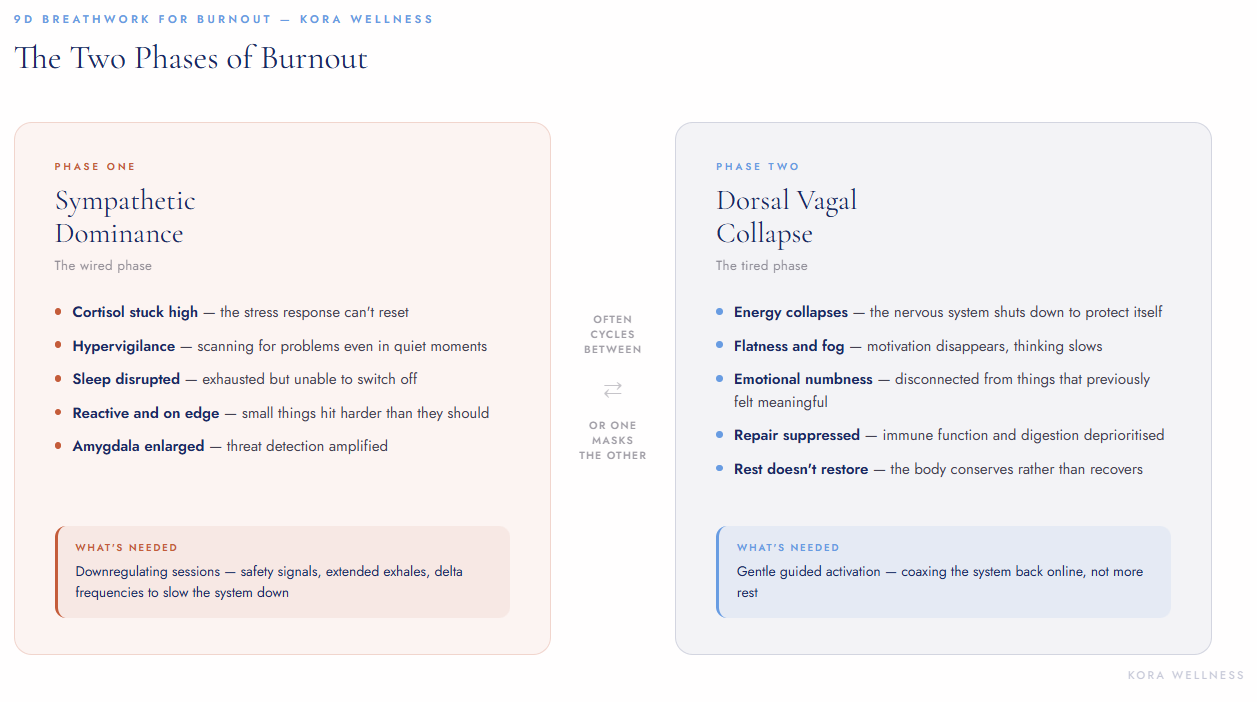
Burnout isn't one state - it's two. Which phase you're in changes everything about what your nervous system actually needs.
Why rest alone can't reach it
When the nervous system enters dorsal vagal shutdown, it suppresses the systems responsible for repair. Immune function drops and digestion slows. The cellular restoration that should happen during sleep and rest gets deprioritised, because the body's energy is going towards protection rather than recovery. It isn't resting - it's conserving, which are different things with different outcomes.
Christina Maslach's research at UC Berkeley describes burnout building through repeated cycles of overextension followed by inadequate recovery, each cycle leaving a slightly larger deficit. A holiday removes the demand. It doesn't repair the system and it doesn't restart the processes that shutdown has suppressed - which is why you can come back from two weeks away and feel okay for about four days before everything reasserts itself.
What the nervous system actually needs to shift out of that state is a direct physiological signal of safety - something the body receives and responds to below the level of conscious thought. Not a decision to relax or a change in perspective. An input the Autonomic Nervous System (ANS) can actually use. That's what body-based practices provide and it's the specific thing that rest - genuinely useful as it is - doesn't deliver. Research published in Scientific Reports backs this up: facilitated breathwork with appropriate screening consistently produces wellbeing improvements and meaningful autonomic recovery in people with chronic stress and burnout.
What downregulating 9D breathwork does to a burned-out nervous system
Downregulating 9D breathwork centres on slow nasal breathing with extended exhales and that specific pattern matters more than it might seem. Research consistently identifies this as the most effective non-pharmacological method for improving vagal tone and heart rate variability (HRV), both of which are measurably depleted in burnout.
HRV - the variation in time between heartbeats - is one of the clearest available indicators of how well the nervous system is functioning. Research published in Scientific Reports links burnout directly to reduced vagal tone and declining HRV: the brake on the stress response weakens, cortisol loses its ability to cycle properly and the body's capacity for genuine recovery shrinks. A 2025 PMC review confirmed that slow nasal diaphragmatic breathing - exactly the pattern used in downregulating 9D sessions - meaningfully improves vagal tone, HRV, parasympathetic activity and cortisol regulation. A Frontiers 2025 paper framed vagal tone as a "reservoir of self-regulatory resources," which is a useful image: burnout drains it and consistent downregulating breathwork is one of the more direct ways to refill it.
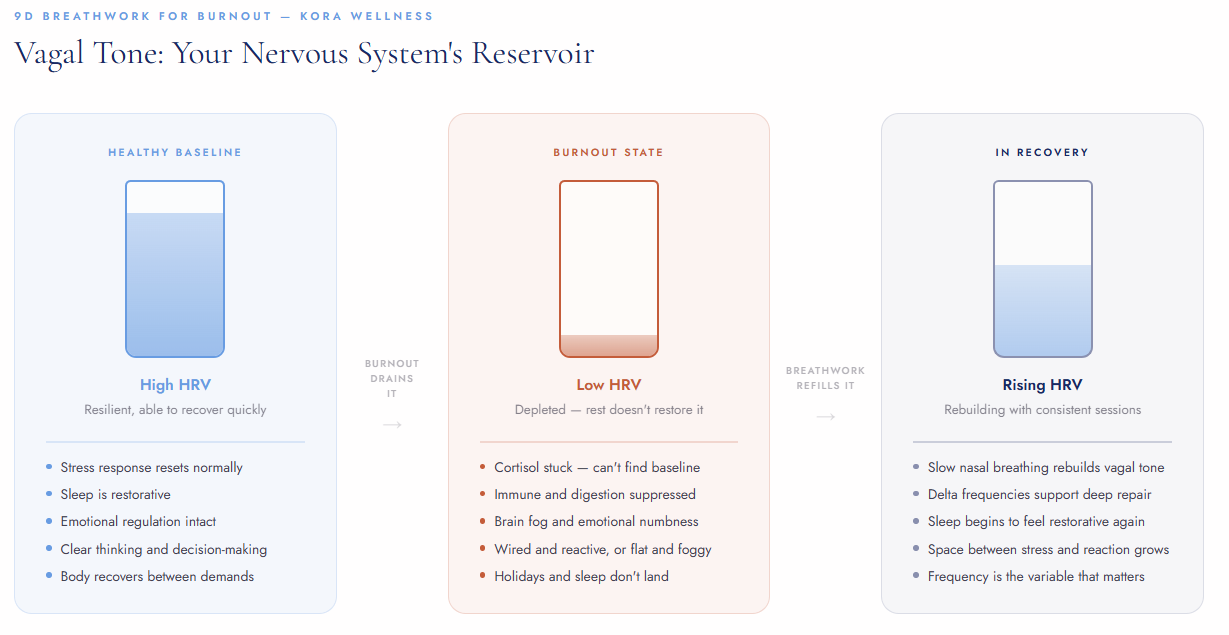
Vagal tone is your nervous system's reserve capacity. Burnout drains it. Rest alone doesn't refill it — but consistent downregulating breathwork does.
The difference between a downregulating 9D session and simply lying down and breathing slowly is the audio environment. Nine layered elements - binaural beats tuned to delta and theta frequencies, the brainwave states associated with deep sleep and deep rest, guided narration, somatic breath cues, spatial sound - work together to bring the nervous system into a state of safety that conscious effort alone rarely achieves. The mind doesn't need to manufacture stillness or talk itself into relaxing. The audio does the physiological work. And once the body receives that signal (the one it's been waiting for) it knows what to do with it.
Shoulders that have been up around ears for months begin to drop, the jaw unclenches, cortisol falls. The body that has been in protection mode gets permission, finally, to repair. For a more detailed look at what's happening across both session types and why the order you do them in matters, our post on activating vs downregulating 9D breathwork covers the mechanism in full.
The sequence that actually produces change
Once you understand the two phases of burnout, the sequencing becomes fairly clear.
For a nervous system in sympathetic dominance - reactive, wired, unable to settle - downregulating sessions are the starting point. Multiple sessions per week, consistently, gives the HPA axis room to begin resetting and starts rebuilding the vagal tone that burnout has depleted. This is where the physiological work of recovery actually happens - not in the decision to slow down, but in the repeated, embodied practice of it.
Once a baseline of genuine regulation starts to establish itself - once the body has had enough experience of safety that it can hold it between sessions - activating work can come in. Activating breathwork moves the stored emotional content that burnout tends to accumulate: grief, frustration, the feelings that got filed away because there wasn't capacity to process them. A nervous system with some regulation behind it can receive and integrate that release. One that hasn't yet built that baseline may find the activation amplifies the dysregulation rather than clearing it, which is why sequencing matters.
For people coming to Kora Wellness in Port Kembla and across the Illawarra dealing with burnout, the practical starting point is usually this: begin with downregulating sessions, go more than once a week and stay there long enough to notice the differences accumulating outside the studio before introducing activating work. One session per week is where casual benefit starts but it's not where burnout recovery happens. The real shift comes from frequency.
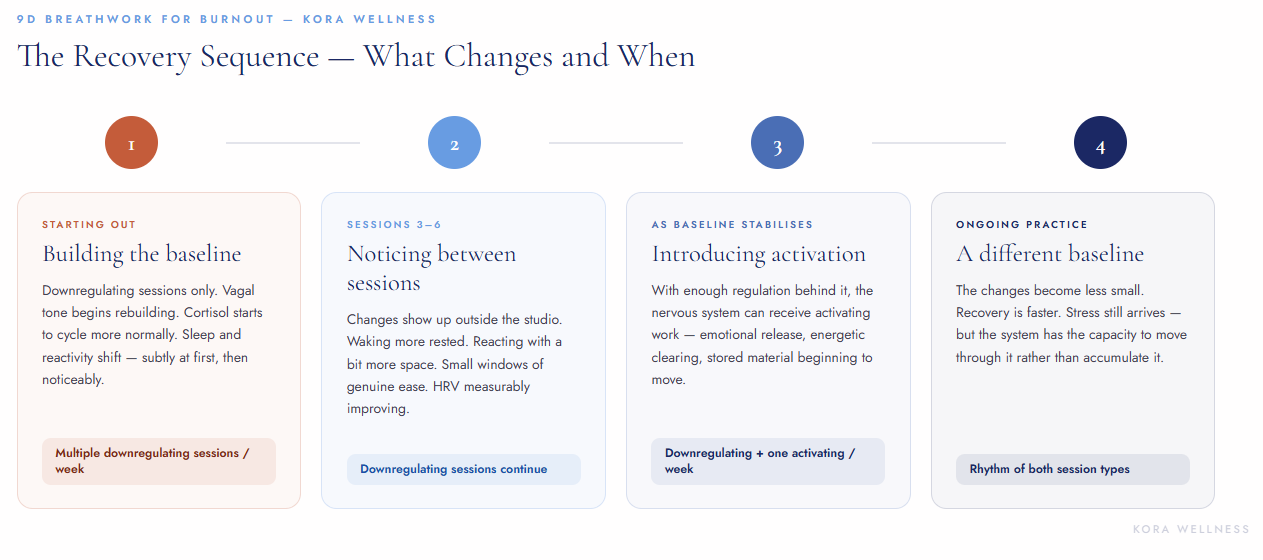
Recovery doesn't happen in a single session — it accumulates. Here's what shifts at each stage of a consistent practice.
Ready to check what's running this week? View the current schedule and book here.
What it actually feels like when you're burned out
People arrive at Kora Wellness for burnout from quite different places. Some are still in the wired phase - anxious, a little sceptical, not sure they can actually switch off - and find themselves genuinely surprised when a downregulating session quietens that in a way nothing else has managed. Others come in already in collapse, flat and foggy, wondering whether they're too depleted for this to work at all.
After a first downregulating session, most people describe something that isn't quite transformation; it's quieter than that,- and in some ways more useful. A quality of rest that's been unfamiliar for a long time. Not sleep, though some people drift close to it. More a sense of having been held, of having spent an hour somewhere their body wasn't required to perform or defend or manage anything. Some people cry and some just feel heavy in the way that comes before something releases rather than the way that comes from carrying too much.
The changes that build across multiple sessions tend to show up in ordinary moments between visits: waking up a little more rested, reacting a little less sharply to things that would usually spike a stress response, finding small windows of genuine ease that hadn't been there before. That's vagal tone starting to rebuild and the HPA axis beginning to find its footing again. It doesn't announce itself dramatically, it accumulates quietly, which is also how burnout arrived, and it turns out, how recovery works too.
If you want to know what a full session involves - from arrival to the end of the audio - our post on what actually happens in a 9D breathwork session walks through it in detail.
Frequently Asked Questions
Can 9D breathwork help with burnout?
Yes. Downregulating 9D breathwork directly targets the physiological markers that research identifies as depleted in burnout: vagal tone, heart rate variability, and HPA axis regulation. Slow nasal diaphragmatic breathing (the breath pattern used in downregulating 9D sessions) has been shown in multiple peer-reviewed studies to improve vagal tone, increase HRV, reduce cortisol, and promote parasympathetic nervous system activity. A 2025 PMC review confirmed these effects specifically for slow nasal diaphragmatic breathing. For burnout recovery, consistency across multiple sessions per week produces measurably greater change than a single session. View session types at Kora Wellness here.
Why doesn't rest fix burnout?
Rest removes demand but doesn't deliver the active physiological signal the nervous system needs to exit a stress state. When the body enters dorsal vagal shutdown (the collapse phase of burnout) it suppresses the immune and digestive processes that recovery depends on. Passive rest does not restart those systems. Research by Christina Maslach at UC Berkeley shows burnout builds through repeated cycles of overextension and inadequate recovery, each leaving a larger deficit that time off alone doesn't address. Downregulating breathwork delivers a direct safety signal to the autonomic nervous system that rest cannot replicate. Research in Scientific Reports confirms facilitated breathwork produces meaningful autonomic recovery in chronically stressed individuals.
What is the difference between burnout and exhaustion?
Exhaustion typically resolves with adequate rest and recovery time. Burnout is a chronic stress-related disorder involving measurable dysregulation of the autonomic nervous system and the HPA axis. A 2025 MRI systematic review found that burnout causes structural brain changes - amygdala enlargement and prefrontal cortex grey matter loss - that do not resolve with rest alone. Burnout requires active nervous system intervention, not simply time off.
What type of 9D breathwork is best for burnout?
For most people in burnout, downregulating sessions are the recommended starting point. Downregulating 9D breathwork uses slow nasal breathing with extended exhales, binaural beats tuned to delta frequencies and a guided audio environment designed to shift the nervous system into parasympathetic dominance. This directly addresses the vagal tone depletion and HPA axis dysregulation that characterise burnout. Activating sessions can be introduced once a felt baseline of regulation has been established. For a detailed explanation of both session types, see our post on activating vs downregulating 9D breathwork.
Why are women more affected by burnout than men?
Women report burnout at higher rates than men - 59% versus 46% in 2024–2025 workforce data - driven partly by the convergence of professional demands, caregiving responsibilities and gendered expectations, particularly at midlife. A 2025 study in the Journal of Women and Aging identified midlife as the specific burnout peak for women. That said, burnout is significant across both sexes. Men tend to present differently, often sitting in sympathetic overdrive longer before the collapse phase surfaces, which means burnout in men can go unrecognised for longer. The physiological recovery process is the same regardless of gender.
How many 9D breathwork sessions does it take to recover from burnout?
Burnout recovery is not a single-session outcome. For a depleted nervous system, multiple downregulating sessions per week is where meaningful change begins. Most people notice differences in sleep quality, emotional reactivity and baseline resilience by their third or fourth session. The shift people describe as genuinely feeling different - not just during a session but between them - comes from consistent practice rebuilding vagal tone and resetting the HPA axis over time. View the current schedule at Kora Wellness.
Can breathwork make burnout worse?
Applying the wrong session type at the wrong time can slow recovery rather than accelerate it. Beginning with activating breathwork on a nervous system already in sympathetic overdrive can temporarily amplify activation rather than relieve it. This is a sequencing issue, not a failure of the method and it's why understanding the difference between session types matters. At Kora Wellness, the monthly schedule is posted so you can identify which session type is running before you book. For fully personalised sequencing, a private 1:1 journey is tailored specifically to where your nervous system is right now.
Is 9D breathwork safe when you're burned out?
Yes. Downregulating 9D breathwork is appropriate and beneficial for burned-out nervous systems. The gentle physiological profile of downregulating sessions - nasal breathing throughout, audio tuned to restorative frequencies - is designed specifically for systems that need repair rather than activation. Research in Scientific Reports confirms that facilitated breathwork with appropriate screening produces consistent wellbeing improvements with minimal adverse effects. If you have specific medical conditions alongside your burnout, our honest safety guide covers contraindications in full.
What does burnout feel like in the body?
Burnout typically moves through two overlapping patterns. Sympathetic dominance presents as anxiety, hypervigilance, racing thoughts, disrupted sleep and an inability to wind down - sometimes called the "wired" experience. Dorsal vagal collapse - described within Dr Stephen Porges' Polyvagal Theory - presents as flatness, brain fog, emotional numbness, loss of motivation and disconnection from things that previously felt meaningful - the "tired" experience. Many people in burnout cycle between both, or experience one while the other runs underneath. Both are nervous system states and neither is a character flaw.
If rest isn't working, it's not because you're doing it wrong
The people who come to Kora Wellness in Port Kembla for burnout have almost always already tried to recover. They've taken time off, cut back, prioritised sleep, said no to things. And they're still running on empty in a way that doesn't make sense given everything they've done.
What they find when they start coming consistently isn't a dramatic shift. It's more like a gradual returning to themselves;small signs, between sessions, that something is recalibrating. Sleep that feels more restorative. A bit more space between a stressor and a reaction. The odd moment of genuine ease that isn't just collapse. Over time, as downregulating sessions rebuild the baseline and activating sessions start to move what's been stored, the changes become less small. But it starts quietly and it starts with frequency.
Our sessions are at Kora Wellness, 43 Wentworth Street, Port Kembla NSW, serving Wollongong, Shellharbour, Thirroul, Warilla and the broader Illawarra. View session types here or book directly here.
If you'd rather have a conversation before booking, email us directly - no obligation.
About the Author
Kora Wellness is the Illawarra's dedicated 9D breathwork studio, founded by Hayley Simpson and located at 43 Wentworth Street, Port Kembla NSW. Hayley is a certified 9D Breathwork facilitator and Master NLP Practitioner with a trauma-informed approach. Kora Wellness offers weekly group sessions, private 1:1 journeys, and online breathwork for clients across Wollongong, Shellharbour, Thirroul, Warilla and the broader Illawarra.
