9D Breathwork for stress relief in Wollongong — Why most stress relief doesn't actually work
Published by Kora Wellness | Port Kembla, NSW | Serving the Illawarra region including Wollongong, Shellharbour, Thirroul, and Warilla.
Most people who find their way to Kora have already tried the list; they've downloaded the apps, they've taken the walks, they've cut back on caffeine and added magnesium and told themselves they just need a holiday. Some of them have tried therapy, or yoga, or a long weekend away and come home feeling better for about four days before everything quietly contracts back to where it was.
And it's not that those things don't help, they do, in the moment. It's that chronic stress doesn't actually live in your thoughts or your schedule. It lives in your body - more specifically, in your nervous system. The part of you that's been quietly scanning for danger and holding the thread of tension long after the situation that started it has passed. That part doesn't respond to a calendar change and it doesn't reset because you've decided to relax.
It needs something different. Something that meets it at the level it's operating from.
That's what we do at Kora Wellness in Port Kembla. The 9D breathwork we offer works directly with the autonomic nervous system - not asking your mind to override what your body is holding, but giving the body itself a way through. This post is about what that looks like, why it works differently to most stress relief and what you can realistically expect when you start.
If you're ready to experience this rather than read about it, our next sessions are listed here. No pressure to know what you need before you arrive - that's what we're here for.
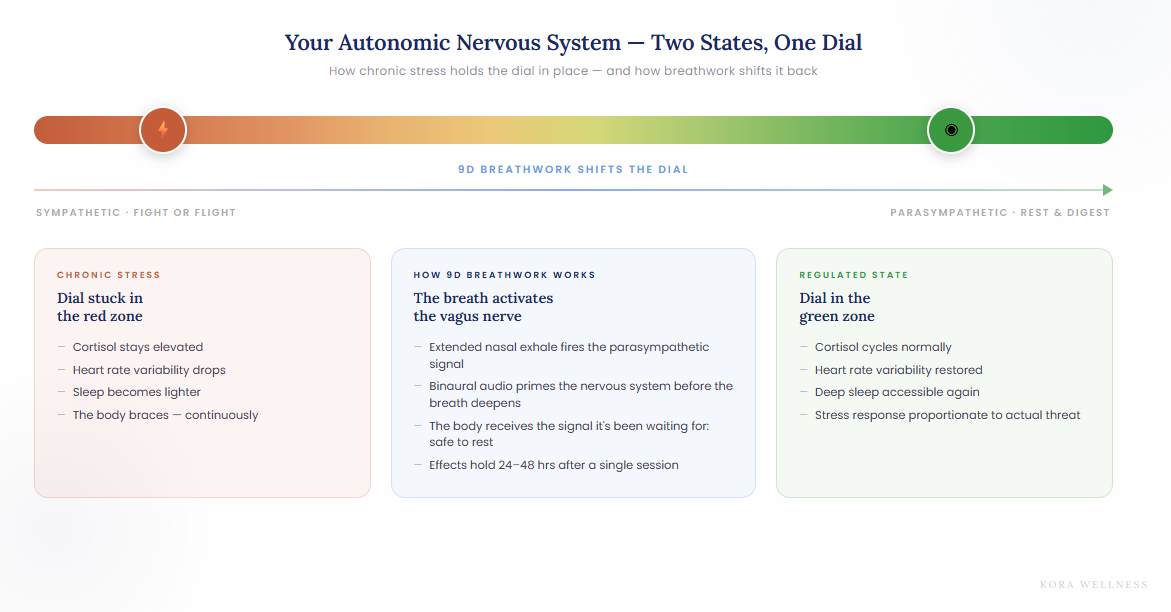
Chronic stress isn't a mindset problem, it's a nervous system stuck in the wrong setting. Breathwork works at the level of the dial, not just the thoughts about it.
What chronic stress actually does to your nervous system
Your sympathetic nervous system is your body's emergency response - the system that mobilises energy, narrows focus and readies you for threat. It's brilliant at what it does. The problem is that it wasn't designed to run continuously and modern life often asks it to. So many thing contribute to it running 24/7; a difficult season at work, financial pressure, parenting while managing everything else, caring for someone else while quietly falling apart yourself. These don't register as single events your body can process and move through. They register as sustained threat and the system stays primed accordingly.
Dr Stephen Porges, whose Polyvagal Theory has changed how we understand the body's stress response, describes this as neuroception - your nervous system's constant, below-conscious scan of the environment for signals of safety or danger. The important thing about neuroception is that it doesn't consult your rational mind. You can know, intellectually, that you're safe. Your body can still be holding the opposite. Which is why telling yourself to calm down has such a frustrating hit rate.
Over time, sustained sympathetic activation leaves a physical trail. Cortisol (your primary stress hormone) stays elevated when it should be cycling down. Heart rate variability drops, which is your body's way of losing the rhythmic flexibility that comes with being genuinely regulated. Sleep becomes lighter and less restorative. Digestion goes sideways. The immune system quietly pulls back. And because it happens gradually, none of it feels like a crisis. It just feels like how things are now.
That's the part worth paying attention to.
When chronic stress runs long enough, it stops feeling like stress and starts feeling like normal; the baseline shifts upward. What used to feel like a hard week is now just a week. What used to feel like rest doesn't register as enough anymore. The nervous system has recalibrated and relief, when it comes, feels like a brief holiday rather than a genuine return to somewhere solid.
Why most stress relief tools work in the moment but don't change the pattern
Here's a distinction that doesn't get made enough: stress relief and nervous system regulation are not the same thing. And if you've ever done everything you were supposed to do - the walks, the early nights, the time off - and still felt like you were running on the wrong setting, this is probably why.
Stress relief does work. A walk along the Illawarra escarpment, a long bath, a real conversation with someone who gets it, a Friday evening where you actually switch off - these genuinely lower cortisol in the moment. The body responds, your shoulders drop, something inside you loosens and you feel better; that's real. The problem is what happens next: you go back to the same baseline. Which produces the same pressure. Which creates the same need for relief. The window opens, the window closes and the room stays the same temperature.
Nervous system regulation is something different. It's about changing the baseline itself - the threshold at which your system shifts into a stress response in the first place. Dr Herbert Benson at Harvard Medical School spent years documenting what he called the relaxation response: a measurable, physiological shift that doesn't just reduce the feeling of stress, but actively counteracts the stress response at the autonomic level. Slow, diaphragmatic breathing is one of the most reliable ways to trigger it. It stimulates the vagus nerve, which carries the parasympathetic signal to the heart, lungs, and gut. Research published in Frontiers in Psychology found that people who practised diaphragmatic breathing over eight weeks showed significantly lower salivary cortisol than those who didn't and not just during the practice, but as a sustained change. The thermostat moved.
That's what consistent breathwork for stress relief can do, when it's approached as regulation rather than relief.
If you're curious about what session type would suit where your nervous system is right now, our services page breaks down the difference, or you're welcome to reach out directly. We're used to people arriving without a clear picture of what they need.
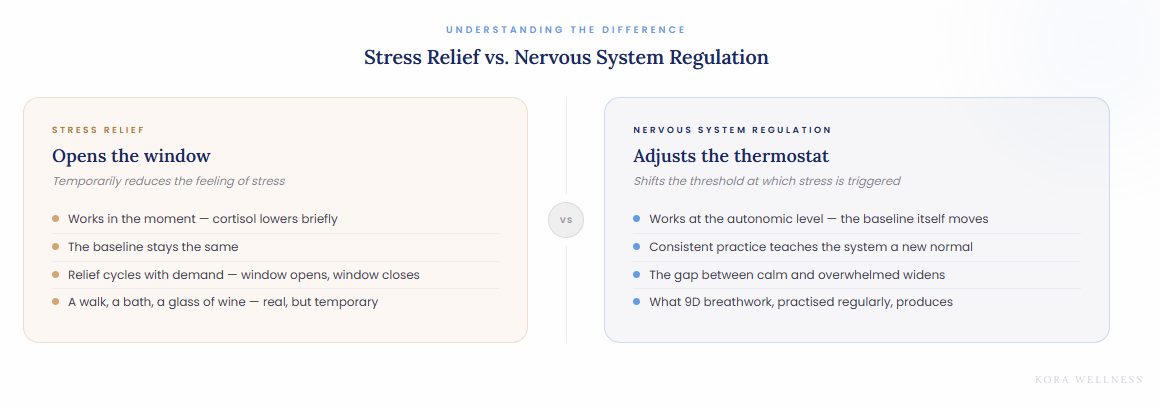
Most stress tools open the window. Breathwork, done consistently, adjusts the temperature and that's the difference between managing stress and building genuine capacity.
How 9D breathwork works on stress - the mechanism
A 9D breathwork session is a guided experience you have lying down, with headphones on. The "9D" refers to nine layers of audio - binaural beats, somatic music, theta-wave frequencies, guided voice - all working together underneath and around the breathwork pattern itself. At Kora Wellness, every session is facilitated by a certified 9D breathwork facilitator. You're not alone in a room listening to a recording. Someone is holding the space with you.
For stress specifically, this matters more than it might sound. Here's something we see regularly: people who are highly stressed often find that standard breathwork (the kind you do alone, with an app or a YouTube video) actually makes them more agitated, not less. Because once the room is quiet, their mind fills it. They start thinking about whether they're breathing correctly, checking how much time has passed, noticing that they don't feel relaxed yet. A nervous system that's been running hot doesn't settle easily into silence. It reads the silence as more information to process.
The audio in a 9D session changes that equation. The binaural beats work by delivering slightly different frequencies to each ear and the brain resolves the difference into a perceived third tone. In doing so, it begins to entrain toward calmer brainwave states. The somatic music and guided voice give the analytical mind something to follow, rather than leaving it to generate its own noise. By the time the breath pattern deepens, the nervous system is already partway regulated.
Bessel van der Kolk, whose research on trauma and somatic experience has influenced how practitioners think about stress physiology, writes about the body holding patterns that the thinking mind can't access or release through thought alone. Breathwork - particularly in a facilitated, held environment - is one of the approaches he identifies as capable of reaching what cognitive work cannot. You're not processing your stress. You're giving your body a direct route out of it.
What this produces in a session
In a downregulating 9D session (the type best suited to stress and burnout) the breath stays slow and nasal throughout, with an extended exhale. Most people notice something physical within the first twenty minutes or so. Their chest loosens and shoulders drop, without anyone asking them to. Their jaw unclenches and some people cry - not from anything specific, but from the release of something that had been held for a long time. Others simply feel a quiet that's unfamiliar, the sensation of a nervous system that has actually stopped bracing.
That feeling typically holds for 24 to 48 hours after a session. With consistent practice of multiple sessions per week rather than one, the nervous system starts to hold the regulated state for longer between sessions. Morning cortisol, which tends to spike in chronically stressed people as the body braces for another demanding day, begins to settle and their sleep deepens. The gap between being okay and being overwhelmed gets a little wider and the baseline moves.
What stress looks like at Kora and why it doesn't matter which version yours is
The people who come to Kora Wellness from across the Illawarra - Wollongong, Shellharbour, Thirroul, Warilla and everywhere in between - carry stress that looks different on the surface but feels remarkably similar underneath. There are people in demanding careers where being switched on is essentially the job description and switching off has quietly become something that happens to other people. There are parents running households, holding everyone else's needs, whose own name keeps ending up at the bottom of the list. There are people in physical work - shifts, sites, roles where the body absorbs the load - and the stress lives as much in their muscles and chronic pain as it does in thought. And there are people who simply had a hard season that lasted longer than expected and the recovery they were waiting for never quite came.
What unites all of them is this: the nervous system doesn't sort stress by category. Elevated cortisol from a difficult workplace and elevated cortisol from financial pressure look identical to the body. The breath pattern that shifts a person from sympathetic activation into parasympathetic rest works the same way regardless of what put them there. This is one of the things we appreciate most about 9D breathwork as a modality; it works with what the body is actually doing, not with the story of how it got there.
Where things do vary is starting point. Someone who's been running at a low-level hum of stress that’s tired but functioning and noticing the accumulation, will usually feel a shift more quickly than someone who's been running on empty for years and has lost their felt sense of what regulated even feels like. We'll always take the time to understand where you're starting from before recommending a session frequency. The community we serve in Port Kembla is varied but then, so is the work.
How often do you need breathwork for stress to actually change?
Most people don't ask this directly, but it's usually one of the first things they're thinking. The honest answer is: it depends on how long the pattern has been running, but one session a week is a starting point, not a finishing line.
A single session produces a real shift and most people feel it immediately. That feeling of having genuinely exhaled of having actually let something go, tends to hold for a day or two. One session a week gives you a reliable weekly reset and there's genuine value in that. But if the goal is to actually change the baseline - to stop needing the reset because the system is holding a calmer state on its own - then single weekly sessions alone usually aren't enough, especially when the stress has been building for a while.
For a nervous system that's actively dysregulated, what we find works best is multiple downregulating sessions per week. Not because more is always better, but because the nervous system learns through repetition. It needs to experience the regulated state often enough that it starts to recognise it as home, not as a temporary visitor. You can't think your way to a new baseline. You have to arrive there enough times that the body stops treating it as unfamiliar.
For someone moving through a stressful period who wants to build capacity rather than just recover — who wants to be able to handle more without tipping, a combination of downregulating and activating sessions works well. Downregulating breathwork restores. Activating breathwork expands what the system can move through without overwhelm. Both are available at Kora Wellness. We'll help you figure out what the right balance looks like for where you are.
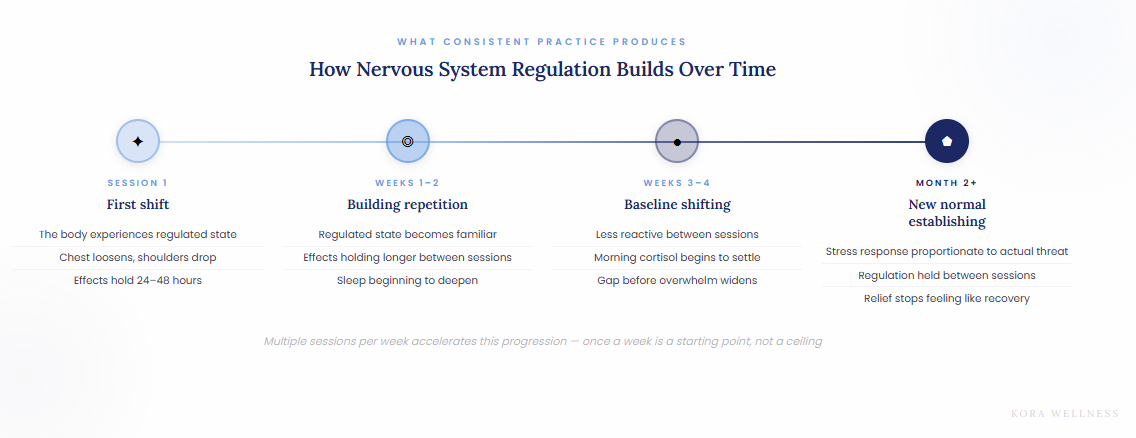
The first session creates a shift. Consistent practice changes the baseline and that's where real stress relief lives.
Frequently asked questions — breathwork for stress relief
Can breathwork help with stress relief?
Yes. Breathwork activates the parasympathetic nervous system - the body's rest-and-digest state - by stimulating the vagus nerve through extended exhalation. This reduces cortisol, lowers heart rate and shifts the body out of fight-or-flight. A systematic review published in Frontiers in Human Neuroscience (Zaccaro et al., 2018) found that slow breathing techniques produce measurable improvements in HRV, parasympathetic activity and psychological stress markers across multiple studies.
What is the difference between stress relief and nervous system regulation?
Stress relief is temporary, it reduces the feeling of stress in the moment. Nervous system regulation is structural, it changes the baseline threshold at which your system enters a stress response in the first place. Most stress-relief tools (massage, a walk, a glass of wine) provide relief. Breathwork, practised consistently, can shift the baseline. This is the difference between managing stress and building capacity.
How does 9D breathwork reduce stress differently to regular breathwork?
9D breathwork combines a guided breathwork pattern with binaural audio, somatic music and facilitated guidance delivered through headphones. The multi-layered audio does the nervous system priming that a stressed individual cannot reliably do for themselves because it bypasses the analytical mind and initiates a physiological shift through sound before the breathwork pattern begins. This makes it substantially more accessible for people whose stress is too high to settle into traditional breathwork.
How many breathwork sessions does it take to reduce stress?
Most people notice a shift after a single session. Sustained reduction in baseline stress (where the nervous system holds a calmer default state between sessions) typically requires multiple sessions per week over several weeks. For actively dysregulated or chronically stressed nervous systems, multiple downregulating sessions per week produce the most consistent structural change. Weekly sessions are a useful starting point but are not sufficient on their own to shift a well-established stress pattern. This is why we offer an affordable membership option to help you access both type of breathwork throughout the week.
Is breathwork for stress safe?
Downregulating breathwork (nasal breathing throughout, slow-paced, with extended exhalation) is safe for the vast majority of people and has a meaningfully different physiological profile to activating breathwork. It does not produce hyperventilation, tetany, or the strong emotional releases sometimes associated with continuous circular mouth-breathing techniques. People with cardiovascular conditions or epilepsy should consult their GP before any breathwork. Pregnant women and those with certain mental health conditions should discuss with their treating practitioner.
Where can I do breathwork for stress relief in Wollongong?
Kora Wellness is the Illawarra's dedicated 9D breathwork studio, located at 43 Wentworth Street, Port Kembla NSW 2505. Kora offers weekly group sessions, private 1:1 journeys and online breathwork for clients across Wollongong, Shellharbour, Thirroul, Warilla and the broader Illawarra region. Sessions are bookable online via the Kora Wellness website or the Mind Body app.
What does a 9D breathwork session for stress feel like?
Most people describe a progressive release of physical tension starting in the shoulders and chest, followed by a feeling of warmth, heaviness and mental quiet. Some people experience emotional release (tears, a sense of grief lifting). Others simply feel deeply rested. The experience varies by individual and by where the nervous system is starting from. Almost universally, people report leaving a session feeling lighter than when they arrived.
Can I do breathwork for stress at home?
Simple breathing techniques like extended exhalation, box breathing and nasal breathing can be practised at home and offer genuine benefit for mild stress. However, when stress is chronic or the nervous system is already dysregulated, the analytical mind often interferes with solo practice: the person thinks about whether they're doing it right, checks how much time has passed, or finds the silence activating rather than settling. Facilitated 9D breathwork removes these barriers through guided audio and a held container.
How is breathwork different from meditation for stress?
Meditation works primarily through cognitive redirection or training attention. Breathwork works primarily through physiology by directly altering the autonomic nervous system state through breath mechanics. For people whose stress manifests physically (tight chest, shallow breathing, racing heart), breathwork often produces faster physiological results than meditation. The two are complementary: breathwork shifts the state, meditation builds the capacity to sustain it.
If any of this resonates, we'd love to welcome you to Kora Wellness in Port Kembla. Our sessions are open to anyone in Wollongong, Shellharbour, Thirroul, Warilla, and across the Illawarra — and there's no pressure to arrive with a clear picture of what you need. Browse available sessions and book here.
About the Author
Kora Wellness is the Illawarra's dedicated 9D breathwork studio, founded by Hayley Simpson and located at 43 Wentworth Street, Port Kembla NSW. Hayley is a certified 9D Breathwork facilitator and Master NLP Practitioner with a trauma-informed approach. Kora Wellness offers weekly group sessions, private 1:1 journeys, and online breathwork for clients across Wollongong, Shellharbour, Thirroul, Warilla and the broader Illawarra.
