How to start Breathwork at home (And when to let someone hold the space for you)
Published by Kora Wellness | Port Kembla, NSW | Serving the Illawarra region including Wollongong, Shellharbour, Thirroul, and Warilla.
Something brought you here. Maybe it's the mental chatter that won't slow down, or the tiredness that sleep isn't fixing. Whatever it is, that pull toward something different is worth following.
If you've been feeling it lately, that low hum of stress that doesn't quite switch off, the nights where sleep keeps slipping away, the sense that you're always on but never quite present, you're not alone. And your body isn't broken. It's just holding a lot.
Breathwork can be the gentlest, most accessible doorway back to yourself. You already have everything you need. Your breath is always there, always willing, always ready to help you come home.
This guide will walk you through exactly how to begin a safe home practice - even if you've never done anything like this before - and help you understand when a deeper, guided 9D Breathwork session might be the next right step for you. There's no rush. Your pace is perfect.
The difference between daily breathing and a full 9D journey
Before we dive into the practical how-to, it helps to understand what you're actually choosing between. Because both have real value, they just live at different depths.
Daily breathing techniques are short, light and self-led. Think of them as nervous system hygiene; the kind of nourishing habit that helps you stay regulated in the middle of real life. Five minutes of intentional breathing in the morning can genuinely change the quality of your day. You don't need anything special to begin.
A 9D Breathwork journey is something else entirely. It's an immersive experience that weaves together conscious connected breathing, layered music, binaural beats, hypnotic language and energy-clearing work. If daily breathwork is like a warm bath, a 9D session is like a deep tissue massage for your nervous system and subconscious mind. It can surface emotions, memories and sensations you didn't know were stored - and when it's held well, that release is profound.
You can explore more about how the method works on our What is 9D Breathwork page. For now, know this: both practices belong in your life. Start with the gentle daily version to build body trust and capacity. When you feel the pull toward something deeper, a guided space is there to hold you.
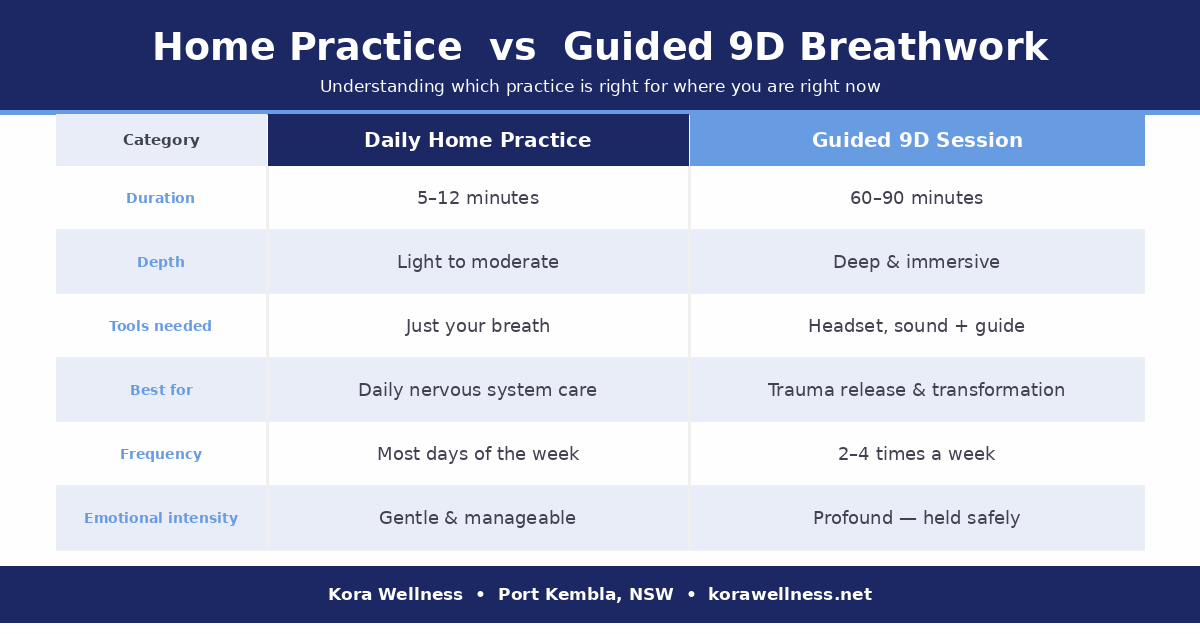
Comparison table showing differences between home breathwork practice and guided 9D breathwork sessions — duration, depth, intensity, and frequency.
Your 10-Minute beginner breathwork routine (No audio needed)
This sequence is audio-free, gentle and safe for beginners. It's not a full 9D journey - it's a loving sampler that introduces you to rhythm, presence and the feeling of settling into your body. Most people find it takes 10 to 12 minutes.
Step 1: Box Breathing — 3 Minutes
Box breathing is one of the most researched breathwork techniques for nervous system regulation. It works directly with your autonomic nervous system, helping shift you out of that "always on" stress response.
Inhale through your nose for 4 counts
Hold for 4 counts
Exhale through your nose for 4 counts
Hold for 4 counts
Repeat
Keep your shoulders soft, jaw relaxed. Let your belly lead, not your chest. If your mind wanders (it will), just come back to the count. That's the practice.
Step 2: 4-7-8 Breathing — 3 Minutes
This technique is famous for activating the parasympathetic nervous system; the part of you that knows how to rest. The long, extended exhale is the magic. It signals safety to your brain.
Inhale through your nose for 4 counts
Hold for 7 counts
Exhale slowly through softly pursed lips for 8 counts
If 7 and 8 feel too long at first, that's okay. Shorten the ratio to fit your body. Your body is wise. If it needs 4-5-6, honour that. You can learn more about this technique in our detailed guide on box breathing and 4-7-8 breathing.
Step 3: 3-3-3 Grounding breath — 2 Minutes
This is the simplest, most grounding breath of the sequence. If you only have time for one technique, this is a beautiful choice.
Inhale for 3 counts
Exhale for 3 counts
Pause for 3 counts
Breathe low - imagine the breath moving into your belly and the sides of your ribs. Light and easy. This one works well before sleep, before a hard conversation or whenever you need to come back to ground.
Step 4: Gentle Conscious Connected Breathing — 2 to 3 Minutes
This is a very soft introduction to connected breathing - the core breathing pattern used in a full 9D session. At this light intensity, it's safe, manageable and often leaves you feeling gently buzzy and calm.
Mouth breathing, soft circular rhythm
No pause between your inhale and exhale, let them flow into each other
Keep it easy and slow - this is not about force or pushing
If you feel dizzy or lightheaded, return to nasal breathing immediately
You might feel tingling in your hands or warmth in your chest. That's normal. That's your body opening up.
Step 5: Rest and feel — 1 to 2 Minutes
This is the most important part that most people skip. Please don't skip it.
Close the active breathing.
Let your breath return to whatever feels natural.
Close your eyes if they aren't already.
Just notice. Notice the drop into stillness.
Notice any warmth, tingling, or calm moving through you.
Notice what your body has to say.
Thank your body.
It showed up. It always does.
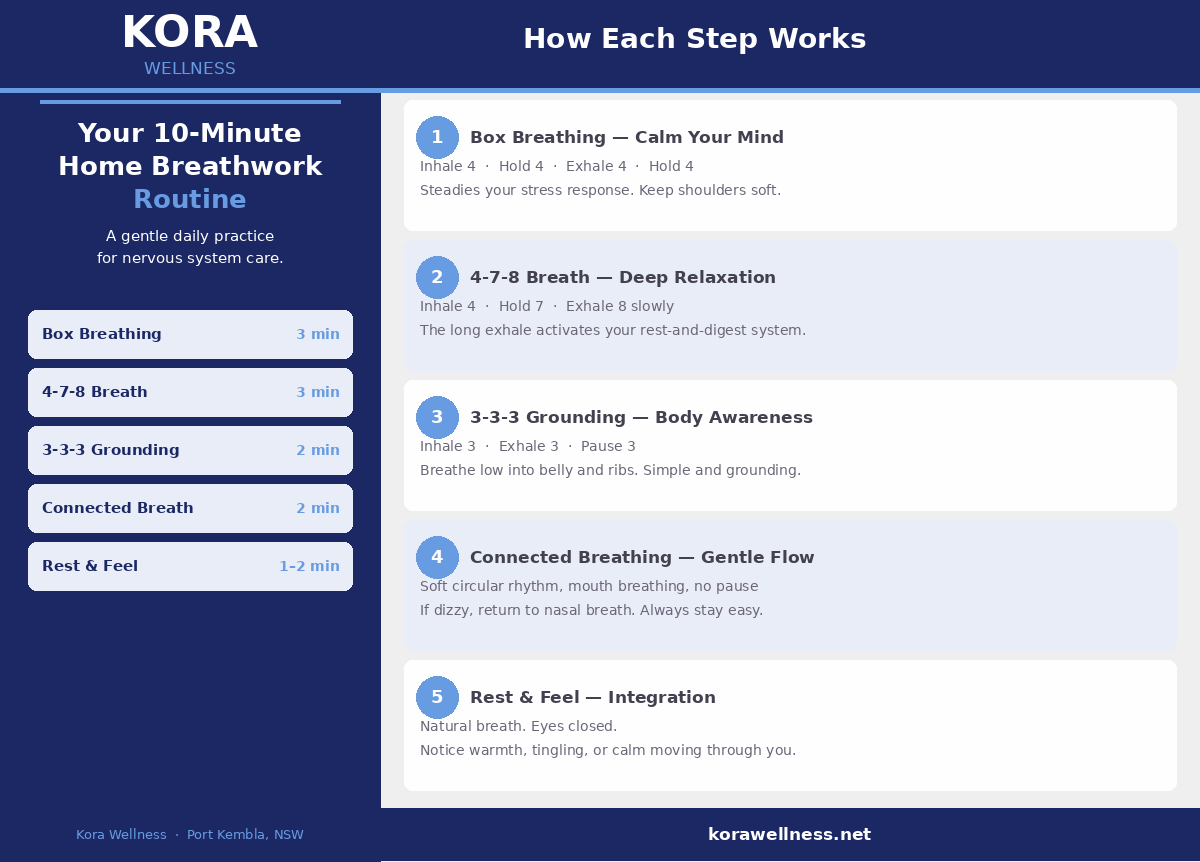
Step-by-step visual guide to a 10-minute home breathwork routine from Kora Wellness, including box breathing, 4-7-8, 3-3-3 grounding, and connected breath.
How to set your space (So your nervous system can actually land)
You don't need a dedicated meditation room or any special equipment. But small intentional choices make a real difference. Your nervous system is always reading its environment; soft cues of safety help you go deeper, faster.
Choose a quiet room. Silence your phone or switch it to aeroplane mode. Those fifteen minutes are yours.
Make it cosy. A yoga mat or carpeted floor, a pillow under your head, a blanket, an eye mask if you have one. The more snug and supported your body feels, the more easily it will let go.
Check the temperature. In Australian summer heat, keep the room cool or practice in a shaded space. Heat amplifies breath sensations and can push intensity higher than you want for solo practice.
Set a gentle timer. Knowing a soft chime will mark each section means you don't need to keep checking the clock. That's one less thing your nervous system has to manage.
Tell your household. A quick "I'm unavailable for 15 minutes" removes the subconscious listening for interruptions. You deserve unbroken space.
Optional: dim lighting, a soft playlist without lyrics, a drop of lavender or frankincense on your wrists. These aren't necessary, they're simply an invitation to go deeper if they resonate.
Practising Breathwork in Australian summer: What you need to know
If you're in Wollongong or anywhere in the Illawarra and you're reading this during warmer months, there are a few extra things to keep in mind. Heat changes how your body responds to breathwork.
Hydrate well beforehand. Drink a full glass of water before you begin and sip again when you're done. Breathwork (especially connected breathing) can mildly dehydrate you.
Keep your space cool. Ceiling fans, good airflow, or air conditioning if you have it. On extreme heat days, shorten your session to 6 to 8 minutes rather than the full routine.
Grounding foods after. Fruit, yoghurt, oats, a light salad - these help your body stabilise after a session. Avoid anything heavy or stimulating right away.
If you practise outdoors: choose early morning or late afternoon, never in direct midday sun and wear sun protection. Shade is your friend.
Common questions about Breathwork at home (Answered honestly)
How long should a breathwork session be?
For beginners doing daily maintenance, 5 to 12 minutes is genuinely enough. There's no virtue in forcing longer sessions when you're just starting out. For days when you need deeper stress regulation, 15 to 20 minutes works beautifully. A facilitated 9D Breathwork session - the kind offered at Kora Wellness in Port Kembla — runs 60 to 120 minutes including integration and grounding time afterward.
Your body decides. If you feel over-activated at any point, that's important information. Shorten the session and return to slow nasal breathing.
How many times a week should you do breathwork?
For gentle daily practice: 5 to 10 minutes most days of the week works well. For more focused sessions: 3 sessions of 10 to 20 minutes is a solid rhythm. For deep guided down-regulating journeys with a facilitator: 2-3 times a week if you’re body is experiencing a lot of anxiety, stress or overwhelm. For deep guided activating journeys with a facilitator: 1-2 times a week if you’re looking for transformation, deep impact and big releases, both with easy daily breathing woven in between.
The most important thing isn't the length or the frequency - it's the consistency. Repetition, not heroics. Your nervous system heals through gentle, regular signalling that it's safe to rest.
Can you overdo breathwork?
Yes! And it's worth knowing this. Over-breathing or pushing too hard can trigger dizziness, tingling, emotional flooding or fatigue that lingers. Early signs you've crossed your edge: numbness in the hands, lightheadedness that doesn't settle within a minute, or agitation that isn't moving through. If any of these happen, slow down, switch to gentle nasal breathing and rest. Your body is not failing, it's simply asking for a slower pace.
If you have a medical condition, have had recent surgery or are pregnant, please speak with your healthcare provider before beginning any breathwork practice and let your facilitator know before a guided session. There are contraindications for breathwork and it’s important you have informed consent and your doctors permission before you progress.
Can you do 9D Breathwork at home by yourself?
You can do a gentle version of connected breathing at home safely, this guide shows you how. But a full, immersive 9D Breathwork experience - the kind with layered audio, binaural beats, hypnotic language and proper facilitation - is designed to be guided.
For solo practice at home: keep the connected breathing portion to 2 to 3 minutes. Track your intensity on a scale of 1 to 10 and aim to stay between 4 and 6. Journal one page afterward. If strong emotions surface, pause, place one hand on your heart and one on your belly and lengthen your exhales. For everything deeper, work with a guide unless you have enough mind, bogy and emotional tools in your pocket to help you navigate this safely.
To understand why, you might find it helpful to read what actually happens in a 9D Breathwork session, it walks you through the experience from start to finish.
Why a guide makes all the difference for deep work
For light daily practice, you don't need anyone. Your breath and your willingness are enough.
But for the deeper layers - the grief that won't shift, the anxiety that wakes you at 3am, the subconscious patterns running quietly beneath your choices - a skilled guide matters enormously. Here's why:
Safety and nervous system co-regulation. A trained facilitator watches your breath rate, your body cues and your emotional state in real time. They help you modulate intensity, gently slowing you down if things are moving fast and encouraging you forward when you're holding back unnecessarily. You're not alone in it.
Technique and pacing. You're coached on rhythm, breath holds, sound release and when to rest. The immersive audio, created specifically for 9D Breathwork, does work that your silence at home simply cannot replicate.
Integration support. What comes up in a session needs a place to land. Skilled facilitators offer aftercare guidance so the insights that emerge translate into real shifts in your daily life, not just a fleeting feeling you can't hold onto.
Personalised holding. A quality guided session is designed around you; your goals, your history, your nervous system's particular rhythms. It's not a generic track you press play on and hope for the best.
At Kora Wellness, Hayley - a Master NLP Practitioner and trained Breathwork Facilitator - create a container that is both deeply grounded and genuinely heart-led. You'll be held, you'll be safe, and you'll be able to go as far as you're ready to go, without having to manage any of it alone.
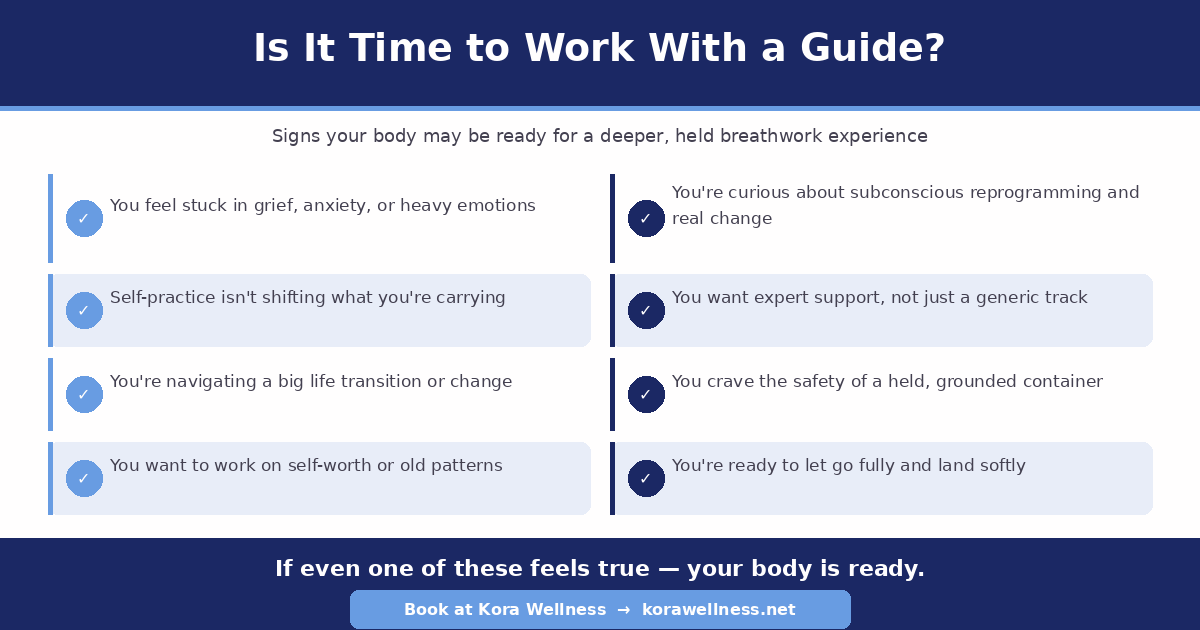
Checklist graphic from Kora Wellness showing 8 signs it might be time to book a guided 9D breathwork session rather than practising alone at home.
Signs you're ready for a guided session
Sometimes we know. And sometimes we need permission to trust what we know.
Here are some signs your body might be ready for a deeper, held breathwork experience:
You feel stuck in grief, anxiety, or heavy emotions that self-practice alone isn't shifting.
You want to address patterns around self-worth, old trauma, or a significant life transition; a break-up, a loss, a health scare, a career change.
You're curious about subconscious reprogramming but want expert support, not just a YouTube video and a hope.
You've been craving a genuinely immersive experience - quality headsets, curated multilayer sound, a cosy studio space, someone who sees you.
If even one of those resonates, that's worth listening to.
Explore group breathwork sessions near Wollongong if you'd like the held warmth of a group container. We run sessions Monday, Wednesday and Friday evenings and Saturday mornings. If you're closer to the south end of the Illawarra, breathwork sessions near Shellharbour and sessions near Warilla are also available. Or if you prefer the intimacy and privacy of working one-on-one, private 9D Breathwork near Thirroul and surrounding areas offers a bespoke experience tailored entirely to you.
Tuesday morning online sessions are also available for anyone who prefers to begin from the comfort of home while still having a skilled guide present.
Can breathwork actually release trauma? That's a question worth exploring thoughtfully. Read our piece on whether breathwork can release trauma for an honest, evidence-informed answer.
Your at-home checklist (Print this out)
Copy this into a note on your phone or print it for your mat.
Before you begin:
Set your intention (one quiet sentence is enough)
Phone on aeroplane mode
Timer set for each section
Mat, pillow and blanket arranged
Eye mask within reach
Water bottle filled and nearby
Room cool and shaded
Household knows you're unavailable
Chosen your session length
After your session:
Drink water and eat something grounding within 30 minutes
Take a short walk in shade if you can; notice colours, sounds, textures
Keep the rest of your day gentle if possible
Low screens for an hour before bed tonight
Journal one feeling and one thing you want to carry forward.
Simple integration tips for after your practice
Integration is the often-overlooked gift of breathwork. The session stirs something up, integration is how it actually lands.
Hydrate and eat within 30 minutes. Fruit, yoghurt, oats, or a light salad help your nervous system settle back into the body. Skip alcohol and caffeine for the rest of the day if you can.
Move gently. A slow walk where you actually notice things; the colour of the trees, the sound of the street, the warmth on your skin, it helps your nervous system complete the cycle.
Protect your evening. Sleep after a breathwork session is often genuinely different. Honour that. Low screens, a warm drink and an early night are worth it.
Write one thing down. Not a full debrief, just one feeling and one action. Something your body or mind offered during the session that deserves to be remembered.
Ready when you are
There's no perfect time to begin. There's only now and the willingness to take one small step toward yourself.
Start with the light routine above. Let it anchor your mornings or soften your evenings. Use it on the hard days when your nervous system is screaming and you need something to hold onto. And when you feel the pull toward something deeper - toward the layers beneath the surface, toward the emotions that need more than a few quiet minutes - let that pull be enough. That's your body's wisdom speaking.
When you're ready for a held space, we're here. View our breathwork sessions and book online or if you'd like to talk first, reach out any time. There's no pressure, no expectation, just an open door.
You were made to feel alive. One breath, then another. Start now.
Frequently Asked Questions
What is 9D Breathwork and can I do it at home? 9D Breathwork is an immersive practice combining conscious connected breathing with layered music, binaural beats, guided affirmations and energy-clearing work. At home, you can safely practice gentle connected breathing and regulation techniques, but the full 9D experience with its multi-layered audio and expert facilitation is only experienced in our studio setting. A trained facilitator holds your safety and pacing throughout the session.
How do I start breathwork as a complete beginner? Start simple. A 10-minute routine combining box breathing, 4-7-8 breathing and gentle 3-3-3 grounding breath is ideal for beginners. No special equipment, apps, or audio is needed. Practice consistently - most days if you can - and build from there. The goal isn't intensity, it's regularity.
Is breathwork safe to do every day? Gentle techniques like box breathing and 4-7-8 breathing are safe for daily use. Conscious connected breathing (mouth breathing with no pause) is best limited to short periods — 2 to 3 minutes — for solo home practice. Deep, immersive breathwork journeys with a facilitator are typically done from 1-2 times a week for maximum impact and to allow for integration between sessions.
What should I do after a breathwork session? After any breathwork practice, rest for 1 to 2 minutes before getting up. Drink water, eat something light and grounding and move gently. Protect your day, keep it calm and low-stimulation where possible. Journalling one insight from the session helps it land and integrate into your daily life.
When should I work with a breathwork facilitator instead of practising alone? If you're experiencing grief, anxiety, trauma patterns or emotions that feel stuck and self-practice alone isn't shifting them, a guided session offers something different. A skilled facilitator provides safety, personalised pacing and integration support that solo practice can't replicate. If you're in the Illawarra region, Kora Wellness offers guided 9D Breathwork sessions in Port Kembla with both group and private options.
How is 9D Breathwork different from regular breathwork or meditation? Regular breathwork typically uses a single breathing technique. Meditation focuses on stillness and observation. 9D Breathwork combines conscious connected breathing with a rich, multi-layered sensory experience - binaural beats, solfeggio frequencies, hypnotic language, affirmation and subliminal messaging - to access subconscious patterns and release stored tension and emotion. The "9D" refers to the nine dimensions of experience woven together in each session.
Is 9D Breathwork available online? Yes. Kora Wellness offers online 9D Breathwork sessions every Tuesday morning, so you can experience guided breathwork from your own home with a trained facilitator present throughout. This is a beautiful option if you're not yet ready for an in-studio group session, or if you live outside the immediate Wollongong/Illawarra area.
If stress, anxiety or sleep is what brought you here, these posts go deeper:
9D Breathwork for Anxiety · 9D Breathwork for Sleep · Can Breathwork Release Trauma?
About the Author
Kora Wellness is the Illawarra's dedicated 9D breathwork studio, founded by Hayley Simpson and located at 43 Wentworth Street, Port Kembla NSW. Hayley is a certified 9D Breathwork facilitator and Master NLP Practitioner with a trauma-informed approach. Kora Wellness offers weekly group sessions, private 1:1 journeys, and online breathwork for clients across Wollongong, Shellharbour, Thirroul, Warilla and the broader Illawarra.
