
Breathwork for Emotional Numbness; When you've stopped being able to feel.
Published by Kora Wellness | Port Kembla, NSW | Serving the Illawarra region including Wollongong, Shellharbour, Thirroul, and Warilla.
Something's off, but you can't name it exactly.
You’re not sad or crying in the car and you don’t have any issues with life or how it is going. Dinner happens and work, and conversations with people you love, but none of it is quite reaching you the way it used to.
A song comes on that would once have landed somewhere in your chest and made you want to dance, but instead there's just...silence.
This is one of the harder states to bring to a GP or a therapist, partly because there's no clear distress to report.
You feel fine. You're getting through. The language for it is slippery - "flat," "just not myself," "a bit off" - and none of those words quite capture the particular disorienting quality of watching your own life from just slightly behind glass.
The standard advice of rest more, slow down and give yourself space was designed for a nervous system in overdrive, and shutdown (the not so scientific name for being emotionally numb) is in the opposite direction.
What is emotional numbness?
Emotional numbness is a specific nervous system state, not an absence of one.
When the nervous system has been under sustained stress (or has processed something too large to move through cleanly) it can shift into what Stephen Porges' Polyvagal Theory describes as dorsal vagal shutdown: a system-level dimming in which your body slows down, your emotional register flattens, and you are physically present but experientially somewhere else.
This is protective by design. The nervous system is doing exactly what it evolved to do under conditions of chronic overwhelm or threat it couldn't resolve through action.
Dan Siegel's Window of Tolerance framework places this state in what he calls the hypoarousal zone where you are below the regulated window, and your system has moved past activation and into a kind of organised withdrawal.
Your body slows its metabolic rate, social engagement drops away, and emotions that would ordinarily arrive and move through you instead sit behind something that is accessible in theory, but unreachable in practice.
Emotional numbness is often mistaken for depression and the overlap is real, but they're distinct.
Some people experience both at once; others are numb without meeting any clinical criteria for a depressive episode, carrying something that looks fine from the outside and feels like distance from the inside.
For people whose numbness does shade into persistent low mood, there's more in our post on 9D breathwork for depression and low mood.
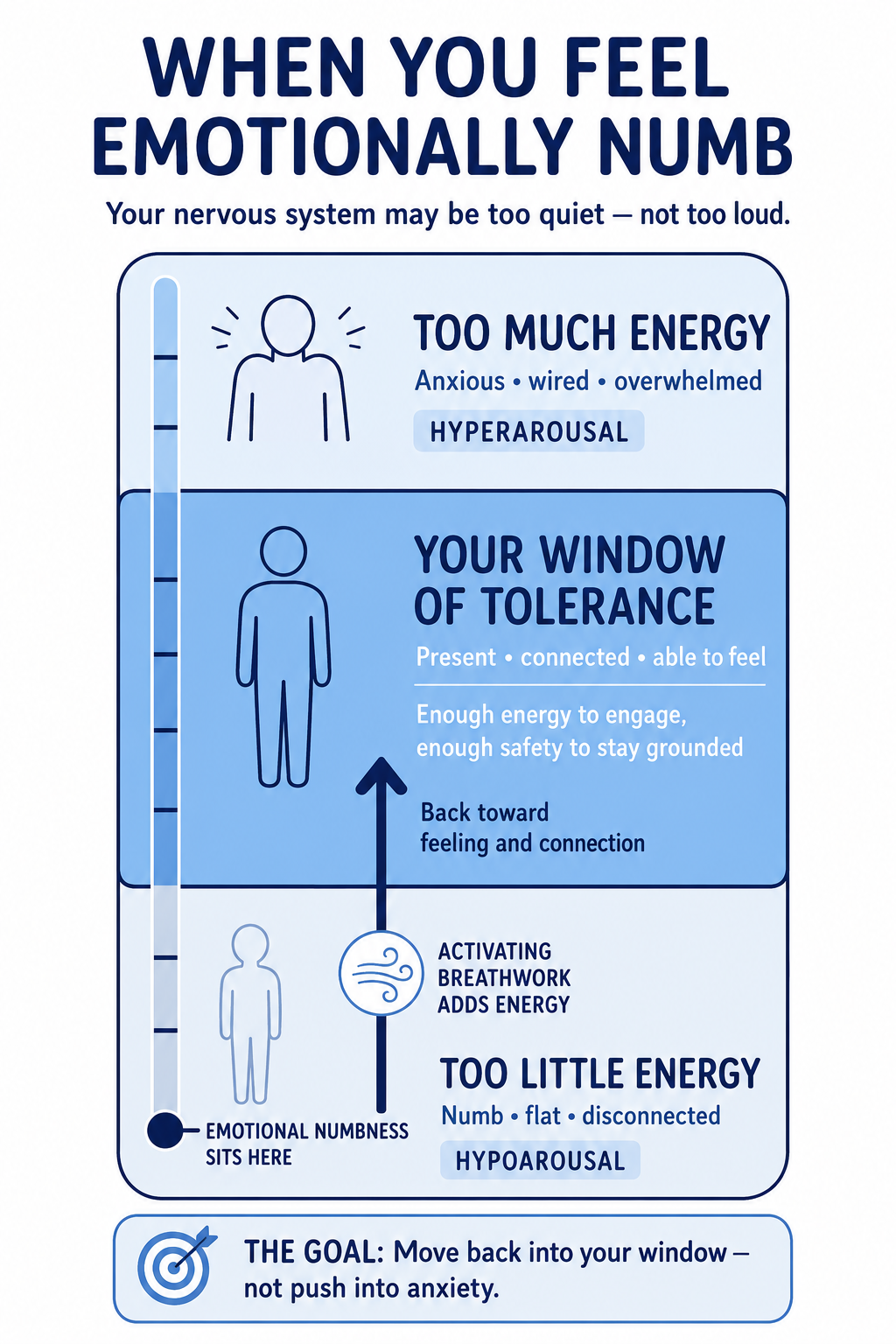
Window of tolerance diagram showing emotional numbness in the hypoarousal zone and how activating breathwork supports upregulation.
Why rest, meditation and "slowing down" often make it worse
The instinct when you feel flat and switched off is to do less. To rest, slow down, give yourself space. For a nervous system in high activation that is anxious and reactive, that's exactly right.
The problem is that a system in dorsal vagal shutdown is already too still. Adding more stillness to it is like telling someone with low blood pressure to take a medication that lowers blood pressure further.
The treatment has to match the state, and the state here is one of too much quiet, not too much noise.
Meditation, in particular, amplifies whatever state you bring into it. For someone activated and anxious, a structured breathing or mindfulness practice can genuinely move the needle.
For someone in shutdown, that same practice tends to deepen the quiet. And a quiet that is already too quiet becomes harder to sit with, not easier.
A 2023 study published in Cell Reports Medicine by Balban and colleagues at Stanford tracked 113 adults across 28 days and found that structured breathwork, particularly techniques with an active breath pattern, produced greater improvement in positive affect and mood than mindfulness meditation.
Research published in 2025 examining whether technique selection matters in breathwork found that activating and downregulating patterns produce meaningfully different physiological outcomes - meaning that they're not interchangeable approaches to the same result.
This is why the difference between activating and downregulating sessions is something Hayley discusses before every session at Kora, and why understanding why rest alone doesn't shift a shutdown nervous system matters for anyone who's already tried the obvious things without much to show for it.
What activating 9D breathwork does and why it suits this particular state
Activating 9D breathwork uses circular mouth breathing - a continuous pattern with no pause between the exhale and the next inhale. This pattern does something specific to a system in shutdown: it sends a signal of energy.
For a nervous system that has been running quiet for a long time, this is often the first clear signal that the body has resources available, that movement is possible from the inside. The effect is physiological upregulation - genuine arousal - rather than agitation or anxiety.
The binaural beats layered into the 9D audio track are doing something distinct from ambient sound.
Binaural beats work by delivering two slightly different tones (one into each ear) and the brain perceives the gap between them as a third frequency, gradually shifting its electrical activity to match.
The 9D format uses frequencies in the theta and alpha ranges, both associated in early research with emotional processing and increased neural receptivity.
The honest framing here is that this evidence is promising rather than conclusive; what is observable is that the combination of circular breathing and the audio environment produces a state that is different from ordinary waking consciousness, and that difference matters for what happens next.
Alongside the binaural layer, the 9D format includes an NLP reframing and affirmation layer timed to arrive when the person's ordinary waking defenses have quietened.
For someone in emotional shutdown, the defended mind has been filtering, often without the person's awareness, any input that challenges the established flatness.
In a breathwork state, that filtering loosens. Prompts that would normally be argued with or screened out find a more direct route in.
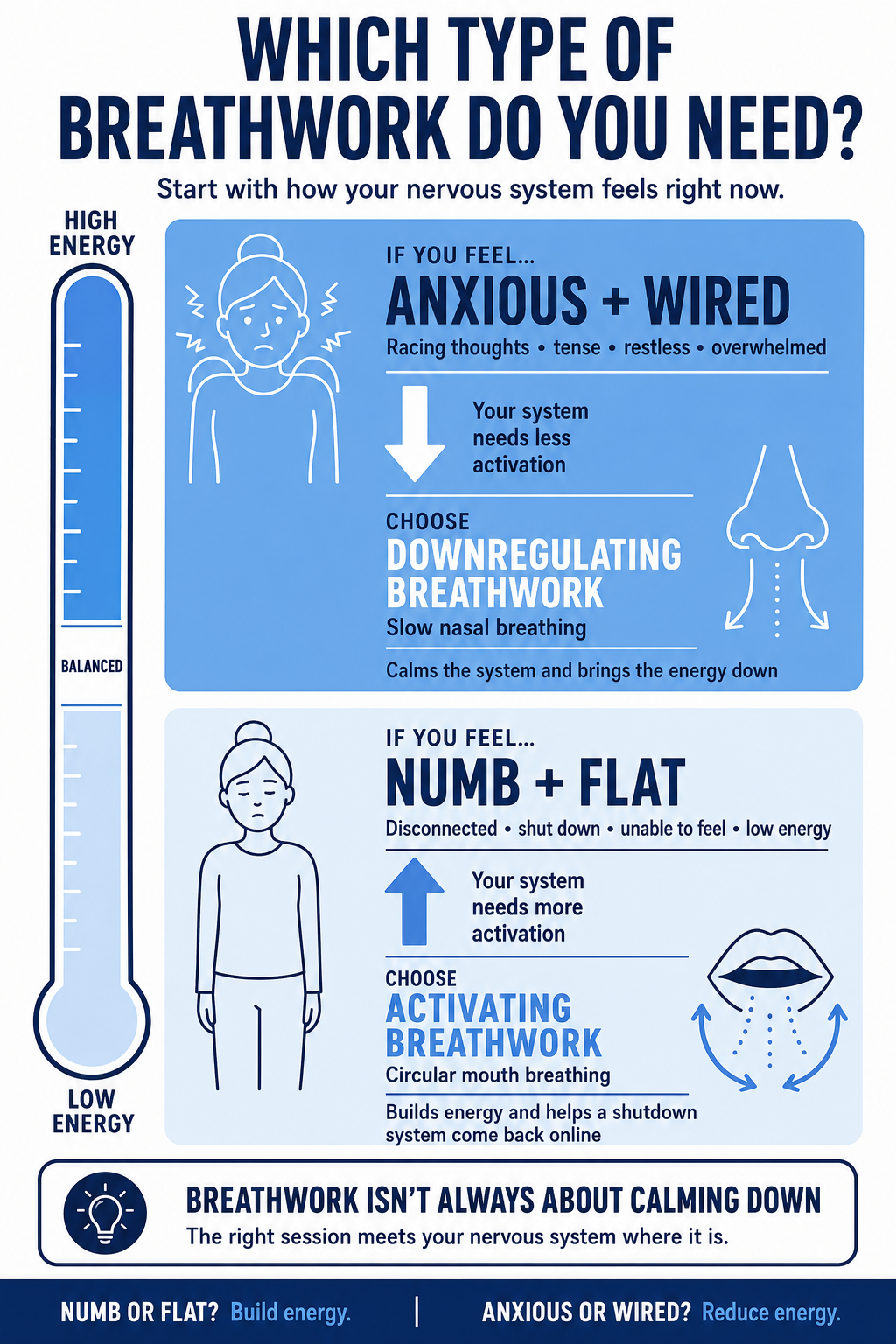
Which 9D breathwork session type for emotional numbness versus anxiety — Kora Wellness.
A group container matters in ways specific to this state. Emotional numbness is partly a social withdrawal phenomenon; the nervous system's social engagement system goes quiet alongside everything else.
Being physically present with people who are audibly in their bodies - breathing, processing, co-regulating - sends cues that headphones and a bedroom floor can't replicate, including the particular pull of proximity to nervous systems that aren't in shutdown.
How stored emotional weight moves through the body in breathwork is covered in more depth in our post on whether breathwork can release trauma - worth reading for anyone whose numbness has a trauma background.
Understanding which session type fits your current state is something Hayley discusses before every private session at Kora. You don't need to have it figured out. Book here and you start from wherever you are.
What to expect from a 9D session ? Especially if you haven't felt much in a long time
People arrive at a Friday evening session in Port Kembla having carried their particular kind of quiet for months.
The first thing that happens in an activating session is usually physical: the breathing pattern produces tingling in the hands, sometimes a warmth through the chest, a sense of the body registering itself in a way that might have been unfamiliar for a while.
For some people, that's where things stay in the first session. For others, something else arrives; tears that seem to have been in a holding pattern, pressure in the chest that becomes something more, a sense of returning to a part of themselves they'd stopped expecting to find.
The nervous system re-learns at its own pace and that pace is cumulative rather than dramatic. A 2023 meta-analysis by Fincham and colleagues in Scientific Reports, examining 18 controlled trials across 785 adults, found that consistent breathwork practice produced reductions in depression and negative affect comparable in size to first-line psychological treatments - and that those effects accumulated through frequency, not through any single session's intensity.
People across the Illawarra who've come in carrying this kind of quiet often describe the first signal of return as a small one.
Music that actually registers on the way home, a conversation that lands somewhere it hadn't been reaching, a Saturday morning that felt, for reasons that are hard to articulate, a little different from the weeks before it.
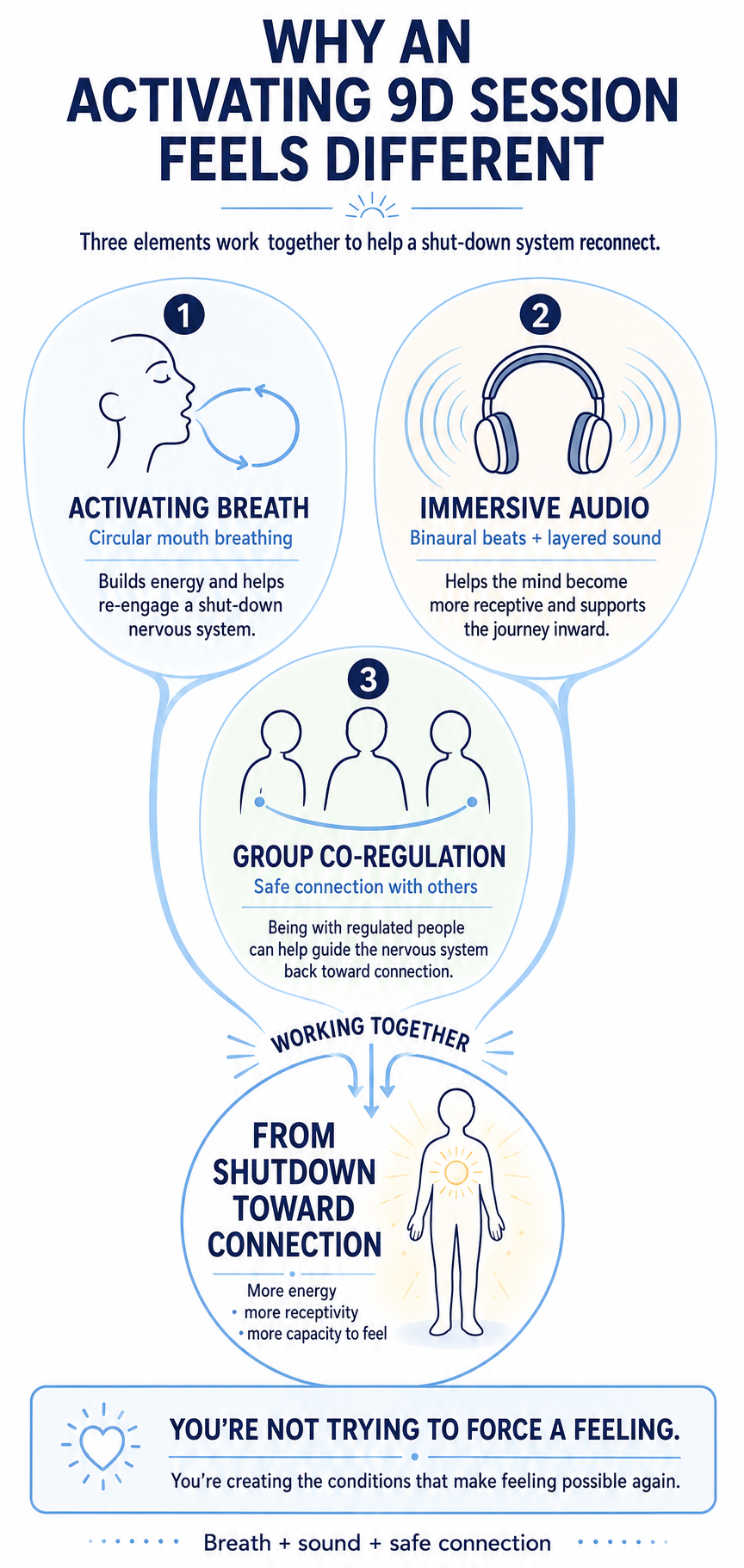
How activating 9D breathwork supports emotional reconnection — Kora Wellness
Free and low-cost mental health support in the Illawarra
Wollongong Mental Health Hub — free, accessible support for people facing barriers to standard services.
- 02 8358 5838
- Unit 2, 36–42 Auburn St, Wollongong NSW 2500
- Mon–Fri 9:00am–5:00pm
Public triage and referral through Illawarra Shoalhaven Local Health District.
Free and low-cost mental health support for young people in Wollongong.
- 02 4220 7660
- 7 Atchison Street, Wollongong NSW 2500
- Mon–Fri 8:30am–5:00pm (Wed until 6:30pm)
Frequently Asked Questions
Can breathwork help with emotional numbness?
Activating breathwork - specifically techniques using circular mouth breathing to generate upregulation in the body - is well-suited to emotional numbness, which is typically associated with a hypoarousal or shutdown nervous system state rather than overactivation.
A 2023 meta-analysis by Fincham and colleagues in Scientific Reports, examining 18 controlled trials across 785 adults, found significant reductions in depression and negative affect from structured breathwork practice, with effect sizes comparable to first-line psychological treatments.
Multiple sessions across several weeks produce more consistent results than a single session.
What causes emotional numbness?
Emotional numbness is typically a protective nervous system response to sustained stress, accumulated overwhelm, or unprocessed difficult experiences.
In Polyvagal-informed frameworks, it corresponds to a dorsal vagal withdrawal state; the nervous system's deepest protective mode, in which the body slows, social engagement reduces and emotional responses flatten as a way of managing what the system can no longer actively process.
It can also develop as a side effect of some medications, as a feature of depression or PTSD, or emerge gradually during periods of chronic low-grade stress without a clear triggering event.
Is emotional numbness a trauma response?
Emotional numbness can be a trauma response, though it also occurs in people without a trauma history.
In the context of trauma, particularly complex or repeated trauma, it often represents the nervous system's attempt to manage experiences that exceeded its capacity to process in the moment.
Complex PTSD is commonly associated with emotional blunting and dissociation as protective adaptations that persist long after the original event.
Numbness also develops from sustained burnout, significant loss, or long periods of high-demand living without adequate recovery, without the specific features of a traumatic event.
Why do I feel nothing even when I should feel something?
The flatness that characterises emotional numbness reflects a physiological state - dorsal vagal shutdown - in which the nervous system has moved into a low-energy protective mode.
In this state, emotional responses that would ordinarily arrive and move through remain behind a kind of perceptual barrier.
A person may be cognitively aware of what they expect to feel in a given moment but unable to access the embodied sensation of it. This is different from not caring - it is a disruption in the connection between cognitive understanding and felt experience, driven by the state of the autonomic nervous system rather than by will or character.
How many breathwork sessions before I start feeling again?
There is no fixed timeline and the experience varies significantly between people.
Some notice a shift within the first one or two sessions and for others, the return is gradual across several weeks of consistent attendance.
Two or more sessions per week appears to produce more reliable results than occasional attendance, because the nervous system learns through repetition rather than through intensity.
Frequency of practice tends to matter more than the duration of any individual session.
Can breathwork make emotional numbness worse?
Downregulating breathwork (nasal breathing techniques designed to calm an overactivated nervous system) can deepen a hypoarousal state, because it adds more stillness to a system that is already too still.
Activating breathwork using circular mouth breathing moves in the opposite direction, toward upregulation, and is better suited to emotional numbness.
Confirming which session type fits your current state with your facilitator before attending is worthwhile. People with bipolar disorder should not attend activating breathwork sessions, as this carries a clinical risk of triggering a manic episode.
Is breathwork safe if I have a history of dissociation?
Activating group breathwork sessions are generally not the appropriate starting point for someone with a significant dissociation history, as the intensity of the experience in a group container may not allow for adequate individual support and real-time response.
A private one-on-one session with a trauma-informed facilitator is a safer entry point because it allows the facilitator to pace the session individually, monitor closely and respond to what emerges in real time.
If you have a dissociation history and are interested in breathwork, contacting the facilitator directly before attending a group session is strongly recommended.
What is the difference between emotional numbness and depression?
Emotional numbness and depression can overlap but are distinct presentations.
Depression typically involves persistent low mood, loss of interest, and negative self-referential thinking - an active experiential state the person is inside and suffering within.
Emotional numbness is characterised more by the absence of affect than by the presence of negative affect: the person may not feel sad so much as they feel very little clearly.
Some people with depression experience numbness as a prominent feature, particularly in burnout-adjacent presentations and when antidepressants blunt affect. Others experience significant numbness without meeting clinical criteria for a depressive episode.
Why does meditation not help with emotional numbness?
Meditation is primarily a downregulating practice; it slows breathing, reduces physiological arousal and cultivates present-moment awareness.
For someone in a hypoarousal state, applying a calming practice can deepen the shutdown rather than lift it, adding more quiet to a system that is already too quiet.
Activating breathwork, which uses circular mouth breathing to generate physiological arousal, travels in the opposite direction - toward stimulation rather than calm - and is better suited to a nervous system that needs a signal of energy and aliveness rather than an instruction to slow and settle further.
About the author
Kora Wellness is the Illawarra's dedicated 9D breathwork studio, founded by Hayley Simpson and located at 43 Wentworth Street, Port Kembla NSW. Hayley is a certified 9D Breathwork facilitator and Master NLP Practitioner with a trauma-informed approach. Kora Wellness offers weekly group sessions and online breathwork for clients across Wollongong, Shellharbour, Thirroul, Warilla and the broader Illawarra.
