
9D Breathwork for Depression and Low Mood
Published by Kora Wellness | Port Kembla, NSW | Serving the Illawarra region including Wollongong, Shellharbour, Thirroul, and Warilla.
There is a particular kind of weight that does not announce itself all at once. It settles in gradually, quietly enough that for a long time you can convince yourself it is just tiredness, or the tail end of a hard season that will eventually turn.
You keep going, because going is what you have always done. But somewhere along the way you notice that the things that used to land, a good conversation, a meal you were looking forward to, a small piece of work finished well, have started arriving slightly flat.
The texture of ordinary life has shifted and you cannot quite put a date on when it happened.
By the time most people acknowledge this to themselves, they have been carrying it for longer than they can clearly account for.
The gap between how they feel and how they would like to feel has widened so gradually that it became the new normal before it registered as a problem. If any of that sounds familiar, this post is for you.
The physiological reality of depression and persistent low mood lives in the body, not only in the mind.
Medication works on brain chemistry and therapy shifts how you interpret experience and relate to your own thoughts, but breathwork enters differently.
It acts through the nervous system directly, changing what the body is doing before the mind has had a chance to catch up or argue back.
A 2023 meta-analysis by Fincham and colleagues in Scientific Reports found that effect measurable: clinically meaningful reductions in depressive symptoms across 18 randomised controlled trials, with an effect size comparable to established psychological treatments.
One thing worth understanding before booking: which type of breathwork tends to help with depression depends on which end of the nervous system you are operating from.
Flat, numb depression and anxious, agitated depression both sit under the same diagnostic umbrella, but they often call for different session formats and attending the one that fits your current state makes a real difference to what you feel in the days after.
Why depression lives in the body, not just the mind
Hypoarousal is the depression most people recognise from the outside: flat affect, slowed movement, the sense of being behind glass.
The body is in what researchers call a freeze response, a partial shutdown where it is not unsafe but not engaged. Activation has dropped below the threshold where ordinary things feel real or reachable.
For this pattern, activating 9D breathwork, which uses continuous circular mouth breathing, tends to be a better fit. It raises activation deliberately and creates physiological conditions where the emotional and cognitive experience can follow.
Hyperarousal looks different. It's the restless, agitated version: can't sit still, can't sleep, a mind that won't stop even when the body is exhausted.
Depression, in this state, is the exhaustion of the nervous system running too hot for too long and it may respond better to a different approach.
Downregulating 9D breathwork, which uses slow nasal breathing throughout the session, is designed for a nervous system that needs to come down rather than come up.
Choosing the wrong format is one of the most common reasons people try breathwork for low mood and don't notice the shift they were expecting.
A person in hypoarousal who attends a downregulating session may leave feeling heavier, not lighter. Knowing which format fits where you are matters before you begin.
Kora's booking process includes a health screening waiver and a personal check-in sheet on the day gives Hayley context for how to facilitate appropriately. The difference between activating and downregulating sessions goes into more detail if you want to understand the distinction before you arrive.
The physiological mechanism that breathwork acts on runs through the vagus nerve and the HPA axis (the hypothalamic-pituitary-adrenal system that governs the body's cortisol response). The vagus nerve is the main communication channel between the brain and the body's major organs.
When its tone is chronically reduced, as it tends to be in depression, the body loses flexibility in its stress response, cortisol stays elevated longer after each stressor, and serotonin and dopamine levels (both influenced by vagal signalling through the gut-brain axis) are suppressed.
This is why depression has a body-level dimension that neither medication nor therapy addresses directly. Breathwork enters through the one pathway that does.
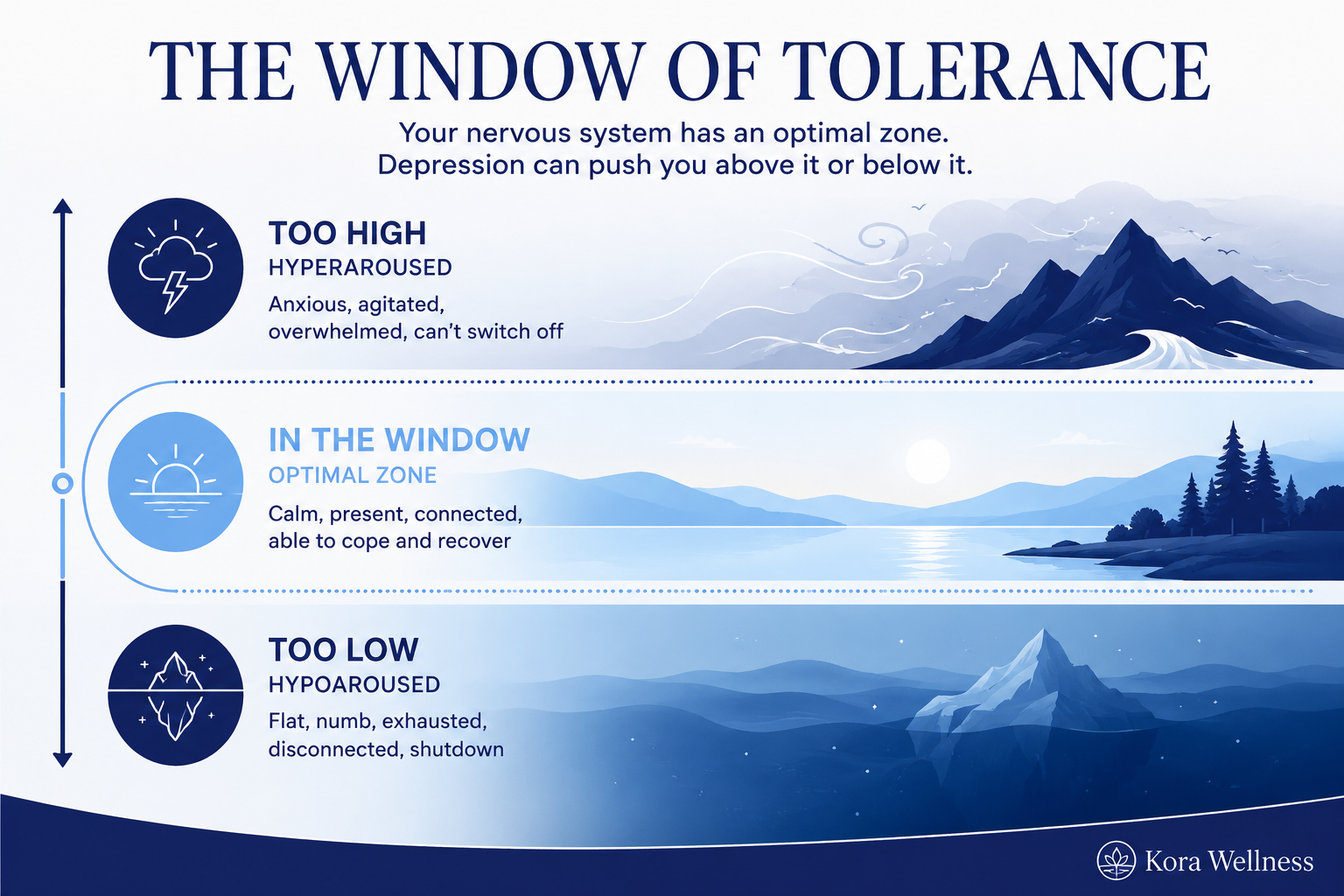
The type of session that helps depends on which side of the window you're on, and the two states can look very different from the outside.
What breathwork actually does, and why the 9D format is different
When you breathe in a pattern that extends the exhale (nasal breathing in a downregulating session, continuous circular mouth breathing in an activating one) the vagus nerve fires.
It sends a signal to the heart to slow down and to the adrenal glands to ease off cortisol production.
Heart rate variability (the natural beat-to-beat variation that reflects how flexible and responsive the nervous system is) rises. The body begins shifting from sympathetic to parasympathetic dominance.
This is the mechanism behind what Fincham and colleagues measured: real physiological change, not a temporary feeling of calm that evaporates when the session ends.
The 9D audio system adds a layer on top of this that standard breathwork and home practice don't have. Two slightly different tones play into each ear simultaneously, a few hertz apart.
The brain perceives the gap between them as a single sound and, over the course of a session, its own electrical activity begins to follow that frequency, a process called brainwave entrainment.
Alpha frequency ranges (roughly 8–13 Hz) are associated with calm, relaxed alertness; theta ranges (4–7 Hz) with deep rest and emotional processing.
Research into binaural beats is still developing: a 2025 study examining theta-frequency brainwave synchronisation found measurable effects on mood state, and a separate study on binaural beat audio and affective symptoms showed changes in psychological measures.
The audio tracks also embed solfeggio frequencies, specific tones associated with particular physiological states, across the session.
The clinical evidence for specific solfeggio claims doesn't reach the standard of the breathwork or binaural beat literature, and this post won't overstate what the research supports.
What is easier to describe is the sensory experience: the layering of frequencies in a 9D session creates an audio environment qualitatively different from breathing in silence or with a simple meditation track.
People who have done both consistently describe it as a different category of experience and the sound design makes it easier to drop in and stay there in a way that silence or ambient music don't produce.
Each 9D journey is a professionally produced audio recording, scripted and recorded by the 9D Breathwork franchise and licensed to facilitators like Kora Wellness.
Woven into the music, frequencies and breathing cues are spoken NLP affirmations and reframing prompts (neurolinguistic programming uses specific language patterns to shift how a person is relating to their own experience).
Because the voice arrives through headphones mid-session rather than in face-to-face conversation, it lands differently. In ordinary waking life, the mind is defended: it screens incoming messages, argues back, contextualises.
During a breathwork session, the breathing pattern has already changed what the body is doing. The nervous system is in a different state than it was twenty minutes ago, awake but more open, with the usual filters operating differently.
The affirmations arrive in that context, not into a defended mind, but into a system that's genuinely more receptive than it is under ordinary conditions. This is the physiological basis for what people describe as 9D breathwork bypassing the thinking mind, which is less mystical than it sounds.
The last layer is one that home practice and apps can't replicate: other people breathing in the same room.
Nervous systems regulate each other; co-regulation is a neurological process.
What happens in a group session is partly the breathing, partly the audio, partly Hayley's facilitation and partly something that emerges from the shared experience of a room of people doing the same thing together.
Depression often involves a quiet withdrawal from connection, not by choice but as a symptom. The group container at Kora is part of what the session intervenes on, not incidental to it.
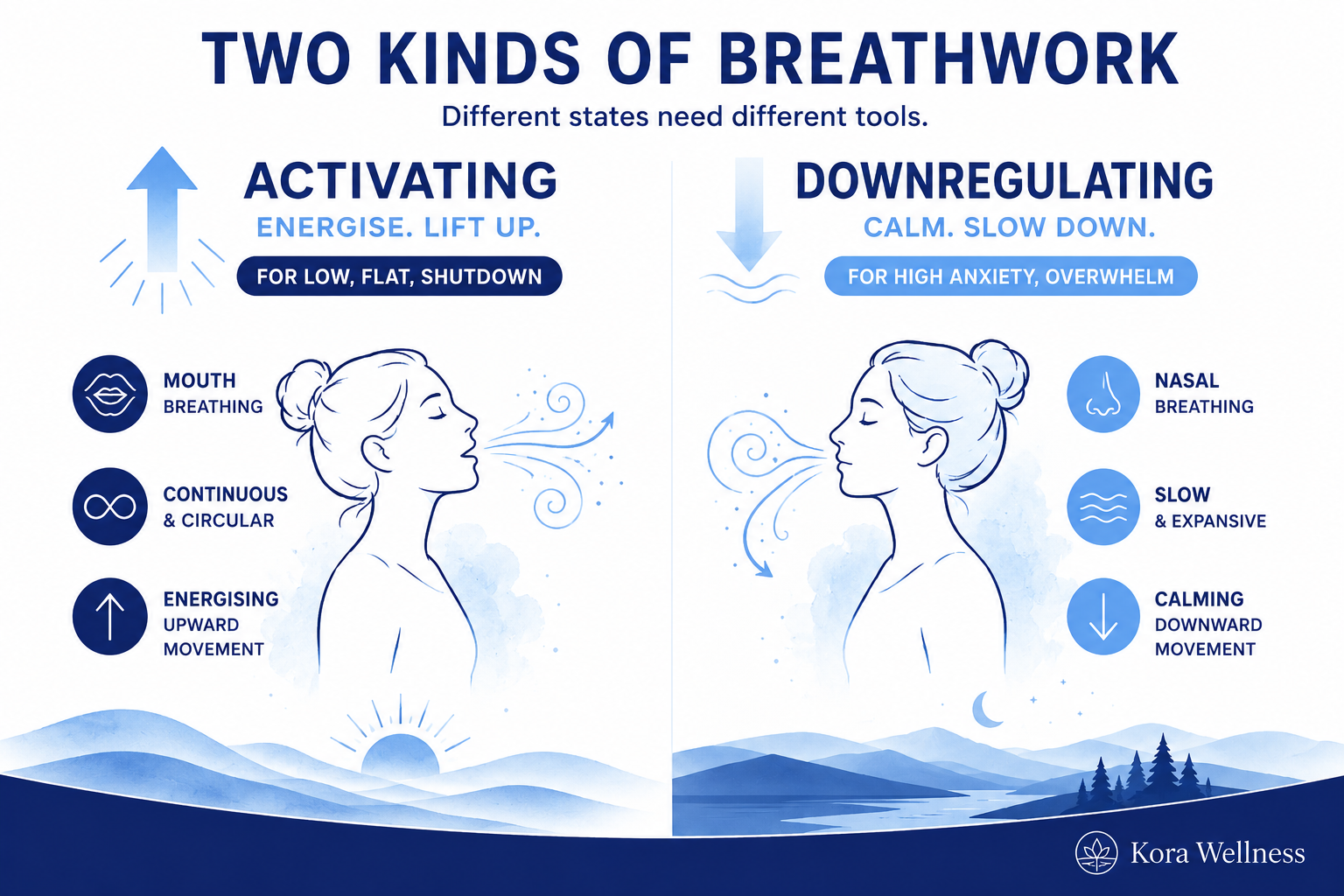
Flat, numb depression and anxious, agitated depression call for different session formats; the distinction is physiological, not a matter of preference.
Not sure which format suits where you are right now? We always welcome emails or calls to help you decide which journey is best suited for where you are at. Feel free to call us or if you’re ready to book a session at Kora Wellness, we can take it from there.
What the evidence says
A 2023 meta-analysis by Fincham and colleagues in Scientific Reports reviewed 18 randomised controlled trials involving 785 adults and found breathwork produced a significant reduction in depressive symptoms, with a Hedges' g = −0.40, p < 0.0001. This is a clinically meaningful effect size, comparable to results from established psychological treatments for depression.
A 2024 scoping review by French and colleagues in Counselling and Psychotherapy Research looked across multiple study designs and found controlled breathing consistently improved mood outcomes in people being treated for depression, identifying it as a credible adjunct approach and recommending further controlled research.
A 2023 paper in Frontiers in Neuroergonomics (PMC10228690) examined depression through the lens of the brain-heart axis and vagal dynamics, arguing that dysregulated cardiac vagal and autonomic function may be a causal factor in depression rather than merely a consequence of it. This reframes depression as partly a nervous system regulation problem, connecting mood regulation to autonomic function rather than brain chemistry alone.
A supporting paper on the vagus nerve (PMC9685564) traced the mechanism further, showing how vagal signalling influences serotonin production through the gut-brain axis, which is consistent with the body-level model of depression the PMC10228690 paper describes and with the physiological approach breathwork takes.
Early research into binaural beats (PMC11811546, PMC12597119) shows measurable effects on mood state and affective symptoms. The research is not yet definitive, but the mechanism of brainwave entrainment is consistent across multiple studies and consistent with what people report from 9D sessions.
Sources: Fincham et al., Scientific Reports (2023) · French et al., Counselling and Psychotherapy Research (2024) · PMC10228690: brain-heart axis and vagal perspectives on depression · PMC9685564: vagus nerve, serotonin, and gut-brain signalling
The Fincham finding is worth sitting with: across 18 trials and nearly 800 participants, breathwork reduced depressive symptoms with an effect size that matches what psychological therapies produce.
Hedges' g of 0.40 is considered a small-to-medium effect by research convention, which understates it, because in mental health treatment, effects of this consistency across multiple independent trials are actually rare.
The question isn't whether breathwork produces a depression effect. The question is why, and which format produces it most effectively for any given person.
The PMC10228690 paper is relevant to that question. Its argument, that depression may arise partly from dysregulated vagal and autonomic nervous system dynamics rather than brain chemistry alone, shifts how we understand what breathwork is doing.
If depression is, at least in part, a nervous system regulation problem, then breathwork is not a complementary therapy being layered on top of the real treatment.
It is acting on a dimension of the condition that medication and therapy don't directly reach.
On binaural beats: the evidence base is earlier-stage. The mechanism (the brain entraining to the perceived gap between two slightly different tones) is measurable and reproducible across multiple studies.
The translation of that entrainment into specific mood outcomes is where the research is still developing, with some studies showing reductions in depression and anxiety scores and others showing more mixed results.
The early evidence is consistent enough to justify inclusion in the 9D format, the mechanism is neurologically plausible, and the clinical picture will be clearer in five years than it is now.
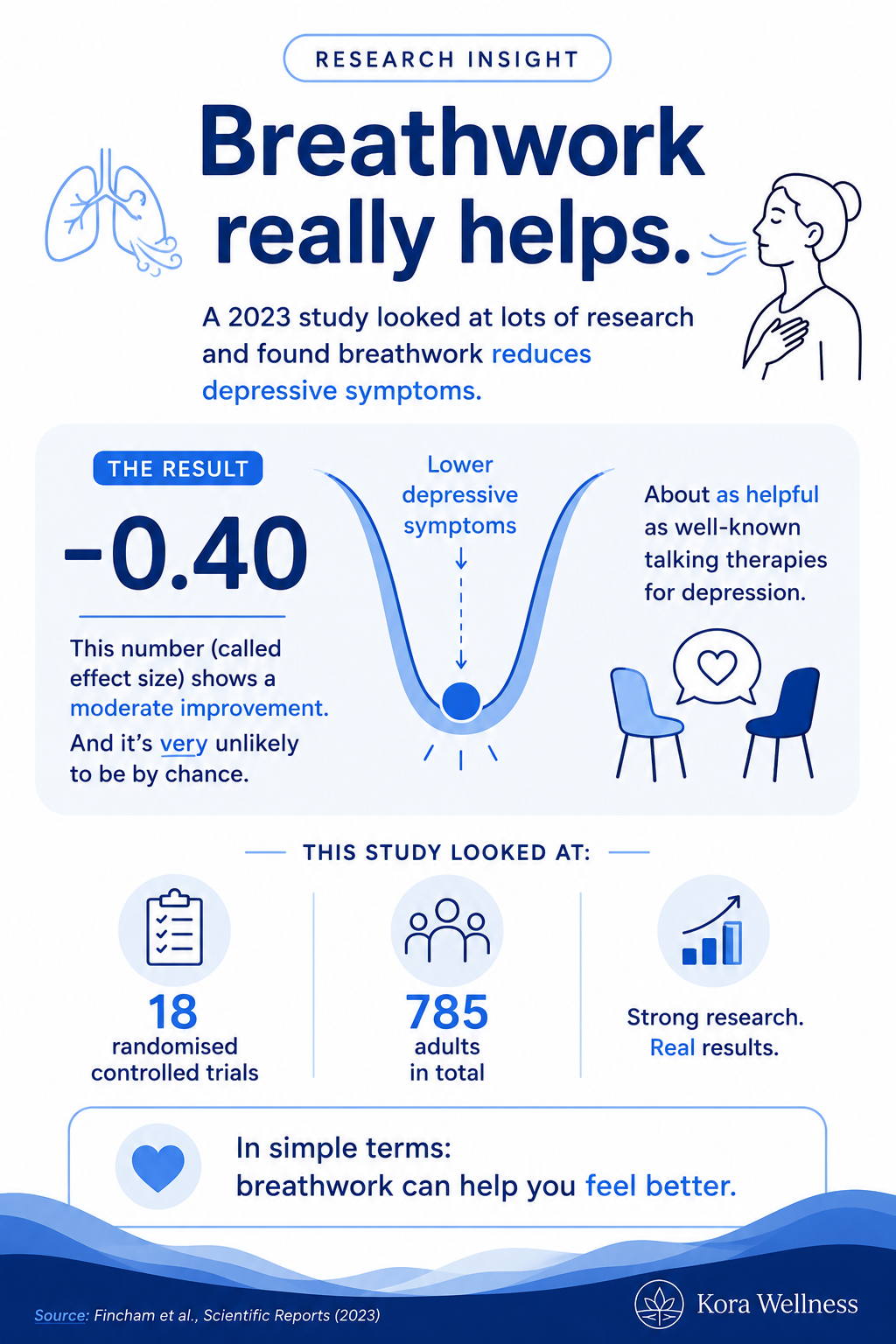
18 randomised controlled trials, 785 adults, Hedges' g = −0.40: the effect is consistent, meaningful, and reproducible.
What a session feels like when you come in carrying something heavy
In July, the sky over Port Kembla goes dark before dinner.
The people who come to a Wednesday or Friday evening session at the studio on Wentworth Street often arrive straight from work, or after a full day of holding themselves together, keeping the gap between how they feel and what the day required from showing on their face.
They come in carrying something they haven't put down in a while.
The session format is the same regardless: mats on the floor, blankets, an eye mask at the top of each mat.
You lie down, put on headphones and follow guided breathing while the 9D audio (layered frequencies, binaural tones, guided voice, music) moves through the session.
There is nothing required of you except following the breath cue and staying with it.
The first few minutes tend to produce one of two things: a noticeable loosening, or a quiet resistance; if it arrives, it's a sign the body recognises it's being asked to do something different.
A body that has been carrying something for a long time can brace slightly against the idea of putting it down. If that happens in the first few minutes, the session is already working.
Emotion surfaces when the usual defended state shifts, and in a 9D session, the combination of audio environment and breathing pattern creates conditions for that shift to happen more completely than in ordinary life.
Crying is common in sessions for depression, not from distress but from relief, the body releasing something it has been carrying without a clear name for it.
What the shift looks like varies: unexpected lightness, grief that has been sitting beneath the surface for months, or nothing particularly dramatic during the session and a noticeable difference in the days that follow: a shorter gap between a stressor arriving and the body settling, a slight change in the texture of daily life.
How stored emotional weight moves through breathwork follows a different logic than processing it cognitively and the experience in the room reflects that.
What people consistently describe about leaving a session is how different it feels from leaving a therapy appointment, which ends with something to think through or process.
After breathwork, the shift has already happened in the body and there's nothing to do with it cognitively, because it didn't go through the mind.
By the time people who come regularly are into their sixth or eighth session, most of them describe that difference becoming more pronounced: a baseline that has shifted in a way they can feel but couldn't quite have predicted from the outside.
If anxiety is running alongside the low mood, it's worth knowing that this is one of the more common presentations we see and the two often respond to the same format, at least at the start.
Before you book: what's worth knowing
Breathwork is a complement to professional mental health support, not a replacement for it.
For anyone living with clinical depression, the most evidence-supported approach involves therapy, medication where indicated, and body-based practices like breathwork working alongside each other, each addressing a different dimension of the same condition.
If you're currently seeing a GP, psychologist, or psychiatrist, telling them you're attending breathwork sessions is straightforward and unlikely to raise any concerns. Our role is facilitation and nervous system support. Clinical treatment sits with your treating team.
If you're in crisis or experiencing thoughts of suicide, please reach out to Lifeline on 13 11 14 before booking a session. You can also use their online chat at lifeline.org.au.
Activating breathwork (the continuous circular mouth breathing format used in 9D activating sessions) is contraindicated for anyone with a bipolar disorder diagnosis, pregnancy, cardiovascular conditions, detached retinas and schizophrenia.
The breathing pattern carries a genuine clinical risk for those who live with these and cannot be accomodated.
Antidepressants are not a contraindication: breathwork and medication work on different pathways and there is no evidence of interaction.
If you're looking for professional mental health support in the Illawarra alongside your sessions at Kora, these services are a good starting point:
- Stride Mental Health: Wollongong Mental Health Hub
Free mental health support for people who face barriers to accessing services, including walk-in access. stride.com.au/wollongong-mental-health-hub - Grand Pacific Health: Mental Health Direct
Illawarra-based team of psychologists, counsellors, and mental health social workers covering Wollongong, Nowra, and surrounds. gph.org.au - Illawarra Community Mental Health (ICMH)
Public health triage and referral through Illawarra Shoalhaven Local Health District. Phone: 02 4254 1500. - headspace Wollongong
Mental health support for people aged 12–25, including for young people themselves and for parents. headspace.org.au/headspace-centres/wollongong - Lifeline Illawarra
24/7 crisis support line: 13 11 14. Online chat available at lifeline.org.au
The body is carrying this. The right session gives it somewhere to put it down.
Kora Wellness runs group sessions weekly. Our $99 intro offer covers your first three group sessions. We can't wait to welcome you to the Kora family.
Book a session at Kora Wellness in Port KemblaFrequently asked questions about breathwork and depression
Can breathwork help with depression?
Yes. A 2023 meta-analysis by Fincham and colleagues published in Scientific Reports reviewed 18 randomised controlled trials involving 785 adults and found breathwork produced a significant reduction in depressive symptoms, with a Hedges' g effect size of −0.40 (p < 0.0001), a clinically meaningful result comparable to established psychological treatments.
Breathwork acts directly on the nervous system through the vagus nerve, lowering cortisol and shifting the body from sympathetic dominance toward parasympathetic dominance.
The type of session that tends to help most depends on how depression is presenting: flat or numb depression may respond better to activating breathwork, while anxious or agitated depression may respond better to downregulating breathwork.
What type of breathwork is best for depression?
The right session type depends on how depression is presenting in the nervous system.
Flat, numb, or shutdown depression reflects hypoarousal, where the nervous system has dropped below what researchers call the window of tolerance. Activating 9D breathwork, which uses continuous circular mouth breathing, raises activation and tends to be a better fit for this state.
Anxious or agitated depression reflects hyperarousal, the nervous system running too high, and may respond better to downregulating 9D breathwork, which uses slow nasal breathing throughout.
The health screening waiver during booking and a personal check-in sheet on the day help us understand where you are and facilitate accordingly.
Is breathwork safe if I'm taking antidepressants?
Yes. Breathwork does not interact with antidepressant medication. The two work on different pathways: medication on brain chemistry, breathwork on the autonomic nervous system through the vagus nerve.
There is no evidence of adverse pharmacological interaction. It is worth noting on your check-in sheet that you are currently taking medication, so we can support the session appropriately.
Can breathwork make depression worse?
For most people with depression, breathwork, when the session type is matched to their nervous system state, does not worsen depression.
However, choosing the wrong format can produce an unhelpful experience: a person in hypoarousal (flat, numb depression) attending a downregulating session may feel heavier, because that format further reduces an already low activation state.
Identifying the right session type before attending matters for this reason.
Anyone experiencing a mental health crisis or active suicidal thoughts should contact Lifeline on 13 11 14 before booking a session.
How many 9D breathwork sessions do I need to notice a difference in my mood?
Most people notice a subjective shift, a change in how they feel in the hours following a session, from their first or second attendance.
Baseline change, the kind that carries over into daily life between sessions, typically becomes noticeable within three to six weeks of attending regularly.
Frequency matters significantly: two to three sessions per week produces faster and more durable change than once-weekly attendance. The nervous system is a pattern-learning system, and each session builds on the last.
The learning compounds with repetition rather than plateauing after an initial improvement.
Is breathwork safe if I have bipolar disorder?
Activating 9D breathwork (which uses continuous circular mouth breathing) is contraindicated for people with a bipolar disorder diagnosis, with no clearance pathway.
The circular breathing pattern carries a genuine clinical risk of triggering a manic episode regardless of the person's current mood phase, and this applies whether or not the person is currently medicated or in a stable period.
If you have a bipolar disorder diagnosis, please speak with your treating team before attending any breathwork sessions.
Can breathwork replace therapy or medication for depression?
No. Breathwork is a somatic complement to professional treatment, not a standalone replacement for therapy or medication.
For clinical depression, the evidence-supported approach typically involves psychological treatment, pharmacological support where indicated, and body-based practices that work on the nervous system directly.
Breathwork addresses the physiological dimension of depression (the autonomic nervous system state, vagal tone, and cortisol pattern) in a way that neither therapy nor medication directly targets. It is most effective used alongside professional support, not instead of it.
Why do I feel emotional or cry during a breathwork session?
Breathing-induced shifts in physiological state can surface emotion that the body has been holding without conscious access.
During a session, the breathing pattern changes the nervous system's activation state, shifting from the defended, alert mode of ordinary waking life to a more open, less filtered one.
Emotion (sometimes grief, sometimes relief, sometimes without a clear label) can arise in this context. This is a normal and expected part of breathwork, not a sign that something has gone wrong.
Many people describe the experience as a release rather than a distress response.
What is the difference between breathwork for depression and breathwork for anxiety?
The physiological mechanisms overlap substantially. Both conditions involve the vagus nerve, cortisol dysregulation, and autonomic nervous system imbalance.
Anxiety primarily involves hyperarousal, with the nervous system running at an elevated activation level, and responds to downregulating breathwork.
Depression can involve either hypoarousal (flat, numb, shutdown) or hyperarousal (anxious, agitated depression), and the session type should be matched to the current state rather than to the diagnostic label.
Many people experience depression and anxiety simultaneously, in which case downregulating breathwork is usually the appropriate starting format, with activating sessions introduced once the nervous system has more capacity.
About the Author
Kora Wellness is the Illawarra's dedicated 9D breathwork studio, founded by Hayley Simpson and located at 43 Wentworth Street, Port Kembla NSW. Hayley is a certified 9D Breathwork facilitator and Master NLP Practitioner with a trauma-informed approach. Kora Wellness offers weekly group sessions, private 1:1 journeys, and online breathwork for clients across Wollongong, Shellharbour, Thirroul, Warilla and the broader Illawarra.
