
How to reset your Nervous System when rest isn't enough
Published by Kora Wellness | Port Kembla, NSW | Serving the Illawarra region including Wollongong, Shellharbour, Thirroul, and Warilla.
You've been sitting wherever you happen to sit for twenty minutes doing nothing in particular and something has shifted.
There's a flat, suspended kind of silence in the air around you that doesn't quite match what you’ve come to expect.
There’s pressure and a heavy quality to the air that feels really dense and like the world is waiting for you to do something, be somewhere or just keep pushing through when your tank has been empty for months.
Your body is still running on the adrenalin of the upcoming end of financial year that’s coming up.
When you've been carrying that kind of weight in your mind and body for extended periods of time (and let’s face it, most adults have been doing exactly that in one way or another) the nervous system doesn't just reset because the season has changed or the school term ended or the project finally wrapped up.
The brain may understand that things have eased but the body hasn't received that message yet. The nervous system doesn't distinguish between kinds of pressure; it only knows how long it's been on.
This post is about the gap between a nervous system that’s been activated for far too long continually and a nervous system that knows how and when to shut off.
We’ll include what sustained stress actually does to the body over time, why a long weekend or even a proper holiday often can't close it and what does.
There's good evidence for what actually works and it turns out to be more specific, and more within reach, than most burnout advice would have you believe.
If this year cost you more than you expected, keep reading. There is a very specific reason why starting a downregulating breathwork practice makes sense for your body right now and why waiting until you feel ready is actually the one approach least likely to help.
Ready to feel this rather than read about it? Kora Wellness runs weekly sessions at 43 Wentworth Street, Port Kembla. Book your first session here.
What sustained pressure actually does to your body over time
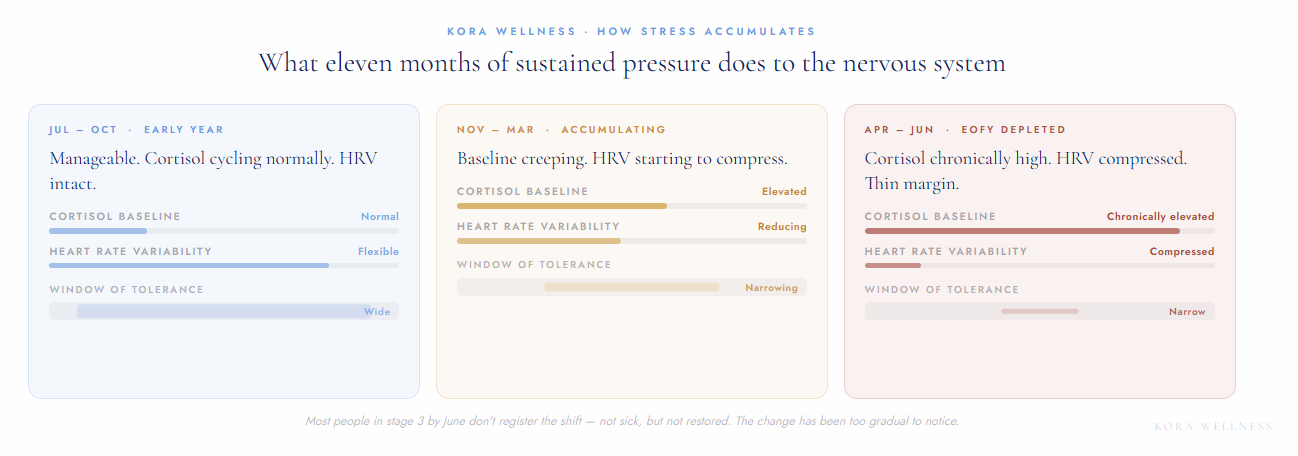
The shift is too gradual to notice from the inside. Most people arrive at the end of a long stretch operating on a significantly thinner margin than they started with.
Cortisol is a stress hormone and the chemical your body releases when it decides there's something to manage. In a healthy stress cycle, cortisol rises when a challenge arrives and drops once the challenge passes.
What a long stretch of sustained pressure often produces is a nervous system that has been cycling through enough short bursts of stress, often enough, for long enough, that the drop-off stops happening fully. The baseline has crept up, slowly enough that nobody notices until it's already happened.
The symptom of that creeping baseline is something most people recognise even without a name for it:
you're technically fine, but something feels flat
not sick, but not rested
sleep is less satisfying than it used to be
small things land harder than they should
you're more reactive, or more withdrawn, in ways that have started to feel normal but didn't used to be.
Your heart rate variability which is the natural variation in the gap between each heartbeat, is one of the more reliable measures of nervous system load.
A flexible, well-regulated nervous system produces a heartbeat that varies slightly from beat to beat. That variation is a sign the nervous system is adaptable: able to shift between alert and calm, effort and recovery.
Under sustained stress, that variation shrinks. It's a sign the body is running in a rigid, high-alert pattern rather than an adaptive one.
What burnout actually does to the nervous system plays out at this level and not just as a feeling, but as measurable change in how the body regulates itself.
The window of tolerance narrows gradually across a long stretch of sustained pressure, and by the time it finally eases, most people are operating on a thinner margin than they were twelve months ago, without realising it's happened.
Why rest doesn't always work and what your nervous system actually needs
Most people's first instinct after a hard stretch is to rest. Stop working, sleep in, take a few days somewhere quiet. Rest matters so it's not the wrong instinct.
The problem is that for a nervous system that has been in a sustained activation state for months, or sometimes even years, rest often doesn't deliver what you'd expect.
Stephen Porges, the neuroscientist who developed Polyvagal Theory (which is a model for understanding how the nervous system processes safety and threat) showed that the nervous system learns patterns of activation.
When you've been running at high alert for an extended period, the body begins to treat that level of arousal as its default. The environment has been saying: stay ready.
A long weekend, or even a week away, doesn't override that learned pattern. The external demand drops, but the underlying state of the nervous system stays where it is. This is why people come back from holidays still feeling tired.
It's also why a good night of sleep one evening doesn't carry over the way it did a few years ago. The nervous system hasn't received a new signal because it's been put in a room with less happening, but it's still waiting for the next problem to arrive.
The overlap between burnout and anxiety in the body runs through exactly this mechanism: both involve a nervous system that has adapted upward and both respond to a direct downward shift rather than a passive pause.
What downregulating breathwork does to your cortisol and HRV
The vagus nerve is the main communication line between your brainstem and your body's major organs - heart, lungs, gut.
When you breathe slowly through your nose and let the exhale run longer than the inhale, the vagus nerve fires in a way that sends a specific signal to the heart: slow down.
At the same time, it signals the adrenal glands to ease off cortisol production. HRV rises. The body begins to shift from its sympathetic (alert) state to its parasympathetic (repair) state. You can feel the initial change within a few minutes of a session but the real value builds over weeks.
Fincham and colleagues, writing in Scientific Reports in 2023, reviewed the research across multiple breathwork studies and found significant reductions in both anxiety (effect size around 0.32) and depression (around 0.40).
These are clinically meaningful numbers that are comparable to results from established psychological treatments.
The finding matters for recovery specifically because it suggests breathwork isn't only producing temporary calm in the moment. It's producing measurable change in the underlying systems that drive anxious and dysregulated states.
There was also an 8-week randomised controlled trial published on PMC which studied participants who practised slow diaphragmatic breathing daily.
After eight weeks, the breathwork group showed significantly lower cortisol than the control group, measured in both blood and saliva. The nervous system wasn't just settling during sessions, it was recalibrating what normal looked like outside of them.
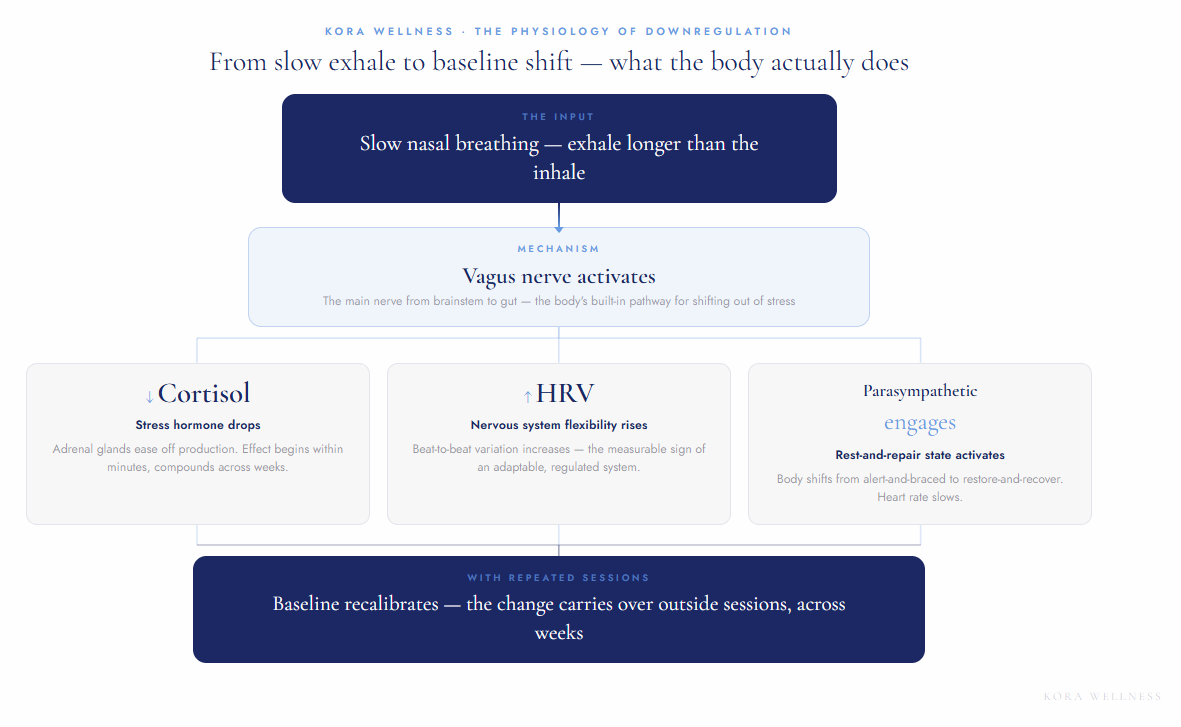
One input, three measurable effects and with repetition, a baseline that carries over outside sessions and across weeks.
Downregulating sessions are specifically designed for this state and for a nervous system running too high that needs to learn, through repetition, what a lower baseline actually feels like.
Wondering whether downregulating breathwork is the right fit for where you are right now? I’d love to chat and can direct you to the breathwork session that’s best designed for where your nervous system is at right now, or you can find a session at Kora Wellness here.
Why the moment after the pressure lifts is a better starting point than waiting until you feel ready
Most people expect to feel better once the pressure eases.
Sometimes that happens and the first few days after a hard stretch often bring a kind of genuine relief.
But the nervous system's recalibration doesn't follow the same timeline as external events. The body has been carrying the weight of sustained activation, and that weight doesn't lift when the project closes or the deadline passes.
The real fatigue tends to surface a little later (in the first quiet week) when there's finally enough stillness to feel what's been there all along. That moment of quiet depletion turns out to be a better starting point for recovery work than most people expect.
When the desire for something different is genuine and the nervous system is at its most stretched, the physiological contrast produced by downregulating breathwork is also at its most noticeable.
The first session often lands harder than people anticipate and it’s not because it's intense, but because the contrast with the baseline they've been carrying is so pronounced. People consistently describe it as the most deeply rested they've felt in months.
Starting a practice at this point - while the contrast with baseline is still pronounced - also means that by the time the next cycle of demands arrives, the recalibration has had time to build.
How frequently to practise for nervous system recovery is one of the most common questions people ask before they begin, and in a recovery context the answer is usually more than they expect: two to three downregulating sessions a week, for at least six weeks, to shift the baseline rather than just manage individual moments.
The research is consistent on this point: the benefits of breathwork compound with repetition. A nervous system that has had twelve sessions over six weeks is in a measurably different place to one that has had two.
What starting a breathwork practice at Kora Wellness actually looks like
The session format matters more than most people realise before they start.
Our 9D breathwork system includes two distinct types of session: activating and downregulating.
Activating sessions use continuous circular mouth breathing and are built for a nervous system with capacity for intensity. Downregulating sessions use slow nasal breathing throughout which is quieter, deeper and specifically calibrated for someone whose system has been running too high for too long.
For someone coming out of a hard stretch, downregulating is the right starting point with slow nasal breathing with the exhale running longer than the inhale, nothing forced.
You lie down, put on headphones and follow guided nasal breathing while the 9D audio which is a layered blend of binaural tones, music and guided voice which carries you into a state of deep physiological rest.
Most people describe it as the deepest rest they've had in months. Some people cry, not from distress but from the relief of the body finally putting something down.
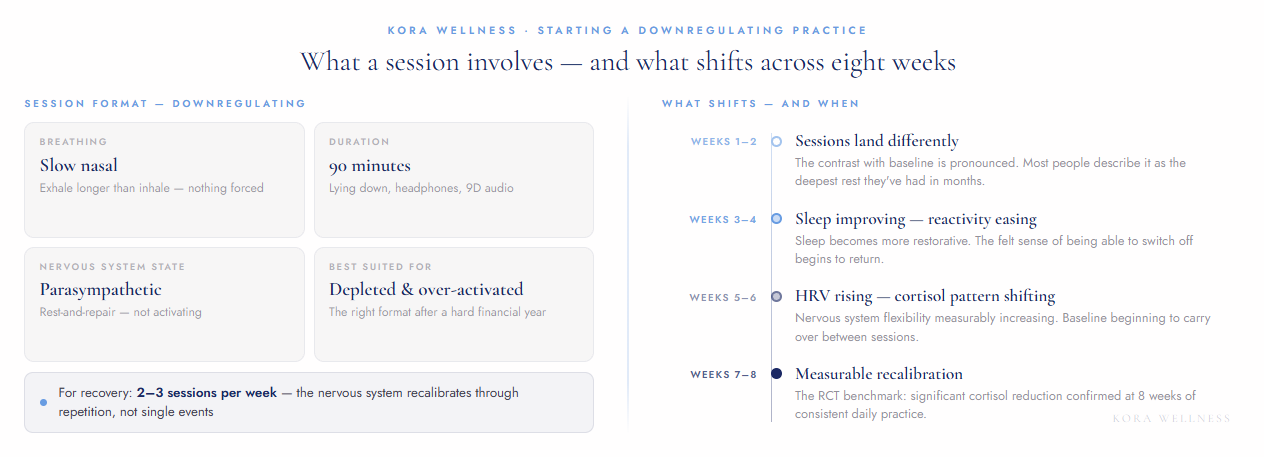
The first session tends to land harder than people expect - the contrast with baseline is that pronounced. The shift across eight weeks is measurable by research standards.
Kora Wellness runs group sessions five days a week: Tuesday, Wednesday and Friday evenings at 6:30pm, and Thursday and Saturday mornings at 10:00am. The studio is at 43 Wentworth Street in Port Kembla, a short drive from Wollongong's CBD and draws people from across the Illawarra - Shellharbour, Thirroul and further.
For new clients, the $99 intro offer covers your first three group sessions with full facilitation. Hayley works from a trauma-informed approach, which means she works from wherever you actually are and not from a script about where a wellness client is supposed to be.
If the past year handed you something heavier than usual, you don't need to have processed it before you arrive. That's what the session is for.
Frequently Asked Questions about nervous system reset and burnout recovery
How do I reset my nervous system after a stressful year?
Resetting the nervous system after sustained stress requires more than passive rest.
When the body has been under chronic pressure, the sympathetic nervous system (the fight-or-flight system) maintains a heightened activation state even when external demands reduce.
Effective reset involves deliberate parasympathetic activation through a direct physiological pathway, such as slow nasal breathwork with an extended exhale. This stimulates the vagus nerve, lowers cortisol and raises heart rate variability.
Regular practice over four to eight weeks produces measurable baseline change.
Why do I still feel burnt out even after time off?
Burnout persists after rest because passive rest reduces demand on a stressed nervous system without changing its activation state.
After months of high-alert operation, the sympathetic nervous system maintains that elevated baseline even when the external pressure lifts - a learned adaptation described in Stephen Porges' Polyvagal Theory.
Recovery requires active physiological downregulation: a direct signal, typically through slow exhalation-extended breathing, that tells the nervous system it is safe to shift out of sustained activation.
What is a nervous system reset?
A nervous system reset is a deliberate shift from sympathetic nervous system dominance - the fight-or-flight state, associated with elevated cortisol and compressed heart rate variability - to parasympathetic dominance, the rest-and-repair state.
This shift is achieved through slow nasal breathing with an extended exhale, which activates the vagal brake: the mechanism by which the vagus nerve slows the heart and signals the body to reduce stress hormone production. Repeated practice recalibrates the baseline outside of sessions over time.
Can breathwork help with EOFY burnout?
Yes. Downregulating breathwork directly addresses the physiological mechanisms of burnout: elevated cortisol, compressed heart rate variability, and sustained sympathetic nervous system activation.
A 2023 meta-analysis by Fincham and colleagues published in Scientific Reports found significant reductions in anxiety and depression across multiple breathwork studies.
A separate 8-week randomised controlled trial found measurable cortisol reductions in participants who practised slow diaphragmatic breathing daily compared to a control group.
How long does it take to recover from chronic stress?
Recovery timeline varies, but research suggests measurable improvements in cortisol and heart rate variability within four to eight weeks of consistent breathwork practice.
The 8-week diaphragmatic breathing RCT published on PMC found significant cortisol reductions compared to a control group after eight weeks of daily practice.
Subjective improvements in sleep quality, mood and the ability to switch off, tend to become noticeable within two to four weeks of beginning regular downregulating breathwork. Full nervous system recalibration typically requires sustained practice over two to three months.
Why do I feel worse in June and July?
June and July combine the accumulated stress load of the Australian financial year with winter seasonal effects: shorter days, lower temperatures, and altered circadian rhythms.
Beyond Blue research found 77% of Australians report elevated stress heading into the financial year close, and the year-end arrives while most people are still working rather than resting.
The nervous system is often at its most depleted in early July - which, for the same reason, makes it a particularly productive time to begin a recovery practice.
What's the difference between rest and a nervous system reset?
Rest reduces external demand on an activated nervous system. A nervous system reset changes the activation state itself.
When the nervous system has been in chronic stress mode, its sympathetic branch remains partially dominant even during rest which is why many people take a holiday and still feel flat or wired a few days in.
A reset requires deliberate parasympathetic activation through the breath-vagus nerve pathway, producing measurable changes in heart rate variability and cortisol that carry over beyond the session.
How does breathwork lower cortisol?
Slow nasal breathing with an extended exhale stimulates the vagus nerve which is the nerve running from the brainstem to the gut that regulates the body's stress response.
Vagal stimulation activates the parasympathetic nervous system, which signals the adrenal glands to reduce cortisol production and slows the heart rate.
Repeated sessions compound this effect: an 8-week diaphragmatic breathing trial found participants showed significantly lower cortisol, measured in both blood and saliva, compared to a control group after eight weeks of daily practice.
Is breathwork good for burnout recovery?
Yes, particularly downregulating breathwork which are sessions using slow nasal breathing with an extended exhale. This format directly addresses the physiological core of burnout which includes elevated cortisol, compressed heart rate variability, and chronic sympathetic activation.
Fincham and colleagues' 2023 meta-analysis in Scientific Reports found breathwork produced clinically significant reductions in anxiety and depression, with effect sizes comparable to established psychological treatments.
For people in active burnout recovery, downregulating sessions are preferable to activating circular-breathing sessions, which place additional demand on an already depleted system.
How often should I do breathwork to recover from burnout?
For burnout recovery, two to three downregulating sessions per week produces better outcomes than once-weekly practice. The nervous system learns from repetition: regular sessions teach it what a regulated baseline feels like and gradually shift the default activation level.
Once-weekly practice maintains the benefit of individual sessions but produces slower cumulative recalibration. People recovering from sustained stress typically notice a meaningful shift in baseline within four to six weeks of committing to two or more sessions per week.
About the author
Kora Wellness is the Illawarra's dedicated 9D breathwork studio, founded by Hayley Simpson and located at 43 Wentworth Street, Port Kembla NSW. Hayley is a certified 9D Breathwork facilitator and Master NLP Practitioner with a trauma-informed approach. Kora Wellness offers weekly group sessions and online breathwork for clients across Wollongong, Shellharbour, Thirroul, Warilla and the broader Illawarra
