Kids Breathwork in the Illawarra — A Guide for Parents
Published by Kora Wellness | Port Kembla, NSW | Serving the Illawarra region including Wollongong, Shellharbour, Thirroul, and Warilla.
You know the look. The one you can pick a mile away when your child walks in from the car park and you can tell within seconds that they're still carrying everything inside. The noise of the school day, the disagreement from lunch, the test they haven't stopped thinking about since Tuesday. They sit down and it's there in their shoulders, in the way they answer.
You ask how the day was. Fine. But you can tell, it’s not fine.
Most children don't have a word for what's happening in their bodies after a full school day. They're not distressed in any obvious way, they're just running on the same stress chemistry that adults bring home from work, except that adults have had more years to notice it. The feelings show up as sharpness, or tears, or that restless inability to settle into anything for more than five minutes.
What you're watching is a nervous system that's been in a low-grade activated state for seven hours without a chance to unwind. Your child isn't doing anything wrong. Their body is doing exactly what it's built to do under pressure BUT it's just not getting a signal to stop.
Breathwork gives it that signal.
At Kora Wellness in Port Kembla, we run dedicated kids breathwork sessions for children aged 5 to 17. This guide covers what those sessions involve, what the evidence shows and everything a parent needs to know before booking.
If you'd like to check when the next kids session is running, you can view the current schedule and book here.
Why children's nervous systems need support right now
Kids breathwork is a guided practice that uses slow nose breathing combined with immersive 9D audio, to activate the parasympathetic nervous system in children.
The parasympathetic nervous system is the branch of your body's nervous system that controls the calm-down response: slowing the heart rate, lowering the stress hormone cortisol and signalling to the body that it's safe to rest.
In children aged 5 to 17, sessions use only this gentle nasal breathing and not the stronger circular mouth breathing used in adult activating sessions.
The scale of anxiety in Australian children is larger than most parents realise. According to the Australian Institute of Health and Welfare, 27.4% of primary school students and 35.9% of secondary school students are currently experiencing clinically significant levels of anxiety or depression.
A 2025 Headspace survey found that nearly half of all young Australians (49%!!!) are experiencing high or very high psychological distress. These aren't occasional bad days. For many children, this has become their normal.
School transitions are a particular pressure point. The shift from primary to secondary school, exam periods and social changes that come with different year groups all coincide with peaks in anxiety onset.
Children in the Illawarra deal with the same structural pressures young people face everywhere; academic load, social pressure, digital saturation and often without any body-based tools to process them.
The nervous system isn't broken in these children. It's doing what it was built to do under sustained pressure.
The problem is that modern childhood creates constant low-level activation with very few natural opportunities to discharge it. Breathwork provides one of those opportunities in a structured, gentle and age-appropriate way.
What kids breathwork actually is, and what it's not
What a session actually looks like: your child lies down comfortably, puts on headphones and breathes slowly through their nose while the headphones guide them through a 9D audio journey.
The 9D audio weaves together binaural beats - gentle tones that shift the way the brain processes sound - nature sounds and guided prompts into a single immersive experience. Many children describe it as feeling like a vivid daydream, or like being somewhere quiet that isn't their bedroom.
The session runs 45 to 60 minutes. There's nothing the child needs to do except breathe. They don't need to have tried meditation before. They don't need to understand the science. They don't need to hold still the entire time; if they want to shift position, that's fine.
For parents wondering about the session, there are three options: you can stay in the studio with your child, wait in the comfortable waiting area on the other side of the curtain, or drop off and return at the end.
All three work equally well and the session isn't affected by whichever you choose. There's no right answer.
You can read a full walkthrough of what a 9D breathwork session involves in our post on what happens in a 9D breathwork session — everything described there applies to the kids format, with the difference that children's sessions use only nasal breathing.
What the research shows about breathwork for children
The evidence supporting breathwork for children has grown considerably in recent years. The 2025 systematic review published in PMC examined 13 studies on diaphragmatic breathing as a therapeutic approach for children and teenagers aged 6 to 18.
Across those studies, children in the breathwork group showed measurable reductions in stress, anxiety and depression compared to control groups. Two of the studies also found improvements in school performance and not because breathing improves intelligence, but because a calmer nervous system can actually concentrate.
The 9D Breathwork organisation ran a pilot program at Saffron Walden County High School in the UK from November 2023 to February 2024, using the same program framework Kora delivers here in the Illawarra.
Students who attended regularly showed scores on the Revised Child Anxiety and Depression Scale dropping below the clinical threshold for anxiety and depression - meaning they moved from the clinically anxious range into the normal range over the course of the program.
Wellbeing scores rose. Attendance improved. Teachers described students arriving to lessons more settled and more able to engage.
The mechanism behind these results is well established. Physiologist Stephen Porges developed the Polyvagal Theory, which explains how the vagus nerve acts as a two-way communication line between the body and the brain.
When slow breathing activates this nerve, the brain receives a direct physiological signal that the environment is safe. Cortisol drops. Heart rate slows. The stress response deactivates.
In children, who have less cognitive control over their emotional state than adults, working directly with the body in this way is often more effective than any talking-based approach.
For children with ADHD, there's specific research worth noting: diaphragmatic breathing exercises have been shown to improve focus and reduce hyperactivity by improving oxygen delivery to the brain and supporting the regulation of attention and arousal. Breathwork isn't a substitute for existing ADHD support, but it can be a useful addition.
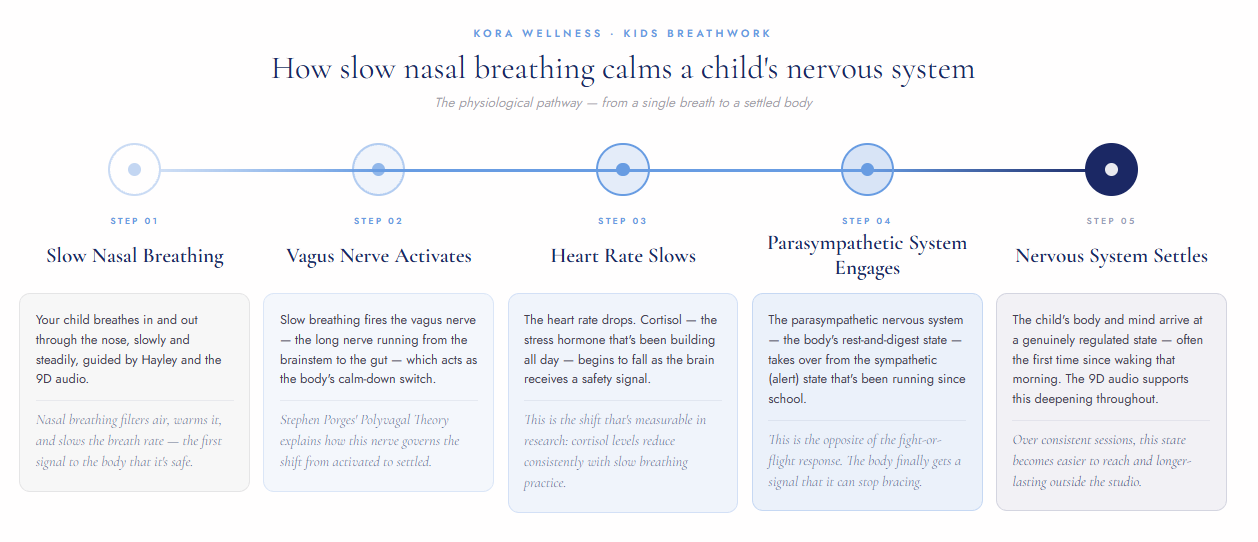
How kids breathwork works - slow nasal breathing activates the vagus nerve, which signals the brain to lower cortisol and shift out of the stress response.
If anxiety is the primary reason you're exploring breathwork for your child, our post on 9D breathwork for anxiety explains the nervous system mechanisms in detail - most of it applies to children and adults alike. To book a kids session directly, the schedule can be found on our Kids Breathwork page.
What a session at Kora Wellness looks like, step by step
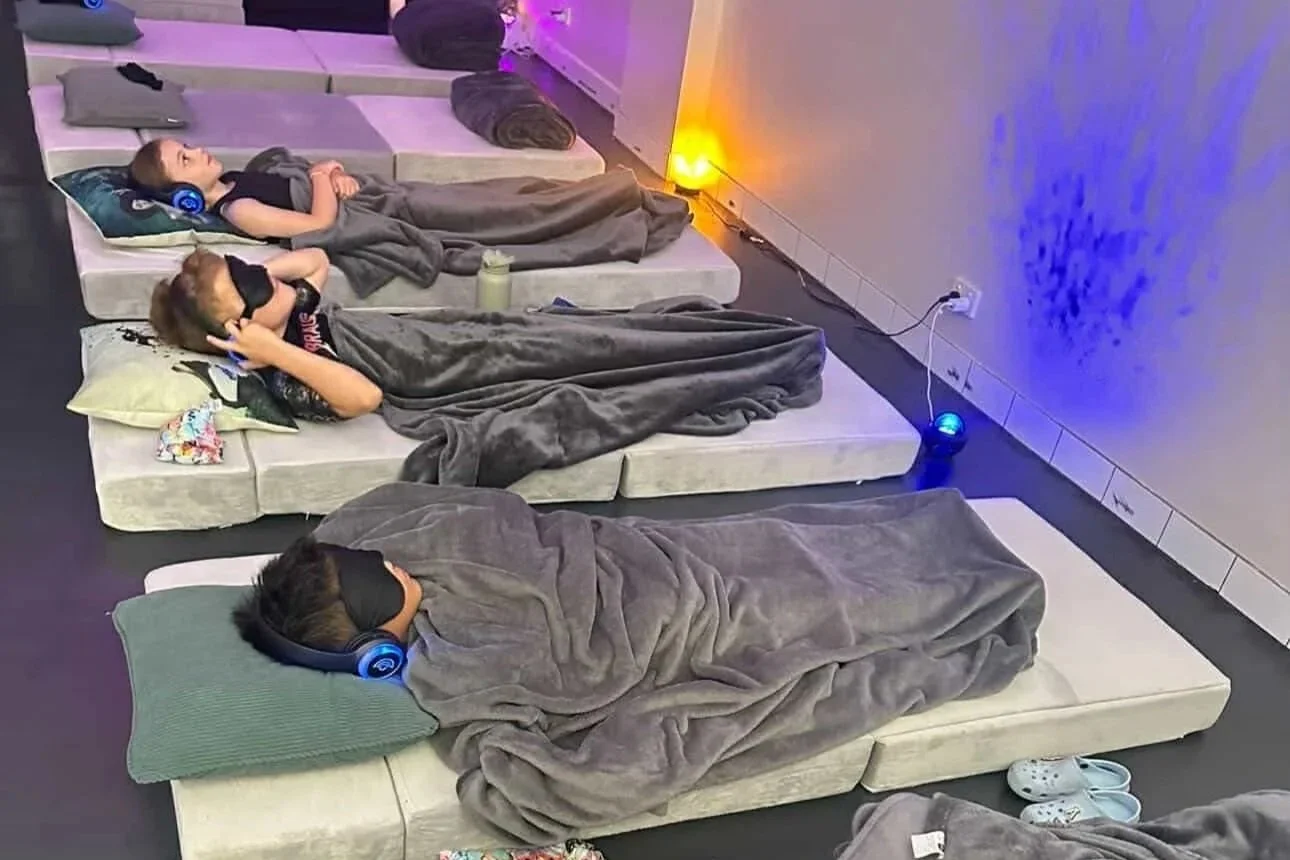
A kids 9D breathwork session in swing with children lying on padded mats with blankets and headphones while listening to the guided audio.
The Kora studio is set up so that children feel safe and comfortable from the moment they arrive. There are no bright lights or clinical settings. Children lie on a mat, with a pillow and blanket if they want one and put on headphones that deliver the 9D audio.
Hayley introduces the session with a short explanation of what will happen which is always adjusted for the age of the group. With younger children (5 to 8), this is very simple: "We're going to breathe slowly and listen to some really cool sounds."
With older children and teenagers, the explanation can go deeper if they're curious about the science.
The session itself runs without interruption. Hayley guides breathing patterns at the start and the 9D audio carries the rest. Most children drop into a deeply relaxed state within the first ten minutes.
Some fall asleep, which is also fine and perfectly natural; the audio continues to work regardless. Others remain aware and describe a sense of floating, or being somewhere peaceful.
At the end of the session, Hayley brings the group gently back to full awareness and gives children a few minutes to sit quietly before they leave. There's no pressure to talk about what they experienced, though many children want to.
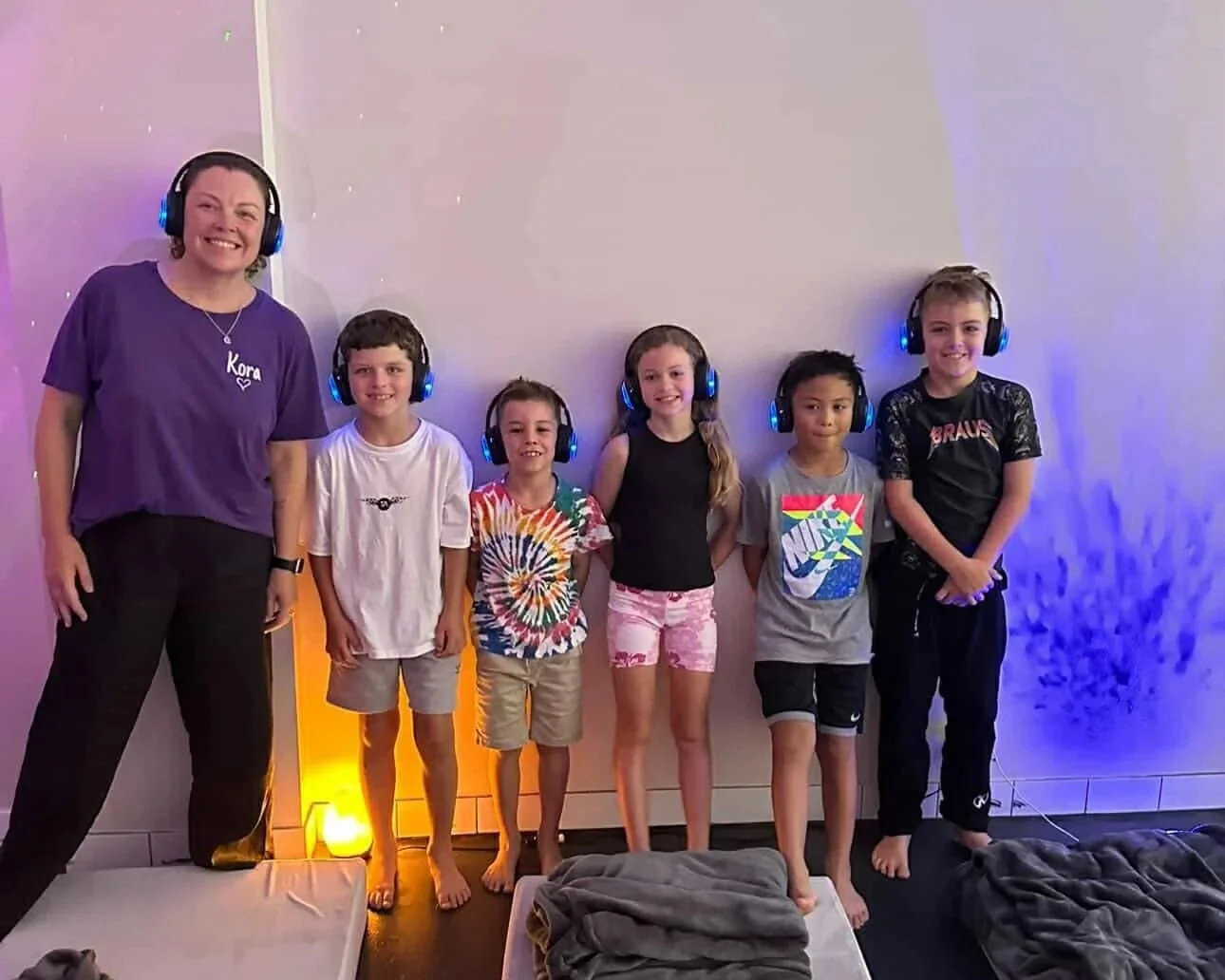
A group of happy kids after listening to the 9D breathwork audio.
Ages, suitability and what to tell Hayley before you book
There's no medical intake form for this program, because the session format is entirely downregulating and the contraindications that apply to adult activating breathwork (including cardiovascular conditions, epilepsy and certain psychiatric conditions) don't apply to gentle nasal breathing sessions. The medical profile is very clean.
If your child has a significant health condition, has been diagnosed with anxiety or a mood disorder, or is currently going through something difficult, you're welcome to mention it to Hayley when you book.
She brings a trauma-informed approach to every facilitated session, which means she has specific training in working with children who have more complicated histories. No child is turned away because their background is harder than average.
Children don't need to sit perfectly still. They don't need to meditate or adopt any particular posture. The session is designed to meet them where they are and Hayley adapts her facilitation to the group in front of her.
Teenagers (13 to 17) often respond most strongly to the sessions, which can be surprising to parents who expect adolescents to be resistant. The 9D audio format holds attention differently from conventional relaxation approaches and many teenagers describe it as the first time they've been able to genuinely switch off in a long time.
For information on the safety profile of 9D breathwork generally, our dedicated safety post covers what to look for and what questions to ask before any session.
How often should children attend?
Session frequency is what separates a single moment of calm from lasting nervous system change.
One session produces real physiological results in the body. Cortisol drops, your vagus nerve activates and the body gets a genuine rest. But those effects fade within a few days when the nervous system hasn't yet learned a new default.
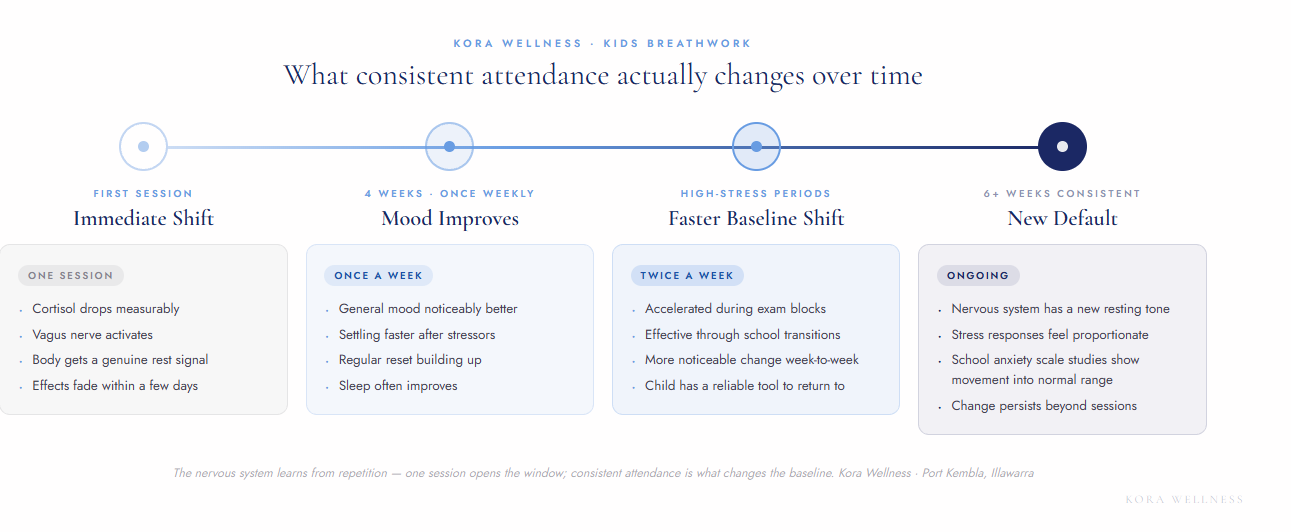
The nervous system learns from repetition - here's what consistent attendance actually changes over four to six weeks.
What changes the baseline (the underlying tone of a child's nervous system) is consistent practice over four to six weeks. Children who attend once a week notice a difference in their general mood and how quickly they settle after stressful moments. Children who come twice a week during a particularly difficult period (an exam block, a school transition, a family change) tend to experience a faster and more noticeable shift.
For general nervous system support: once a week creates a regular reset and gradual improvement in baseline regulation. For children going through a high-stress period: twice a week during that time accelerates the settling of the nervous system and gives the child a reliable tool to return to.
The children whose parents describe the biggest changes are almost always the ones who came consistently for at least a month, not the ones who tried it once and waited to see.
Frequently Asked Questions about kids breathwork in the Illawarra
Is breathwork safe for children?
Yes. Kids breathwork at Kora Wellness uses only downregulating nasal breathing, not the circular mouth breathing used in adult activating sessions. Slow nasal breathing is safe for children from age five and has no significant medical contraindications for healthy children.
If your child has a significant health condition, let the facilitator know before the session so they can support your child appropriately.
What age can children start breathwork?
At Kora Wellness, kids breathwork sessions are available for children aged 5 to 17. Simple nasal breathing techniques can be introduced to children as young as four at home. Structured facilitated sessions with guided audio are most appropriate from age five, when children have enough focus to follow a guided practice for 20 and up to 60 minutes.
How is kids breathwork different from adult breathwork?
Children's sessions at Kora Wellness use only downregulating breathwork - slow nasal breathing combined with 9D audio.
Adult activating sessions use a sustained circular mouth breathing pattern that produces more intense physical and emotional responses. This pattern is not used in kids sessions. The children's program is specifically designed to be calming, gentle and appropriate for developing nervous systems.
Can breathwork help my child with anxiety?
Research supports the use of breathwork for children experiencing anxiety. A 2025 systematic review published in PMC, covering 13 studies with participants aged 6 to 18, found that diaphragmatic breathing reduced anxiety and depression scores compared to control groups.
A school pilot program using the same 9D Breathwork framework found that regularly attending students moved below the clinical threshold for anxiety on a standardised scale. Results are most consistent with regular attendance over four to six weeks.
Can breathwork help children with ADHD?
Research indicates that diaphragmatic breathing exercises improve focus and reduce hyperactivity in children with ADHD, by improving oxygen delivery to the brain and supporting regulation of the attention and arousal systems.
Breathwork is not a replacement for existing ADHD treatment, but it can complement it. Mention your child's diagnosis to the facilitator before the session.
Do I need to stay in the room during the session?
No - and there are three options. You can stay in the studio with your child, wait in the waiting area on the other side of the curtain, or drop off and return at the end of the session. All three are common and work equally well. The session isn't affected by which option you choose.
Is 9D breathwork safe for kids?
Yes, when it uses only downregulating sessions.
9D breathwork combines gentle nasal breathing with immersive audio including binaural beats and nature sounds. Kora's kids program uses none of the activating breathing techniques used in adult sessions.
Facilitator Hayley Simpson is a certified 9D Breathwork facilitator with a trauma-informed approach and experience facilitating sessions for children and young people.
Will breathwork be too intense for a sensitive child?
Downregulating breathwork is specifically well-suited to sensitive children. The session is calming rather than activating and children who are emotionally sensitive often respond more quickly and more deeply than children who are less emotionally aware.
If your child has a history of anxiety, trauma, or significant emotional difficulty, mention this to Hayley before booking so she can support them with that context in mind.
How often should children do breathwork?
For general nervous system support, once a week provides a regular reset and gradual baseline improvement.
For children going through a high-stress period - school transitions, exam blocks, family change - attending twice weekly during that time produces faster and more noticeable results. Consistent attendance over four to six weeks creates more lasting change than occasional sessions.
My child has never tried breathwork or meditation before, is that a problem?
No prior experience is needed. The session is fully guided, the breathing is simple nasal breathing and the 9D audio does most of the work of bringing the nervous system into a calmer state.
Children who have never meditated or tried any relaxation technique typically find it easy to settle once the audio begins. There's nothing to prepare and nothing to practice beforehand.
About the Author
Kora Wellness is the Illawarra's dedicated 9D breathwork studio, founded by Hayley Simpson and located at 43 Wentworth Street, Port Kembla NSW. Hayley is a certified 9D Breathwork facilitator and Master NLP Practitioner with a trauma-informed approach. Kora Wellness offers weekly group sessions, private 1:1 journeys, and online breathwork for clients across Wollongong, Shellharbour, Thirroul, Warilla and the broader Illawarra.
