
What happens after a 9D Breathwork session? A Guide to integration.
Published by Kora Wellness | Port Kembla, NSW | Serving the Illawarra region including Wollongong, Shellharbour, Thirroul, and Warilla.
After the most intense activtating breathwork session, you’ve driven home on autopilot. The session had finished twenty minutes earlier, you’d come back into the room and felt good to leave, but the drive home felt quieter than usual - not uncomfortable, just slower and more intense than usual.
That was Friday evening. By Saturday morning you were on the couch with your coffee, replaying an image that had come up during the session - something you thought you'd put down years ago - and wondering whether the strange tenderness inside yourself felt meant the session had worked, or whether something had gone unexpectedly sideways.
You're not the only one who's wondered that. It's one of the most common things people sit with in the day or two after a 9D breathwork session: a feeling that's real and recognisable but doesn't quite have a name and a quiet uncertainty about whether it means you're okay.
It does and what you're moving through is called integration. This is the period after a breathwork session when the nervous system, the body and the mind are quietly doing the most important work of the whole process.
It doesn't always look like healing. Sometimes it looks like needing an extra hour of sleep, or finding yourself unusually still, or crying at something small on Sunday that wouldn't have touched you on Thursday.
This is what's actually happening - in your body, your brain and your sense of yourself - in the hours and days after a session reaches something real.
What integration actually means
The above distinction matters because most people measure whether a session worked by how they feel at hour two. That's the wrong hour.
The effects of a 9D breathwork session continue well after the breathing stops and the tenderness, vivid dreams, and energy shifts that follow are consistent with what research into circular (or activating) breathwork actually shows about what the brain is doing during and after these sessions.
The word "integration" comes from integrative psychotherapy, where it describes the process of incorporating new experience into existing mental and emotional frameworks.
In the context of breathwork, the meaning is both psychological and physiological: the nervous system isn't just thinking differently, it's physically reorganising in the days after a session.
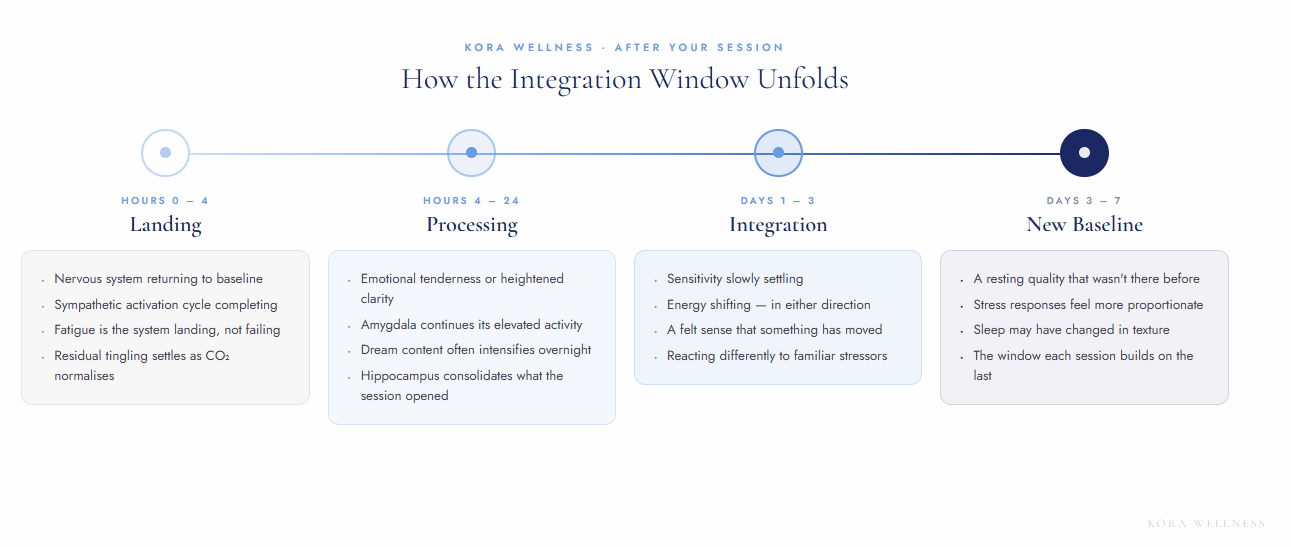
The integration window unfolds in distinct phases. What feels strange at hour four often becomes clarity by day three — if the window is supported rather than judged.
What your body is doing in the hours after a session
What happens after a breathwork session in your body while it’s processing differs depending on which type of session you attended and understanding the difference between activating and downregulating sessions matters here because the integration profiles are distinct.
In an activating 9D breathwork session, the breathing pattern is continuous circular mouth breathing which is a sustained, rhythmic cycle with no pause between the inhale and exhale. This activates the sympathetic nervous system (the body's alert state) before guiding the system back down.
After an activating session, the body is completing a sympathetic activation cycle. The return to parasympathetic dominance (the parasympathetic nervous system being the body's rest-and-digest state) is governed largely by the vagus nerve; the nerve running from the brainstem to the gut that controls the body's calm-down response.
That shift is real and physiological and it takes longer than most people expect; usually several hours. The fatigue that follows an activating session isn't exhaustion. The nervous system is landing after significant movement and landing takes time.
A downregulating session, which uses nasal breathing throughout, works differently. Here the body is brought into deep parasympathetic activation during the session, and after, it resurfaces gradually into ordinary waking activity.
The landing is softer, the post-session window quieter, but processing continues in both. In both cases, something is happening in the brain that doesn't stop when the music stops.
A 2025 study published in PLOS One examined the neurobiological substrates of altered states during breathwork and found that high-ventilation circular breathing produces increased blood flow to the right amygdala (the brain's emotional processing centre) and the anterior hippocampus, which is involved in memory consolidation.
These are the regions that handle emotional memory, fear processing and the integration of experience into long-term storage. The neural processing initiated during a session continues after it ends - which is why the strange, tender, quietly altered quality of the hours following a session is not the experience winding down. It's the brain continuing its work.
There are also physical sensations worth understanding.
During activating breathwork, some people experience tetany which is the tingling or cramping sensation in the hands that comes from a temporary shift in blood chemistry. Continuous circular breathing reduces CO₂ in the bloodstream faster than the body produces it, a state called respiratory alkalosis, which makes nerve membranes temporarily more excitable.
A 2025 paper in Communications Psychology (Nature Publishing Group) confirmed that this decrease in CO₂ saturation supports the emergence of altered states of consciousness. Both the tetany and the altered state resolve as CO₂ normalises in the minutes following the session but the deeper neurological processing continues through the hours and nights ahead.
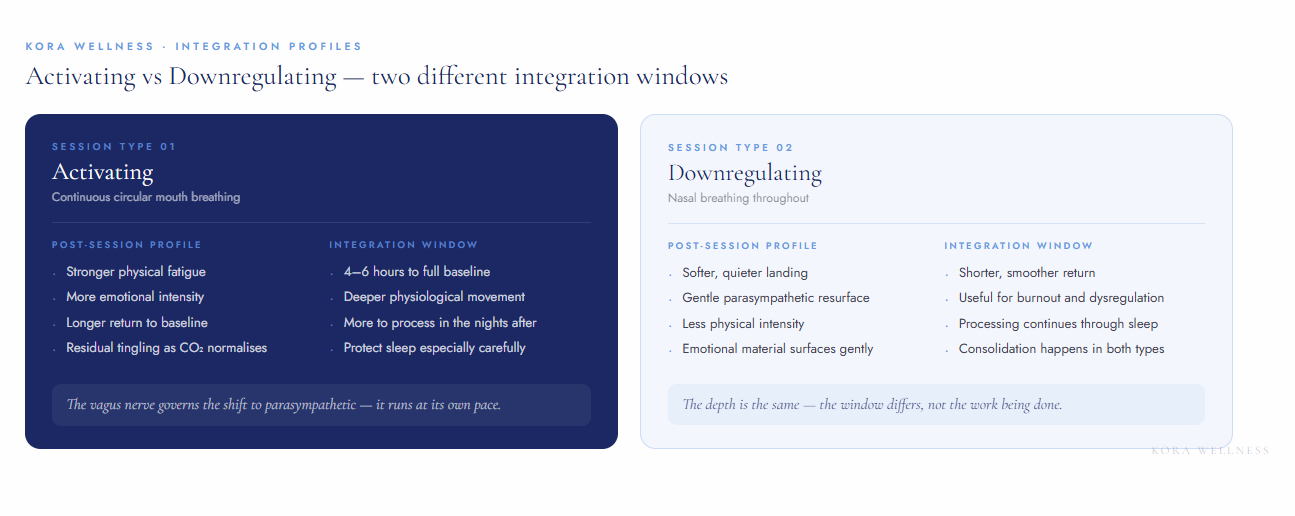
Activating sessions produce a more physically intense post-session window; downregulating sessions produce a softer, quieter one. Both involve real physiological processing that continues after the session ends.
What the next few days often look like
The men and women who come to Kora Wellness from across Wollongong and the Illawarra regularly describe the same thing after their first one or two sessions: crying at something on the drive home, then being unable to explain it.
Not sad, exactly, just open in a way that has nowhere to go yet. By the following morning the emotion has quieted, replaced by a kind of heightened clarity, or occasionally a flatness. Or a sense that the usual emotional noise has been turned down, which can feel disorienting precisely because it's unfamiliar.
Dream content in the nights after a session often intensifies.
This is consistent with what's known about memory consolidation: the hippocampus processes emotional material during sleep, and when the anterior hippocampus has been more active than usual during the day, that processing tends to show up at night.
Some people describe extremely vivid or symbolic dream content in the two nights following a session; others notice nothing unusual until they realise, on day three, that they've slept better than they have in months.
Energy can move in either direction.
Some people describe a burst of clarity and ease in the two days after an activating session; others describe a heaviness that gives way, slowly, to a steadiness they weren't expecting. Both are normal. The nervous system is not in trouble, it is calibrating. There's a difference between fatigue and landing, even when they can feel similar in the moment.
The clearest sign of integration tends to come later in the window and is harder to describe. People reach for words like "lighter" or "something shifted" or "I just feel different" and none of them quite captures it. But all of them are pointing at the same thing.
Something that was load-bearing has moved. You don't know it by thinking about it. You notice it when you react differently to something that would normally have put you sideways.
For what emotional release in breathwork looks like and why emotions surface during and after sessions, that post goes into the underlying mechanisms in more detail.
Why "something's different but I can't explain it" is exactly right
A 2024 study in Cerebral Cortex found that breathwork-induced psychedelic-like experiences are associated with increased neural Lempel-Ziv complexity which is a measure of how richly the brain is processing information.
The altered states produced during circular (activating) breathwork resemble those produced by psychedelic compounds across several experiential domains, and the depth of the altered state predicts psychological follow-on effects, including improved wellbeing and reduced depressive symptoms.
What this means practically is that the reorganisation happening during a session is not primarily cognitive. Trying to understand or interpret what came up in the first 24 hours is like trying to photograph something still moving.
Stephen Porges, whose Polyvagal Theory describes the autonomic nervous system's layered responses to safety and threat, characterises the return to the ventral vagal state (the socially engaged, regulated baseline) as a process that unfolds gradually after any significant activation.
The window between the session ending and full re-regulation isn't empty. It's where the calibration happens and rushing it or judging it before it closes misreads what the body is actually doing.
This is also why the nervous system doesn't reorganise through insight alone. It reorganises through experience and then, through rest and time, through consolidation. The session creates the conditions. Integration is the consolidation.
How to support your integration
Sleep is the most important factor in the integration window and by a significant margin. The brain consolidates emotional and physiological experience during sleep and the hippocampal processing initiated during a breathwork session continues through the nights that follow.
Protecting sleep in the 48 hours after a session makes the integration window more effective. If you can do nothing else, do this.
Hydration is practical and genuine, particularly after activating breathwork. The circular breathing pattern is respiratory effort and light dehydration is common after a full session.
Water and electrolytes support the body's return to baseline; caffeine in the immediate post-session window adds an arousal load the nervous system doesn't need.
Gentle movement in the 24 hours after a session serves the body better than intense exercise. The nervous system is not in a state to process additional stress load, even the healthy kind.
Walking in the afternoons around Port Kembla, stretching, or time outside are sufficient. Movement that allows the body to stay present (rather than movement that demands it to perform) supports the integration rather than cutting it short.
Alcohol in the integration window actively interferes with the process. The first 24 hours after a session involve real neurological work. Alcohol disrupts sleep architecture and suppresses limbic system activity - the system currently doing the consolidation.
The window between the session ending and the next morning is when most of the change actually compounds and alcohol compresses that window.
Journaling works, but not as a productivity tool. Writing in the days after a session isn't about capturing insights or drawing conclusions. It's a way of externalising what is still moving and giving the cognitive system somewhere to put things without requiring resolution.
What came up doesn't need to be understood yet. Writing it down extends the integration window rather than closing it prematurely.
One thing worth resisting: judging the session by how you feel at hour four. The integration window has a rhythm that doesn't necessarily include feeling settled by nightfall. Measure it at the end of the week.
For whether integration symptoms are normal and when to seek additional support, the safety post covers the full picture.
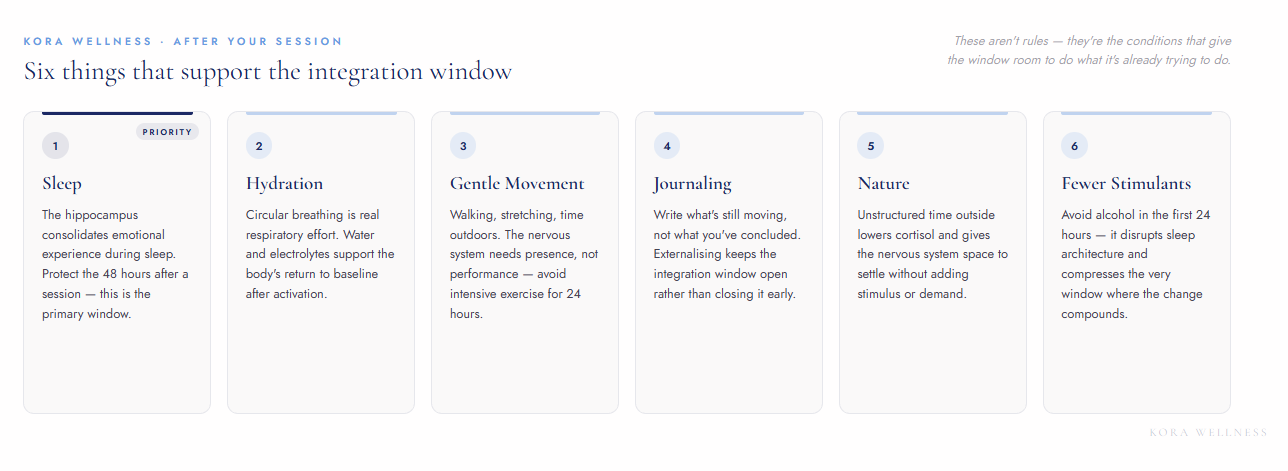
These aren't rules, they're the conditions that give the integration window room to do what it's already trying to do.
Why returning matters - and when
Melis Yilmaz Balban and colleagues at Stanford, publishing in Cell Reports Medicine in 2023, found that five minutes of structured breathwork practiced daily over 28 days produced measurable improvements in mood and reductions in physiological arousal AND the gains kept building rather than plateauing at a stable point.
Single sessions produced less change than consistent practice. The nervous system is a pattern-learning machine and patterns consolidate through repetition, not through single events.
Each session you attend initiates a reorganisation. The integration window is when the nervous system processes what that session opened.
A second session, before the first has fully closed, layers onto that processing, building on what the previous integration started rather than beginning from scratch. Over time, this is how a new resting baseline forms.
The window of tolerance is the nervous system's capacity to hold difficult experience without shutting down or flooding, and it widens through accumulated exposure to regulation, not through a single significant event.
The people who come to Kora Wellness two or three times a week describe something different happening by week four or five: a resting quality that wasn't there before, responses to stressors that feel proportionate rather than outsized and sleep that doesn't require the same effort.
Those changes aren't produced by any single session. They're the accumulated effect of integration stacking with each window building on the one that came before it.
This is why how often to return for sessions is a physiological question as much as a scheduling one. The first session creates the opening. The sessions after it are where the change compounds.
If you've had a session and you're wondering whether to come back - the science suggests yes, and sooner than you might think. Group sessions run across the week in Port Kembla, with both downregulating and activating formats available on our bookings page.
Frequently Asked Questions about breathwork integration
What is breathwork integration?
Breathwork integration is the process by which the nervous system processes, consolidates and reorganises the physiological and emotional changes initiated during a breathwork session.
It typically begins at the end of a session and continues for hours to several days.
During integration, the brain's emotional processing regions - including the amygdala and hippocampus - continue the work begun during breathwork, which is why the days following a session can feel emotionally tender, vivid, or subtly altered compared to normal daily experience.
Why do I feel tired after breathwork?
Fatigue after breathwork is a normal physiological response, particularly after an activating session that uses continuous circular mouth breathing.
The activating breathing pattern stimulates the sympathetic nervous system before bringing it back to parasympathetic dominance which is the body's rest-and-digest state.
That return takes significant physiological effort and the tiredness reflects the nervous system completing a large shift rather than anything having gone wrong. Most people find the fatigue gives way to clarity within several hours.
Is it normal to cry after breathwork?
Yes. Emotional release, including crying, is common both during and after breathwork sessions.
Circular breathwork increases blood flow to the amygdala and anterior hippocampus which are the brain regions governing emotional memory and fear processing. This can surface emotional material that has been stored physiologically without having been fully processed.
Crying after a session is consistent with that material moving. It is a functional response, not a sign something went wrong.
How long does breathwork integration take?
Integration typically unfolds over one to three days after a session, though some people notice a subtler shift continuing for up to a week.
The initial landing phase (returning the nervous system to baseline after activation) usually takes four to six hours. The deeper processing, involving emotional memory consolidation and nervous system recalibration, continues through sleep in the nights following the session.
People who attend consistently tend to find the integration window becomes shorter and smoother over time as their nervous system grows more familiar with the process.
What should I do after a breathwork session?
The most effective post-session support is protecting sleep, staying hydrated and choosing gentle movement over intensive exercise. Protecting sleep in the 48 hours following a session gives the brain its primary consolidation window. .
Hydration supports the body's return to baseline after the respiratory effort of an activating session.
Gentle movement of walking, stretching or time outdoors helps the nervous system remain present without adding stress load. Avoiding alcohol in the first 24 hours preserves the integration window and allows the neurological work to continue without disruption.
Why do I feel worse after breathwork?
Feeling more emotional, more tender, or more reactive in the hours or days following a session is a known part of the integration process, particularly after sessions that accessed material held physiologically.
When breathwork surfaces stored tension or emotional content, there is often a period - usually 24–48 hours - where that material is present and moving before it settles. This is distinct from an adverse reaction.
An adverse reaction presents differently as significant physical distress during the session and is rare when contraindications are properly screened. Increased emotional sensitivity in the integration window is a functional response, not harm.
Why am I more emotional after breathwork?
Increased emotional sensitivity after breathwork is consistent with the neurobiological mechanisms of circular breathing.
A 2025 study in PLOS One found that high-ventilation breathwork increases blood flow to the right amygdala and anterior hippocampus in the regions governing emotional memory and consolidation. This heightened activation continues after the session ends.
Small things that wouldn't normally provoke a response can feel more significant during the integration window because the brain's emotional processing system is running at higher than usual activity.
Is it normal to feel flat or empty after breathwork?
Yes. A quiet or emotionally flat feeling after a session is common and is often described as the absence of something that had previously been present as anxiety, chronic background tension, or the low hum of unprocessed stress.
The nervous system in a deep parasympathetic state can feel very still, which is unfamiliar for people who've been in chronic sympathetic activation. This typically resolves within one to two days and is often followed by a period of greater ease or clarity.
How do I know if my breathwork session worked?
The clearest indicators of a session having produced real change tend to appear not in the first hours but in the days following. You may experience a different quality of response to something that would normally have triggered reactivity, sleep that feels different in texture, or a resting sense of ease that wasn't present before.
Heart rate variability (HRV) is a measure of how flexibly the nervous system responds to demand and it improves measurably with consistent breathwork practice, though most people notice the felt sense of this before they would think to measure it.
Single sessions produce noticeable shifts while consistent practice produces lasting physiological change.
Can breathwork make you feel worse before you feel better?
Yes, and this is a normal part of the integration process when a session accesses material that has been held in the body.
When the nervous system releases stored tension or emotional content, the presence of that material - its surface movement - can feel more acute before it settles. This typically peaks within 24–48 hours and resolves.
It is distinct from an adverse reaction, which presents as physical distress during the session itself and is most likely to occur in activating breathwork with unscreened contraindications.
What are the side effects of breathwork the next day?
Common after-effects in the one to two days following a session include emotional tenderness or heightened sensitivity, unusual dream content, fatigue that gives way to clarity and a sense of something having shifted that is difficult to articulate.
After activating sessions specifically, some people experience residual tingling in the hands or face as the nervous system continues re-regulating after the CO₂ drop. These after-effects are temporary, consistent with normal integration and resolve within the integration window without requiring intervention.
How soon can I do breathwork again after a session?
There is no medical requirement to wait between sessions; integration is not a clinical recovery period.
For people seeking meaningful nervous system change, attending multiple sessions per week produces faster baseline shift than single weekly attendance.
For those working with burnout or chronic dysregulation specifically, multiple downregulating sessions per week is the recommended approach. The practical constraint is scheduling, not physiology. The sessions themselves build on each other: returning while the integration window is still open doesn't disrupt the previous session, it adds to it.
About the Author
Kora Wellness is the Illawarra's dedicated 9D breathwork studio, founded by Hayley Simpson and located at 43 Wentworth Street, Port Kembla NSW. Hayley is a certified 9D Breathwork facilitator and Master NLP Practitioner with a trauma-informed approach. Kora Wellness offers weekly group sessions, private 1:1 journeys, and online breathwork for clients across Wollongong, Shellharbour, Thirroul, Warilla and the broader Illawarra.
