
9D Breathwork and therapy: How each one works and when to use them
Published by Kora Wellness | Port Kembla, NSW | Serving the Illawarra region including Wollongong, Shellharbour, Thirroul, and Warilla.
She had been in therapy for four years, good therapy, with a psychologist she trusted. She understood her anxiety in a way she hadn't before: where it had come from, how it had been wired, why certain situations could still catch her off guard even when nothing obvious had changed. That understanding was real.
After sessions she felt, if not light, at least clearer. But the next morning her chest would be tight before she'd had a single thought, her shoulders already carrying something she hadn't consciously picked up. The understanding was there but the body wasn't following.
This is not an unusual case.
Many of the people who come to Kora Wellness in Port Kembla arrive with genuine insight into their own patterns; people who have done years of careful, valuable work with a psychologist or counsellor and still carry something that hasn't shifted.
Therapy gave them the map. Their body, for reasons that are physiological rather than personal, has been running on different instructions.
The "breathwork versus therapy" question is really this question - not which approach is superior, but why understanding a pattern doesn't automatically change the way the body responds to it. The answer has to do with where each approach enters the problem.
If you're curious what a session actually involves before committing to anything, visit our schedule and bookings page - there's no expectation that you'll know exactly what you need before you arrive.
Why most people asking this question have already answered it
The person who searches "breathwork vs therapy" has almost certainly already tried at least one of them. They're not at the beginning of anything - they're somewhere in the middle, wondering whether what they're currently doing is reaching the part of themselves that still doesn't feel right.
The competition framing comes from the way the wellness industry positions its options. But a psychologist and a breathwork facilitator are not working on the same system in the same way, any more than a physiotherapist and a GP are in direct competition.
One helps someone understand and work through patterns that originate in thought, memory and relational experience. The other changes the physical state the body is running in. Both are real and both reach something the other approaches differently.
The question worth asking isn't which one to choose. It's which layer needs attention first and whether both are needed at once.
How traditional talk therapy works and where the body fits in
The therapeutic relationship itself carries significant weight. Decades of clinical research support the idea that being consistently witnessed, understood and responded to by another person can shift something fundamental in the way the nervous system reads safety.
That's not incidental to therapy, it is part of the mechanism. The relational experience is doing something biological as well as cognitive.
Talk therapy is particularly effective at helping someone name what they carry, find context for why they respond the way they do and build cognitive strategies for working with difficult thoughts and feelings.
For many people, this is exactly what they need. For others it becomes clear (sometimes after years of good-faith effort) that the cognitive layer has been thoroughly worked and something else is still waiting.
Where the body enters is where the picture gets more complicated. When someone's stress response is running high - when they are in a state of significant anxiety or hyperarousal - the reasoning and language-processing parts of the brain become harder to access with full clarity.
This is not a flaw in the person or in therapy. It is a physiological reality: a highly activated nervous system allocates resources toward threat response, narrowing access to the deliberate, reflective processing that talk work draws on.
Doing cognitive work from inside an elevated stress state is possible, but it's working against the current rather than with it.
Bessel van der Kolk's clinical and neuroimaging research, accumulated across four decades and summarised in his widely-read work, makes this dynamic explicit. His central argument is that experiences held in the body's physical responses need somatic approaches.
Body-based work that addresses physical responses directly rather than through reasoning and alongside cognitive ones. Not because talk therapy fails, but because the body has its own memory system operating on a separate schedule from cognitive understanding.
A person can develop genuine insight into why they respond the way they do and still find the body running the same response under stress. The insight is accurate. The body simply hasn't received it through the same channel.
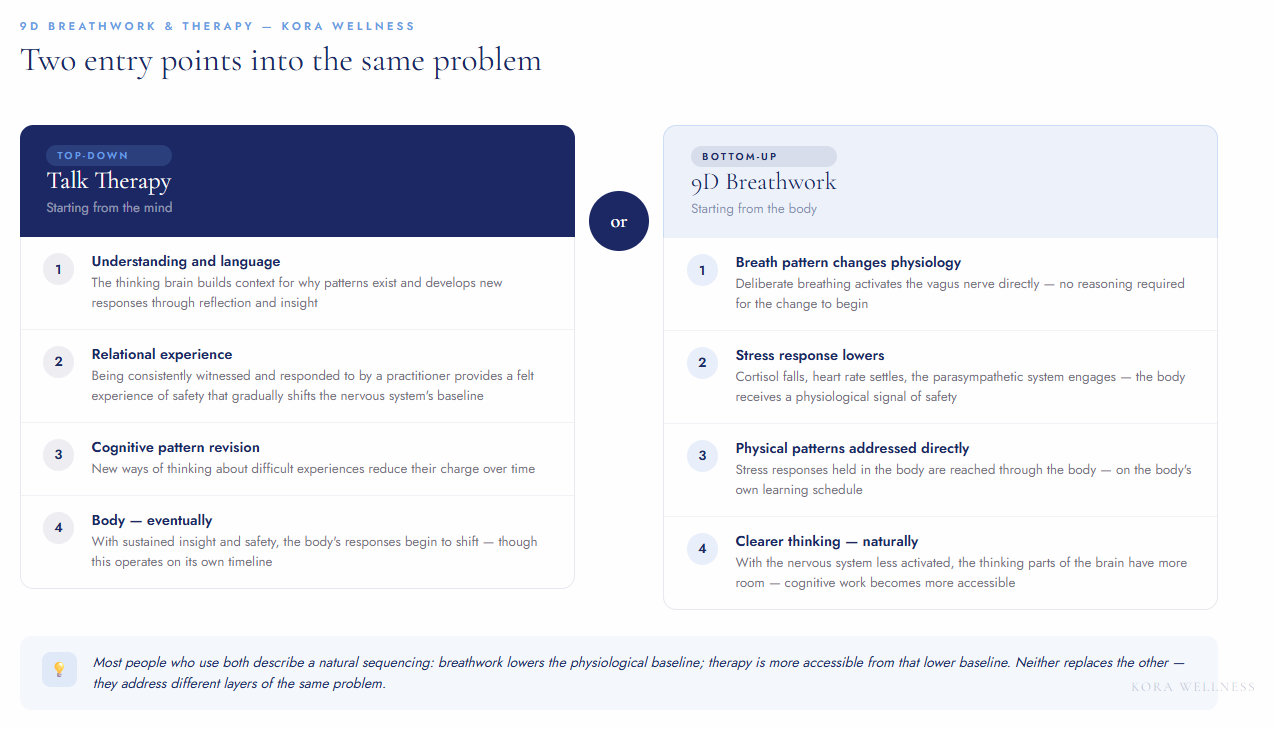
Two entry points into the same problem: therapy begins with understanding and works toward the body; breathwork begins with the body's physiological state and creates the conditions for clearer thinking.
How breathwork reaches the nervous system
The mechanism is relatively straightforward even if the effects aren't. Specific breathing patterns - extended nasal exhales, paced breathing at a slower-than-default rate, or in the case of activating breathwork, sustained circular mouth breathing - activate the vagus nerve, the body's primary parasympathetic pathway.
Stephen Porges's Polyvagal Theory describes the vagus nerve as the foundation of the body's safety response: when it is well-engaged, the body has access to calm, social connection and the capacity for clear thought.
Vagal tone (how responsive the body's built-in calming system is) can be developed through consistent breathwork practice in much the same way physical training develops cardiovascular capacity. It responds to repetition.
The evidence base for this is recent and specific. A 2023 RCT meta-analysis by Fincham and colleagues, published in Scientific Reports, found that structured breathwork produced meaningful reductions in anxiety and depression, with effect sizes in a comparable range to established psychotherapies.
A separate 28-day trial by Balban and colleagues, published in Cell Reports Medicine, found that five minutes of daily structured breathwork improved mood and reduced physiological arousal, with gains that continued building across the full trial period rather than levelling off after the first week.
At Kora Wellness, the 9D format used in Hayley’s sessions adds layered audio - music, binaural beats and guided breathwork - which creates conditions for regulation that are harder to sustain in solo practice, particularly for people whose nervous system tends to scan for threat. The audio environment does some of the work of keeping the body in the session.
This is also where the practical distinction between session types becomes relevant.
Downregulating 9D breathwork uses nasal breathing throughout and has a settling, calming effect on the nervous system. It is appropriate for almost anyone, including people managing ongoing mental health conditions.
Activating breathwork uses sustained circular mouth breathing and produces a more physiologically intense experience. Which session type is appropriate is an individual question, not an absolute one and it's worth understanding before attending for the first time.
A practical guide to where breathwork fits your situation
For someone on a waitlist. Under Medicare's Better Access scheme, Australians can access ten psychology sessions per year - meaningful support, but with a known constraint. In the Illawarra, waiting several months to see a psychologist in Wollongong or the surrounding area is ordinary, not exceptional. During that wait, the nervous system continues operating at whatever baseline it was already running.
Downregulating breathwork at Kora in Port Kembla is available within days and it works on the physiological layer of the stress response regardless of whether talk work is happening simultaneously.
For someone already in therapy. A psychology appointment happens once a week or once a fortnight. Life happens in between. Breathwork two or three times a week provides consistent nervous system support during the integration periods between sessions - the stretches when the cognitive work of therapy is being absorbed by the body, not just held in the mind.
The people at Kora who attend regularly and are also seeing a therapist tend to describe the two as addressing different things; neither competing with nor replacing the other but actually supporting both.
For someone who has done significant cognitive work and still feels something unresolved. The physical-pattern gap - having clear insight into why you respond the way you do, while still finding the body responding the same way under stress - has a physiological explanation. The body's stress responses are learned patterns held in sensation and repetition, on a system separate from the one handling language and reasoning.
Addressing them directly requires body-based work. Not because therapy failed, but because the body's pattern-learning system was not the one doing the cognitive work. How breathwork works on trauma stored in the nervous system goes into the detail of this dynamic.
For someone who hasn't done therapy and is wondering whether breathwork is enough. Breathwork addresses the physiological layer. It does not provide the relational experience of therapy, the development of language for difficult experiences, or a worked-through understanding of where specific patterns originate. Whether one or both are needed depends on what someone is carrying and what they're trying to reach.
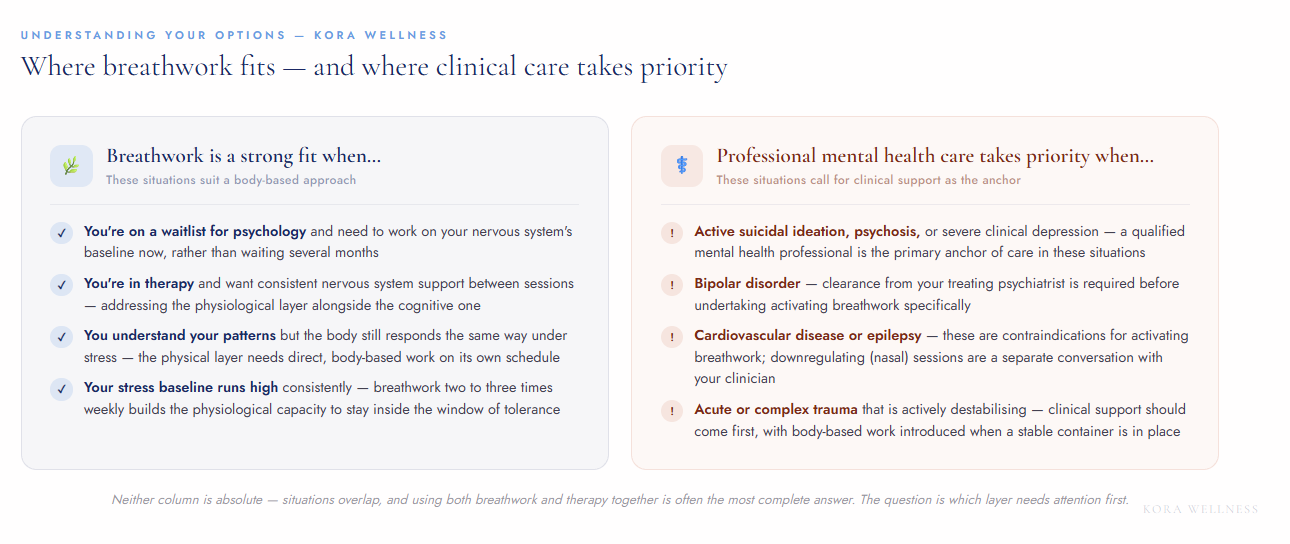
Neither column is an absolute - situations overlap and using both is often the most complete answer. The point is which layer needs attention first.
If you're currently in therapy and wondering whether breathwork would add something rather than compete with what you're doing, the most honest answer is usually one session - you'll know quickly whether the two are reaching different things. You can find our class schedule on our Bookings page.
Situations where professional mental health care takes priority
Active suicidal ideation, psychosis and severe clinical depression require a mental health professional as the primary point of care.
When someone is dysregulated to this degree - outside what Polyvagal researcher Stephen Porges describes as the window of tolerance (the mental and physical state in which a person can sit with difficult feelings without becoming overwhelmed) - a breathwork session is not the right first step.
Breathwork, particularly the activating format, can produce significant physiological and emotional states; in an acute clinical context, these need to be managed within a professional framework. Who should check with their doctor before attending a session is covered in full detail and Kora Wellness's intake process surfaces these questions as a standard part of onboarding.
Downregulating sessions, which use nasal breathing, carry a different risk profile and may be appropriate; this is a conversation for the treating clinician.
Cardiovascular disease, detached retinas, psychosis, bipolar, pregnancy and epilepsy are flat contraindications for activating breathwork, and again, downregulating work is a separate question. How breathwork works on trauma stored in the nervous system addresses some of the nuance around clinical history in more detail.
None of this is about limiting access to a practice the vast majority of people find straightforwardly beneficial. It is about the same thing any responsible practitioner communicates: knowing where the scope of a practice ends and naming it plainly.
What using both actually looks like
The people who describe the most from combining the two tend to notice a particular dynamic. The cognitive work of therapy is easier to access from a regulated state when the body's stress baseline is lower; the reasoning parts of the brain have more room.
Attending a breathwork session during the week between therapy appointments gives the nervous system a different starting point for that cognitive work.
What arrives in the therapy room is someone who is already a little further from the activation threshold, rather than someone carrying the week's accumulated tension into the session.
The person who has done years of good-faith therapy and still finds the body responding the same way under stress is not doing anything wrong.
The cognitive understanding is genuine. The body's pattern-learning system simply hasn't been worked through the same channel - because it couldn't be.
Addressing it directly requires body-based practice: showing up consistently enough that the nervous system learns something new through repetition.
A single session produces real physiological change, but the pattern-learning that creates lasting shift happens across weeks rather than within a single ninety minutes. The role of the nervous system in anxiety explains how that shift builds over time.
Multiple downregulating sessions per week is the baseline for people who want to meaningfully shift the nervous system's resting state. Not because once a week produces nothing - it does - but because the body learns through frequency.
For people using breathwork alongside therapy during an active period of change, two to three downregulating sessions a week builds the physiological capacity to stay inside the window of tolerance and makes the cognitive work of therapy more likely to land in the body rather than staying in the head.
Kora Wellness runs group sessions in Port Kembla across the week, mornings and evenings, specifically to make that kind of frequency realistic for people travelling from across Wollongong, Shellharbour and the broader Illawarra. Book a session at Kora Wellness in Port Kembla to see what's available.

The store front to Kora Wellness in Port Kembla, Illawarra.
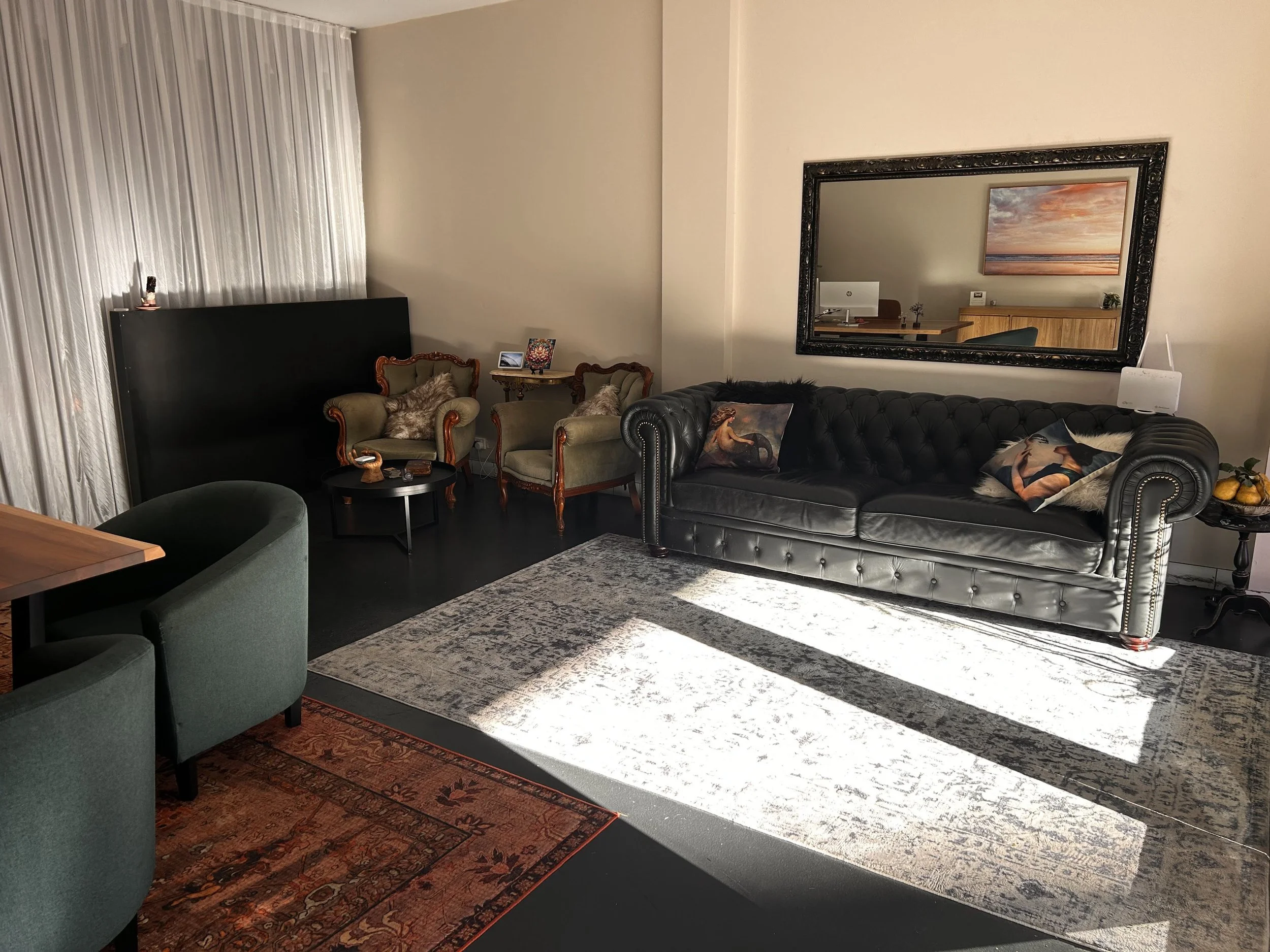
The entrance and waiting room for Kora Wellness in Port Kembla, Illawarra.
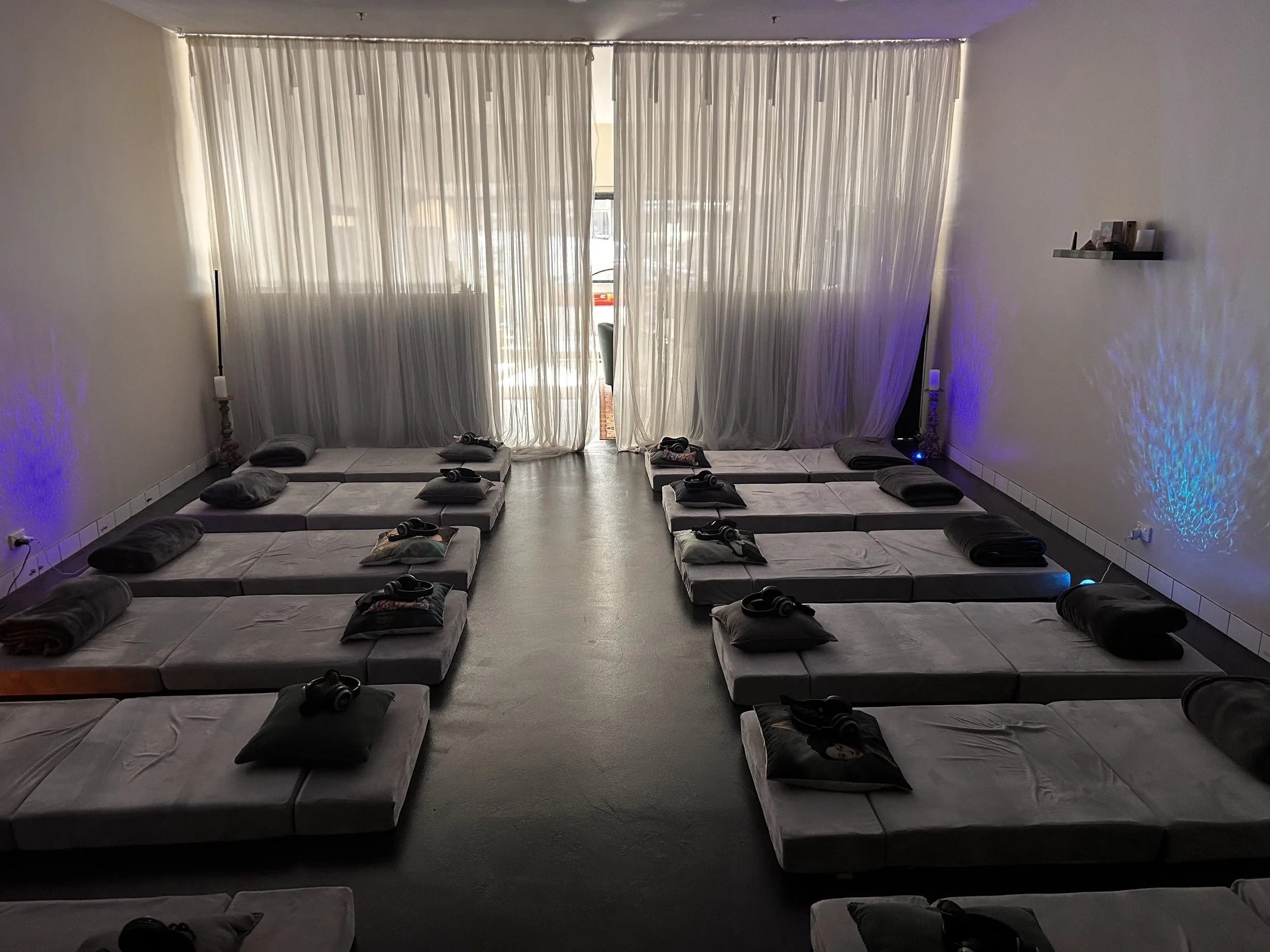
The breathwork room for Kora Wellness in Port Kembla, Illawarra.
Frequently asked questions
Can breathwork replace therapy?
Breathwork does not replace therapy. The two practices work on different systems: therapy primarily addresses patterns through language, understanding and relational experience. Breathwork works directly on the body's physiological stress state.
For people managing significant mental health conditions, therapy - ideally with a qualified psychologist or counsellor - should be the primary anchor. Breathwork can work alongside therapy as a complementary body-based practice, addressing the layer of the stress response that talk work reaches differently.
Is breathwork better than therapy for anxiety?
Breathwork and therapy address different aspects of anxiety. Therapy helps identify the cognitive and relational patterns that drive anxious responses and builds new strategies for working with them. Breathwork, particularly downregulating breathwork using nasal breathing, works directly on the nervous system's baseline arousal state.
A 2023 meta-analysis by Fincham and colleagues in Scientific Reports found breathwork produced effect sizes for anxiety and depression comparable to established psychotherapies. For many people, the two together reach more of the problem than either does alone.
Can I do breathwork if I'm already seeing a therapist?
Yes. Breathwork and therapy work on different layers and do not conflict with each other. Many people in therapy find breathwork useful between sessions for nervous system regulation which helps in reducing the physiological arousal that can make cognitive work harder to access.
Downregulating 9D breathwork using nasal breathing is appropriate for most people managing ongoing mental health conditions. See our post on contraindications for specific health concerns.
What is the difference between breathwork and talk therapy?
Talk therapy is a top-down approach: it draws on the brain's reasoning and language capacity to help someone understand their patterns, build new responses and process difficult experiences within a relational framework.
Breathwork is a bottom-up approach: it uses deliberate breathing to shift the autonomic nervous system's state directly, before reasoning is required. Therapy begins with the mind and works toward the body; breathwork begins with the body and creates physiological conditions that make clearer thinking more accessible.
Is breathwork a form of therapy?
Breathwork is not a form of therapy in the clinical sense. It is a body-based practice that uses structured breathing to influence the autonomic nervous system.
While breathwork has documented effects on anxiety, mood and physiological arousal, it does not provide the relational experience, diagnostic assessment, or treatment planning that clinical therapy offers. In Australia, the term "therapy" in a clinical context refers to work delivered by registered health professionals. Breathwork sits alongside, not inside, that clinical framework.
Should I do breathwork or therapy for trauma?
For trauma, the most effective approach usually involves both body-based work and cognitive or relational work with each addressing something the other cannot fully reach. Bessel van der Kolk's clinical research demonstrates that unresolved traumatic experience is held in the body's physical responses, which require body-based approaches alongside cognitive ones.
Therapy provides the relational container and the narrative processing. Breathwork addresses the nervous system's stored physical response. For complex or acute trauma, a trauma-informed mental health professional should be the primary anchor of care.
Does breathwork work for people who haven't done therapy?
Yes. Breathwork works on the physiological layer of the stress response regardless of whether someone has done therapy. It does not require prior psychological work to produce real effects on the nervous system - cortisol reduction, increased vagal tone, improved mood and sleep quality are physiological changes that don't depend on cognitive preparation.
People with no therapy background regularly attend breathwork sessions and experience meaningful shifts. Breathwork and therapy serve different functions; neither is a prerequisite for the other.
Can breathwork help if therapy hasn't worked?
Breathwork may reach something therapy didn't if the unresolved layer is primarily physical rather than cognitive. People who carry genuine insight into their own patterns but still find the body responding the same way under stress are often describing the physical-pattern gap - the body's learned responses haven't been addressed at the body level.
Breathwork works directly on those physiological patterns through repeated practice. It is not a replacement for therapy but addresses a layer that talk-based work alone reaches differently.
Is 9D breathwork safe if I have a mental health condition?
Safety depends on the type of session and the specific condition. Downregulating 9D breathwork, which uses nasal breathing throughout, is appropriate for most people managing ongoing mental health conditions including anxiety and depression. Activating 9D breathwork, which uses sustained circular mouth breathing, has several contraindications of which you should be aware of before a session.
What is the difference between somatic therapy and breathwork?
Somatic therapy is a clinical modality delivered by a trained therapist, combining body awareness with relational and cognitive therapeutic work within a professional framework. Breathwork is a body-based practice - not a clinical modality - that uses structured breathing to shift the autonomic nervous system's state.
Both are bottom-up approaches that work through the body rather than through reasoning alone. The key distinction is the clinical relationship: somatic therapy operates within a one-on-one therapeutic container, while breathwork can be practiced in a group setting without a clinical practitioner.
If any of this has named something you've been carrying - the gap between understanding your patterns and feeling them shift - a session at Kora Wellness is a direct way to work on that layer. Group sessions run across the week in Port Kembla, with both downregulating and activating formats available.
About the Author
Kora Wellness is the Illawarra's dedicated 9D breathwork studio, founded by Hayley Simpson and located at 43 Wentworth Street, Port Kembla NSW. Hayley is a certified 9D Breathwork facilitator and Master NLP Practitioner with a trauma-informed approach. Kora Wellness offers weekly group sessions, private 1:1 journeys, and online breathwork for clients across Wollongong, Shellharbour, Thirroul, Warilla and the broader Illawarra.
